


COLORADO SPRINGS, Colo.—The Space Force is preparing for significant growth to its procurement budget in fiscal 2027, and the head of the service’s largest acquisition organization said April 14 he is asking companies to invest now in facilities and production capacity so they’re ready to execute when called upon.
The Space Force’s $71 billion budget request, a 77 percent increase over last year, includes $19 billion for procurement—up from just $3.6 billion in fiscal ’26. Lt. Gen. Philip Garrant, head of Space Systems Command, told reporters here at the Space Symposium that the service plans to use that increase to award new contracts and fund major increases to existing production contracts.
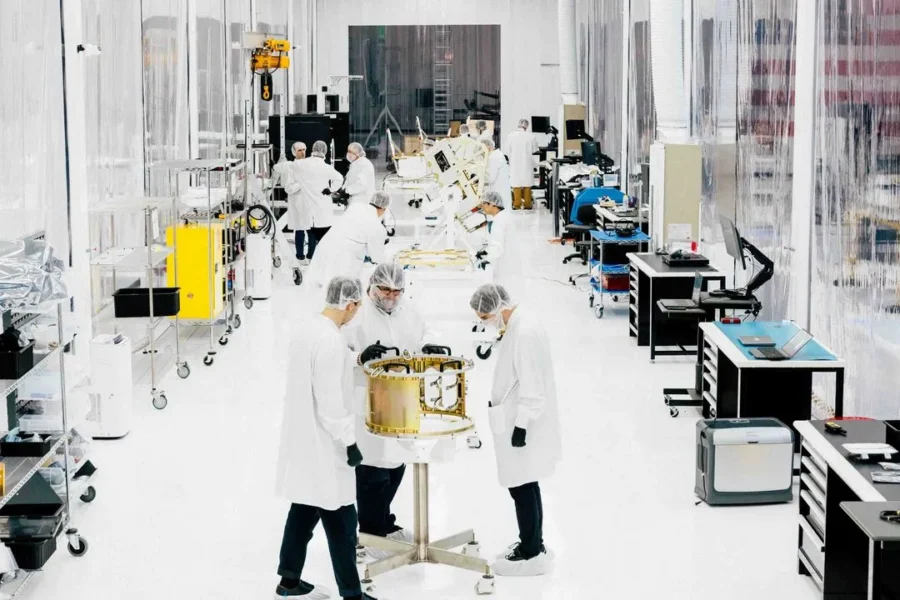
“If a company is nominally making 10, we want you to be prepared to make 40,” Garrant said. “We want industry to make the investments in capitalization and facilitization, and in return you’re going to get these large production contracts.”
The Space Force’s emphasis on increasing satellite production is not unlike the Pentagon’s push to boost munitions production, Garrant said. Over the last year, the Defense Department has signed framework multiyear procurement contracts with several defense primes to speed up manufacturing of key munitions like Lockheed Martin’s Patriot PAC-3 interceptors and RTX’s Standard Missile series. The agreements, which haven’t yet been backed by funding, are meant to send a demand signal to industry so they can confidently spend their own capital to increase production capacity and be ready to follow through when the contract awards come.
Garrant didn’t discuss any pending framework deals being discussed within the Space Force, but said he hears from industry about the importance of tangible signals in the form of contracts and agreements that show the service is serious about increasing production. The Space Force’s budget request helps, he said, but the service will need a timely appropriation to actually turn those projections into contracts.
“It’s a little bit of a chicken or the egg [situation,]” Garrant said. “Industry is like, ‘OK, we’ll capitalize and facilitize, but show me the money. They want the contract. So, we’ve got to get these contracts awarded very quickly. The companies are prepared to make the investments, and then we are off to the races on production.”
Until that funding is available and can start issuing contracts, SSC is making sure it’s ready to execute its end of the deal. One way the government can go fast is by leveraging existing contracts, and Garrant said SSC plans to do just that.
SSC is also building out its civilian workforce to backfill positions vacated last year during the Trump administration’s cuts to the federal workforce. Garrant said he’s been asked to hire 100 new personnel per month to fill close to 1,000 positions, 200 of them new. He said the command has received authorization to start hiring for billets included in its fiscal 2027 budget request in order to get ahead of the influx of funding for new programs and increased production.
Another focus area is on making sure its acquisition enterprise is structured to prioritize speed and scale. Defense Secretary Pete Hegseth has directed major reforms in this area, ordering the military services to move away from siloed acquisition offices to a portfolio approach that empowers acquisition leaders to move money and make trades across programs. The Space Force is working to implement Hegseth’s guidance and has, to date, announced six new portfolio acquisition executives:
- Space access, which includes launch and mobility
- Space-based sensing and targeting, which includes space domain awareness
- Missile warning and tracking
- Satellite communications and positioning, navigation, and timing
- Battle management command, control and intelligence
- Infrastructure, which includes data management as well as training, testing, and personnel
Garrant said the service will announce the remaining three by the end of April or early May.
Along with laying out the acquisition portfolios, the service and Department of the Air Force leadership are discussing how to most effectively implement the organizational structure that undergirds the new PAEs.
“There are conversations at the highest levels of the Department of the Air Force on what the org structure will look like,” Garrant said.