
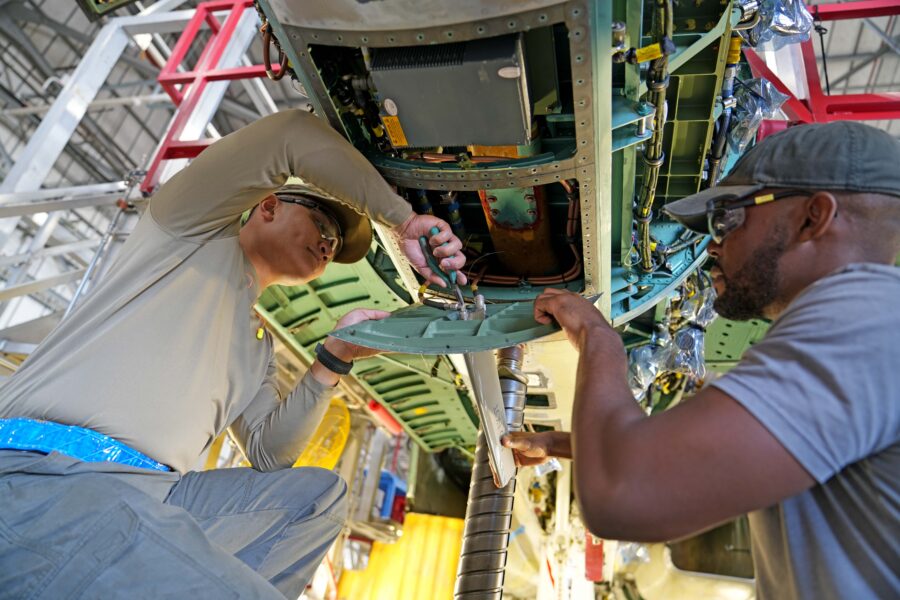
Depot-level maintenance took longer than expected for nearly three-quarters of Air Force aircraft from fiscal 2019-2024, according to a new report, as unplanned repairs rise across the aging fleet.
The report, from the Government Accountability Office, also found that the extent of the delays has been masked because officials often revise their target timelines after unplanned work occurs.
“As a result, the Air Force is not reporting the full extent of depot maintenance challenges and may not be able to make accurate comparisons across the fleet,” the report concluded.
Depot maintenance is the highest, most intensive level of military maintenance, covering repairs “requiring the overhaul, upgrading, or rebuilding” of parts or structures, according to U.S. law. The Air Force has three depots:
- Ogden Air Logistics Complex at Hill Air Force Base, Utah
- Warner Robins Air Logistics Complex at Robins Air Force Base, Ga.
- Oklahoma City Air Logistics Complex at Tinker Air Force Base, Okla.
Aircraft regularly cycle through depots based on predetermined milestones or benchmarks, like flight hours or time in service. Before they arrive, personnel at the depots establish an “original target completion date” after estimating how long it will take to complete all the necessary work.
Once airframes arrive, however, maintainers often discover additional issues that need to be fixed.
“As an example of this unplanned work, officials at Ogden ALC stated that maintainers sometimes discover corrosion or stress cracks that were not previously identified and included in the program office’s work request,” the GAO authors noted in their report.
“According to Air Force officials, unplanned work is becoming more prevalent, in part because of the aging fleet.”
Understanding the rise in unplanned work is complicated, though. The GAO found that official Air Force Materiel Command policy allows officials to revise their target completion dates after maintenance is completed, and many do so after unplanned work is resolved.
It’s not a completely standard practice, and the GAO noted that even using the revised targets, there has been an uptick in the percentage of aircraft delayed in depot. But because the Air Force assesses its depots’ performance using the revised target dates, service leaders aren’t getting a full understanding of how unplanned work slows things down.
In fiscal 2024, for example, 73 percent of aircraft in depot were delayed from their original target date—but only 34 percent were delayed compared to their revised target.
Both figures are up from 2019, but the original target date metric in particular shows a dramatic uptick in delays, more than doubling from 31 percent in six years.
“AFMC officials said the revised target is used as the baseline for assessment because they do not want to use metrics that penalize the depots for issues outside their control, such as unplanned work. However, they did acknowledge that reporting timelines based on the original target shows the full extent of delays,” the report states.
Ideally, the GAO argues, the Air Force should stick with the original target metric but give the depots a way to show how unplanned work outside their control is slowing them down. As things stand now, that’s not possible.
“The Air Force tracks the causes of delays during depot maintenance in a tracking system (root cause reporting system),” the report states. “However, we found several limitations with the usefulness of this system.”
For example, the GAO noted that the tracking system has only seven categories of root causes, none of which are unplanned work. Because the Air Force allows officials to revise their timelines in response to unplanned work, many aircraft are not considered delayed even as they spend extra weeks or months in depot.
In one case, the GAO found that an F-15 entered the Warner Robins depot with a 151-day estimate for completion. Instead, unplanned work led to the Eagle staying in depot three years, more than seven times the original estimate—and the aircraft was not considered delayed.
Even if Air Force Materiel Command does implement categories for unplanned work into its system, the command currently does not do enterprise-wide analysis on those root causes, the GAO report stated, leaving that up to individual program offices.
“By not periodically analyzing these data, the Air Force is missing opportunities to assess trends and recurring problems and to better understand the root causes of delays to ultimately improve depot maintenance timeliness,” the report states.
The GAO report also analyzed staffing levels at the depots and found they were relatively healthy, with all three at or above 90 percent. However, the report did not that the depots could do a better job of understanding pay levels in the private sector so they can compete for personnel in hard-to-fill or especially valuable positions.
The report concluded with 10 recommendations for the Air Force and Pentagon, including directives to use the original timeline as its primary metric, limit revisions after work is completed, include unplanned work in the delay root causes, and more.
“Without complete and credible metrics to understand the full extent of depot maintenance delays, decision-makers will not fully understand the sustainment challenges related to its aging fleet,” the GAO authors warned. “Consequently, they will not have the information needed to determine the resources necessary to sustain the Air Force’s aging fleet and thereby be able to accurately plan for impacts on aircraft availability for training and operations.”
The Air Force agreed with most of the recommendations, but only partially concurred with recommendations about including unplanned work categories in the delay root causes tracking system.
The Air Force will ensure “Air Force Materiel Command properly documents delays for unplanned work or induced delays in the proper locations,” it said in response to GAO’s report.
