


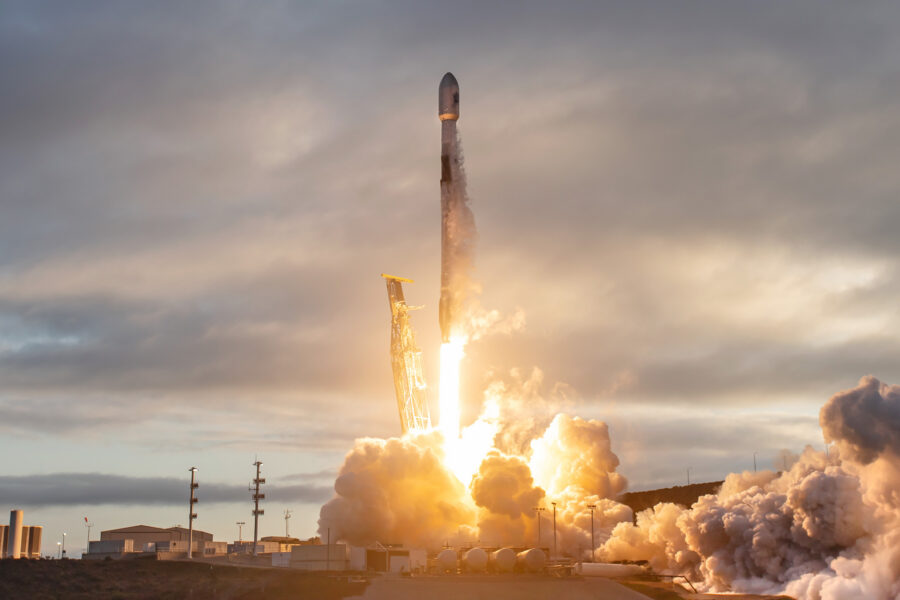
The Space Force expects the scope of its main launch program to grow by 91 missions and nearly $17 billion by fiscal 2032 as demand for national security space capabilities soars.
Those increases are revealed in the latest version of the National Security Space Launch program’s selected acquisition report, drafted in April and published in September. The update brings NSSL’s total expected procurement to $76 billion for 337 launches between fiscal 2004 and 2032.
At the same time, the average cost per launch is dropping significantly, from around $422 million in 2022 to $192 million in the most recent report. That average combines a range of vehicle and payload configurations, which means some missions are much cheaper and others more expensive.
The surge in demand comes as the Space Force is planning to field large numbers of satellites in the coming years to support missions like satellite communications, space domain awareness, missile warning, and moving target indication. NSSL also supports the National Reconnaissance Office and other classified customers who are fielding proliferated constellations of their own.
The Space Force in recent months has acknowledged that its NSSL contracts will need to grow to accommodate that demand. The program has two competitive tracks, or lanes: Lane 1 is reserved for commercial-like missions with higher risk tolerance, whereas Lane 2 serves more demanding customers flying high-value payloads with less margin for error.
In July, the service announced it would triple the size of its Lane 1 contract ceiling from $5.6 billion to $17 billion, increasing the number of missions from early estimates of between 30 and 60 to approximately 170 launches over a five-year period. Likewise, “emergent requirements” are driving the service to increase the number of Lane 2 by 25—from 54 to 79.
The Space Force hasn’t said which programs these launches will support, but it has announced several contracts in recent months to buy satellites that will need rides to space over the next few years. In late May, it awarded SpaceX a $2.3 billion contract to build out its Space Data Network constellation and a $4.2 billion contract for its Space-Based AMTI program. The service also plans to launch new fleets of small surveillance and reconnaissance satellites under an effort called Andromeda, with the initial spacecraft slated to launch in 2029. The Space Force hasn’t said how many spacecraft those constellations will include, but it has set a contract ceiling of approximately $6 billion.
The growing manifest is also likely to support Golden Dome, a sprawling, layered, missile defense architecture. The Space Force is supporting that program in a few ways, including by developing space-based interceptors that can engage a missile during the boost and midcourse phases of flight. Initial prototypes of those spacecraft are expected to be integrated into the Golden Dome architecture by 2028.
The Space Development Agency is also fielding a missile defense and tracking constellation and recently announced it would add 36 more satellites to that architecture to support Golden Dome. Those satellites are also scheduled to be ready for launch by 2028.
Whether these satellites launch on time hinges, in part, on the availability of certified, ready rockets. To qualify to fly Lane 1 missions, companies need to have successfully launched their vehicle at least once. Lane 2 missions, however, require certification from the Space Force, a lengthy process that requires multiple launches. To date, only SpaceX and ULA are eligible to launch satellites for both lanes, though ULA’s Vulcan rocket is currently grounded due to an anomaly on a February NSSL launch.
Blue Origin’s New Glenn is eligible for Lane 1 flights and is on the certification path for Lane 2, but it, too, is grounded after a rocket exploded on the pad in May. Four other companies—including Rocket Lab, Stoke Space, Impulse Space, and Relativity Space—are on deck to compete for missions as soon as their developmental rockets complete at least one launch.
That leaves SpaceX’s Falcon 9 and Falcon Heavy as the only rockets available to support NSSL missions at the moment. The Space Force is weighing near-term options to mitigate schedule delays caused by Vulcan’s grounding—including swapping some missions to SpaceX rockets—but several programs have already seen delays. For example, the launch of the first Next-Generation Overhead Persistent Infrared satellites, slated for March, has been pushed to no sooner than October.
Brig. Gen. Eric Zarybnisky, acting portfolio acquisition executive for space access, told Air & Space Forces Magazine in July that he is “worried about timelines,” particularly for the more urgent Lane 2 missions.
“Those are vastly important national security assets that we need to get to orbit,” he said.