
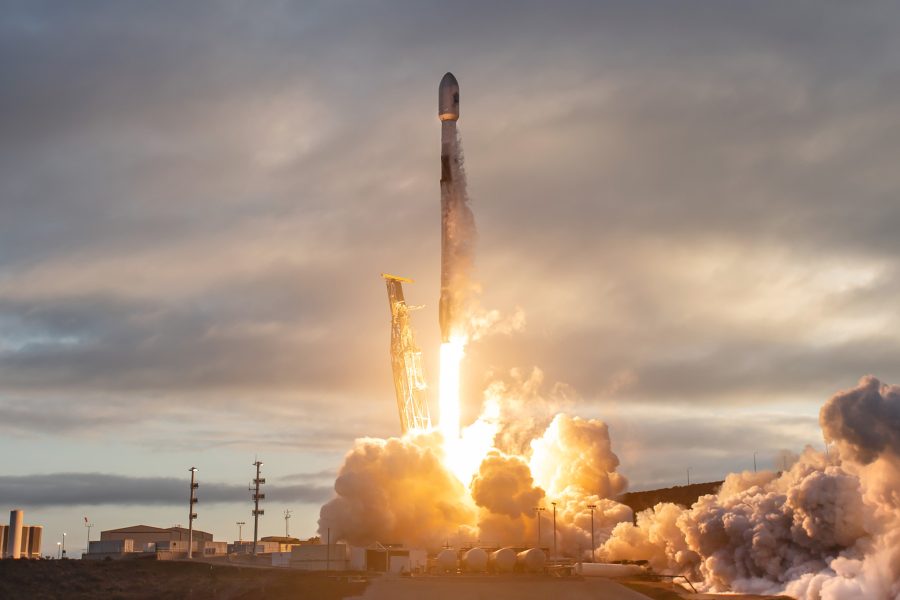
The Space Force is tripling the size of one of its main launch procurement contracts from $5.6 billion to $17 billion to accommodate growing demand from government customers.
The service on July 17 announced a new cost ceiling for Lane 1 of its National Security Space Launch program, the contract mechanism the Space Force uses to launch government payloads with less stringent mission assurance requirements. The scope of the effort has grown from earlier estimates of around 30 to 60 missions to roughly 170 over a five-year ordering period, a Space Systems Command spokesperson told Air & Space Forces Magazine.
“The total number of estimated missions has now increased to approximately 170 due to the growing demand to deliver critical capabilities to orbit for the nation and warfighter,” the spokesperson said. “As a result, it was necessary to increase the … contract value in response to the new estimated mission quantities expected to be ordered under the Phase 3 Lane 1 contract.”
The Space Force would not provide more details on the programs or missions these launches will support, but the surge in demand comes as the service is planning to field large numbers of satellites in the coming years; Deputy Chief of Space Operations for strategy, plans, programs, and requirements Gen. David N. Miller Jr. said in May that USSF’s five-year budget projection includes “thousands” of satellites.
Those increases fall across several mission areas, including space-based moving target indication; data transport; missile warning, tracking and defense; and space domain awareness. The Space Force recently awarded SpaceX more than $6 billion to build satellites for the Space Data Network and a space-based AMTI constellation. The service also plans to launch new fleets of small surveillance and reconnaissance satellites under an effort called Andromeda, with the initial spacecraft slated to launch in 2029. The Space Force hasn’t said how many spacecraft those constellations will include, but it has set a contract ceiling of approximately $6 billion.
The SSC spokesperson did say the launch demand isn’t driven by a single program, but is “due to a broader demand signal increase for a range of capabilities that the NSSL team estimates needing delivery to orbit.”
The Space Force’s NSSL Phase 3 program has two competitive tracks, or lanes. Lane 1 is reserved for commercial-style launches for programs with a higher risk tolerance, and Lane 2 is for more demanding, high-value missions to be flown by rockets certified to carry more sophisticated national security payloads.
The service has approved seven companies to compete for missions under its Lane 1 contract:
- SpaceX
- United Launch Alliance
- Blue Origin
- Stoke Space
- Rocket Lab
- Relativity Space
- Impulse Space.
To qualify for Lane 1 competition, a company’s rocket has to have flown or the firm needs to have a credible path toward flight. To date, only SpaceX, United Launch Alliance, and Blue Origin have rockets that have launched at least one mission, but all of the companies are on a path toward flight in the next year or two. The service started awarding Phase 3 launch services in fiscal 2025 and expects to issue new, competitive task orders to its vendor pool through at least fiscal 2029.
SpaceX and ULA are also the only Lane 2-certified providers, though Blue Origin’s New Glenn rocket is in the midst of that validation process. SpaceX, whose Falcon 9 rocket today is launching the vast majority of military and commercial payloads, has been tapped for most of the Lane 2 missions.
The Space Force is also poised to increase the number of Lane 2 missions it plans to launch in Phase 3 by 25—from 54 to 79, according to a request for information issued in April. Those missions reflect “emergent requirements,” and Col. Eric Zarybnisky, portfolio acquisition executive for space access, said the service is currently reviewing proposals for providers to launch them.
“We’ve seen a large growth in the Lane 1 customers, but we are also having customers come to the table who need that higher level of mission assurance,” Zarybnisky told Air & Space Forces Magazine in a recent interview. “It’s an active conversation when a new program stands up or there’s a new capability they want to get on orbit. … For that specific set of customers, Lane 2 was really the right one.”
It’s not clear what emerging needs these additional Lane 2 launches might address, but it’s likely a high-priority program like Golden Dome, which aims to field an advanced missile defense shield heavily reliant on space capabilities, would utilize the Lane 2 contract. The Space Force is supporting that program in a few ways, including by developing space-based interceptors that can engage a missile during the boost and midcourse phases of flight. Initial prototypes of those spacecraft are expected to be integrated into the Golden Dome architecture by 2028.
Additionally, the Space Development Agency recently announced it would increase the size of its missile tracking layer by 36 satellites to support Golden Dome, awarding spacecraft production contracts to L3Harris and Sierra Space. Those satellites are also scheduled to be ready for launch by 2028.
