
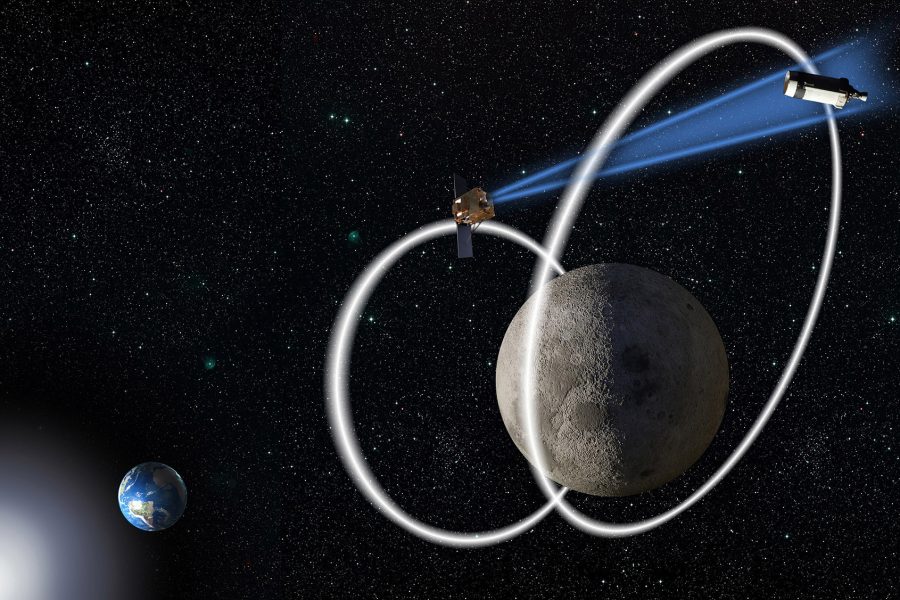
The Space Force is considering launching up to five satellites to cislunar space as soon as 2029 to help lay the foundation for a future proliferated constellation between Earth and the moon.
In a Nov. 2 industry notice, the service said it is “notionally interested” in launching a handful of satellites to inform a future acquisition strategy for a Cislunar Space System to operate beyond geosynchronous orbit. The spacecraft should be ready to launch by late 2029 for initial operations by 2031.
“These vehicles may serve as seed vehicles that will inform the acquisition strategy for a potential future proliferated cislunar constellation,” the notice states. “The government is looking for information on industry’s ability to provide a rapid, low-risk solution.”
The notice comes amid what Space Force leaders have described as a significant shift in the U.S. military’s posture toward cislunar. In an Oct. 21 speech at AFCEA’s Space Industry Days conference, Maj. Gen. Stephen Purdy, who oversees the Space Force’s advanced programs acquisition portfolio, said that as recently as January, he was told to avoid talking about plans for cislunar systems and strategy. Now, leadership across the Department of Defense are leaning in, discussing the region as a “warfighting domain” and pushing for projects to enable operations there.
That momentum is in part driven by China’s move toward the moon, a vision that not only includes lunar landers and a military presence, but work to establish models for positioning, navigation, and timing within the next 10 years, and launch an international lunar research station.
“They’re not planning for a one-off demo,” Purdy said. “They are planning for sustained activity. It’s in their strategic documents … and they’re building the R&D and the S&T and the operational reps and set to get all those missions done.”
Cislunar space is hundreds of thousands of kilometers in distance and its volume is 1,728 times that of geosynchronous orbit. Space systems operating in the region must contend with the combined gravitational characteristics of both the Earth and the Moon as well as unpredictable orbits that require constant station-keeping. Cislunar also lacks its own positioning, navigation, and timing grid—offices like the National Geospatial Intelligence Agency are working to establish that framework.
The Space Force’s notice to industry doesn’t spell out what types of payloads the satellites might carry, though officials have said they’re particularly interested in space domain awareness, PNT, and communications in the cislunar regime. The notice says the Space Force is interested in satellites equipped with propulsion systems that can support its station-keeping requirements as well as orbital transfers. The service also wants information on AI and compute capabilities that can support long-duration autonomous operations.
Purdy said the Space Force plans to act quickly and wants to take advantage of commercially available technology. According to the notice, the service could award up to five contracts and may aim to start funding initial design work as soon as early next year.
“We’re looking for existing commercial or near-commercial means, non-developmental solutions, hardware with actual relevant evidence behind it, software that doesn’t need a huge amount of work … and ground systems,” Purdy said. “This isn’t a four- or five-year science project. This is about getting capability out soon.”