
Space Force Guardians may soon be allowed to stay at a base for longer than the standard three-year tour, a top general said, potentially reducing moves for families.
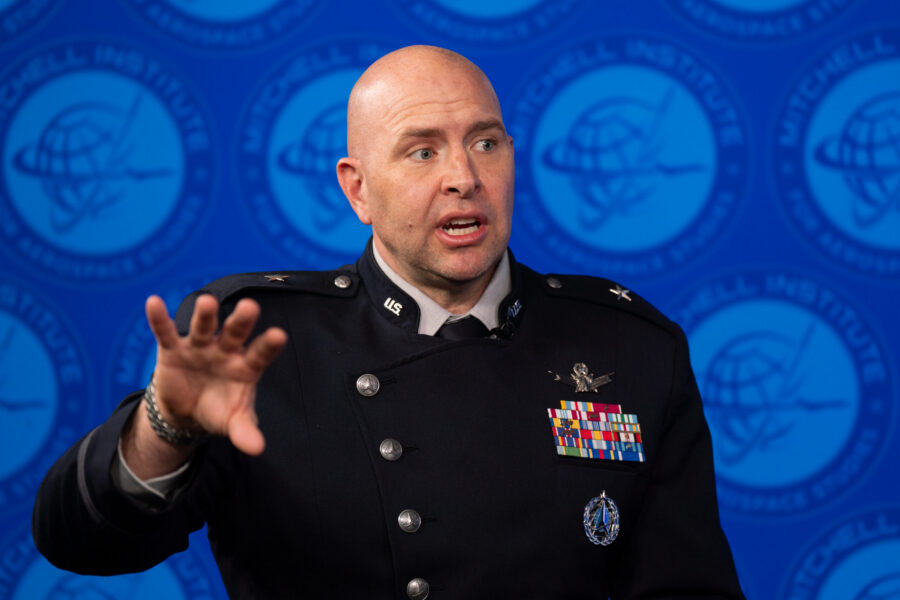
Speaking at AFA’s Mitchell Institute for Aerospace Studies on May 14, Brig. Gen. Christopher Fernengel said Space Force leadership is weighing the option as part of its effort to maintain high quality of life for a growing force.
“That’s kind of core to our enterprise methodology, because from a stability standpoint, a family standpoint, what you want to do is give opportunities,” Fernengel, the service’s director of plans and programs, said.
For most of the other military branches and current Guardians, three-year tours are standard, with some exceptions. But a year ago, Pentagon leadership directed the services to cut their budgets for permanent-change-of-station moves. Fewer PCS moves would be an easy way to do that, though advocates previously told Air & Space Forces Magazine that secondary effects, like the impact on career development or the necessity of manning less-desirable locations, need to be considered.
Fernengel indicated the Space Force has already considered some of these; staying in place wouldn’t mean Guardians can sit still in the same job, he said.
The one-star painted a picture of a captain coming to a base as a space operator and then finding another opportunity, such as a new mission or work in a different unit.
“You could do multiple assignments in a specific area and still not stunt your growth as an officer or enlisted member,” Fernengel said.
The longer tour option is one of many ways the USSF is looking to support its planned growth in both manpower and facilities over the coming years. The service is asking Congress to nearly double its budget from $40 billion to $71 billion, and it is seeking funds to add 2,800 Guardians to the ranks next year and double the total 10,000-member force over the next five years.
The service has 5,608 enlisted and 4,692 officers in its ranks as of this month, an Air Force spokesperson told Air & Space Forces Magazine.
In its fiscal 2027 budget request, the USSF wants $1.8 billion for personnel. That’s an increase of $252 million over the 2026 enacted budget amount.
Leaders have touted quality of life as key to building the new force for current and future missions. Key to that is giving the Space Force, well, more space.
In the same budget request, leaders are asking Congress for $1 billion to build four space operations centers on existing military bases. That funding will support operations for data transport, space-based sensing and targeting, and space control. Those would be located at: Kirtland Air Force Base, N.M.; Redstone Arsenal, Ala.; Schriever Space Force Base, Colo.; and Grand Forks Air Force Base, N.D.
The ops centers must have their own power, communications, and infrastructure support to meet the service’s “no-fail” mission that links space capabilities to military operations across the globe.
Fernengel said current designs are using Schriever as a kind of blueprint that can support up to 10 operations units at each center.
The service “maxed out” its capacity already at the Colorado base, Lt. Gen. Douglas Schiess, deputy chief of space operations, said at the Mitchell Institute’s Spacepower Forum in April.
The idea is to operate multiple missions from different locations, Fernengel said.
That would mean a unit at one center, such as Schriever, might handle a certain kind of mission such as flying GPS during their “commit cycle” of the Space Force Generation Model. Once the unit’s cycle ends and they transition out of active operations to reconstitute and train, the mission would then transfer to another geographic location.
Having geographically dispersed centers able to take on a variety of missions backing each other allows the force to provide capabilities around the clock.
The concept makes the operations center interoperable and resilient through infrastructure support, Fernengel said.
To keep those independent centers and their personnel humming along, Fernengel said the service has also planned investments for critical base operations—civil engineers, fire protection, force protection, lawyers and doctors.