
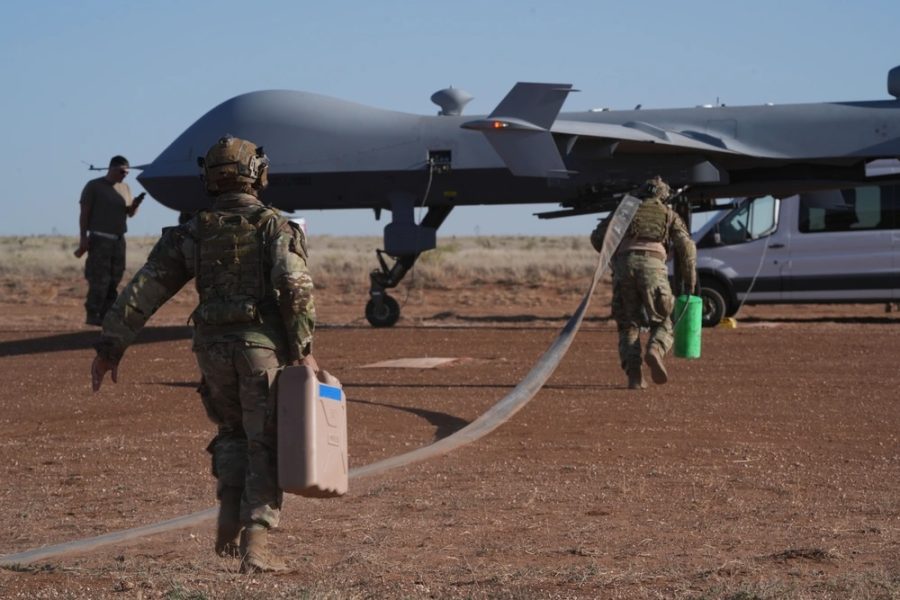
The Air Force is partnering with the Defense Innovation Unit to get industry’s ideas for lower-cost, attritable drones that can fly in groups and take on some of the missions that MQ-9A Reapers have performed.
In a solicitation posted July 7, the Defense Innovation Unit asked companies to submit their pitches for a drone concept called massed modular aircraft, or MMA. Under this system, multiple drones would fly alongside one another, in numbers great enough that they could still overwhelm the enemy even if several were shot down.
In a July 9 release, the Air Force said it is working with DIU on the idea. The organization is one of the Pentagon’s main innovation arms that works with commercial technology companies to transition capabilities to the field on rapid timelines.
“This partnership is crucial for developing next-generation capabilities that will inform the future of the MQ-9 Reaper fleet,” the Air Force release states.
DIU’s pitch comes in the wake of the loss of around 30 MQ-9s in Operation Epic Fury, and as Ukraine has shown the effectiveness of cheap, attritable drones in modern warfare. Attritable systems are designed to be effective but cheap and plentiful enough that losing some in combat would not be an overwhelming or expensive loss.
DIU said that the military’s reliance on “exquisite” aircraft costing more than $30 million apiece “is unsustainable against adversaries utilizing layered defenses enabled by increasingly low-cost antiaircraft capabilities.”
If that dynamic doesn’t change, that will force the military to choose between one of two “unacceptable compromises”: either operating outside the threat zone, which will hinder how effective a drone can be in its mission, or flying in contested airspace and taking greater losses.
DIU argued in its solicitation that the military has to come to terms with the proposition that heavy losses will happen and is ready to adapt.
“To operate effectively, we must accept this inevitable attrition, and deploy larger numbers of less-expensive unmanned platforms, designing them from the start with the expectation that some will be lost in combat,” DIU wrote.
Lt. Gen. Christopher J. Niemi, the Air Force’s Chief Modernization Officer, echoed those points.
“Future conflicts will demand greater mass, faster adaptation and the ability to absorb operational losses while continuing to generate combat effects,” Niemi said in the Air Force’s statement.
The Air Force and DIU want these MMA drones to be modular, or capable of being rapidly fitted with various payloads including full-motion video sensors, so they can do the jobs MQ-9s perform today.
“As we refine requirements for future long-endurance ISR and strike platform capabilities, our objective is to provide commanders with more options by fielding platforms that are more modular, lower cost, and easier to mass produce,” Niemi said.
MMA drones are intended to be capable of launching weapons, collecting intelligence, performing electronic warfare operations, or relaying communications while staying constantly airborne. This will exhaust an enemy and keep them “on the defensive,” the DIU notice states, “forcing them to burn through expensive anti-aircraft missiles and resources faster than they can be replaced.”
MMA drones should be able to carry payloads of at least 2,800 pounds, and be able to fly a combat radius of at least 2,300 nautical mile while loaded up, the notice states. They also should be able to fly a one-way self-deployment flight of at least 8,000 nautical miles.
A secondary attribute DIU wants the drones to have is the ability for one operator to control multiple MMA drones. The unit would like them to be capable of reaching airspeeds of at least 200 knots and be able to take off from 6,000-foot runways or shorter.
Contractors should be able to flight test a full-scale prototype within 21 months of receiving the award and achieve initial operating capability of delivering 20 mission-ready aircraft by fiscal 2031.
The Air Force release suggested the DIU solicitation is just the start of the process.
“Ultimately, this process will directly inform the requirements for the MQ-9’s successor, ensuring the new platform can be more easily adapted to a wide variety of tomorrow’s missions, even ones that aren’t obvious today,” the release states.
In the short term, officials say they want to “buy back” some MQ-9s to replace the ones lost in Epic Fury, an effort that MQ-9 maker General Atomics has suggested could involve procuring the larger MQ-9B, the successor aircraft to the original model.