


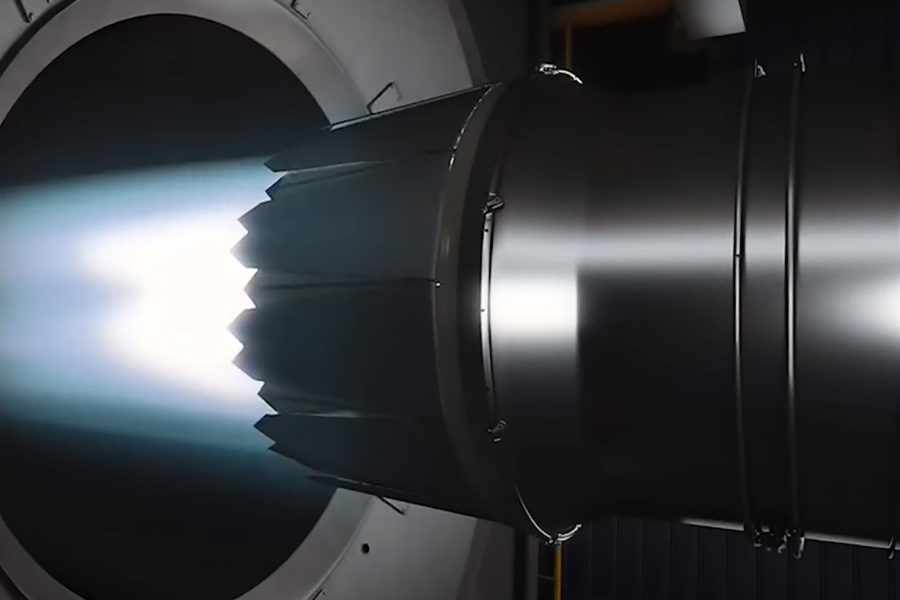
DAYTON, Ohio—The Air Force is preparing to move toward prototyping and testing a next-generation advanced engine and wants to be ready to integrate it onto an aircraft around 2030.
But while the Next-Generation Adaptive Propulsion engine has been closely associated with the Next-Generation Air Dominance fighter, now called the F-47, service officials have yet to determine which aircraft the NGAP powerplant will first go on.
John Sneden, the Air Force’s portfolio acquisition executive for propulsion, told reporters at the Life Cycle Industry Days conference July 27 that the NGAP program has recently finished a readiness review and is ready to start moving toward prototyping, building, and testing adaptive engines.
That preparation is reflected in the Air Force’s future budget projections, Sneden said, which show spending on NGAP growing sharply from $326 million in 2026 to nearly $906 million in 2028. That’s followed by another big year of $865 million in 2029, before falling back down to $303 million in 2030.
That budget spike “is really about building engines, testing engines, and then we’ll be rolling through that competitively over the next few years, and be ready for potential integration activities in the 2030 timeframe,” he said.
GE Aerospace and RTX’s Pratt & Whitney are working on so-called adaptive engines under the multibillion-dollar NGAP program. Adaptive engines are designed to shift to the most efficient thrust configuration for whatever situation a jet is in.
The Pentagon gave serious consideration to modifying the F-35 with adaptive engines under the Adaptive Engine Transition Program, but ultimately decided to instead upgrade the F-35’s already-existing engines, an effort that Sneden said is also progressing toward a 2030 milestone.
Still, the work that was done on AETP has informed the NGAP program.
Sneden said both GE Aerospace and Pratt & Whitney have met the NGAP program’s requirements and showed their systems are ready.
“That means initial hardware is procured, their design meets our standards, everything is clean from that end, and both vendors have been able to do that,” Sneden said.
NGAP engines are also the first that have ever been designed digitally, Sneden said, which allowed the program to verify their design attributes digitally as well.
Sneden said the Air Force is still figuring out which platform it wants to integrate NGAP engines into. That could be the sixth-generation F-47 Boeing is working on, he said, or another platform.
Sneden said NGAP will be flexible enough to give the Air Force multiple paths forward for aircraft propulsion.
“We built NGAP as essentially an agnostic system,” Sneden said. “It was, build the system first, open up options for the future, and then when those options come to the forefront, we’ll be able to take advantage of it. You have to lean into propulsion technology first.”
Col. Timothy Helfrich, the PAE for fighters and advanced aircraft, emphasized that the F-47 is “still on track to fly this administration,” underscoring former Air Force Chief of Staff Gen. David Allvin’s promise that its first flight will take place in 2028.
Helfrich would not comment on propulsion plans for the F-47 in his own July 28 media roundtable, citing its high levels of classification.
However, since NGAP integration is not expected until 2030, it appears that the first F-47 flights will take place using a different engine.
Sneden acknowledged NGAP’s schedule has slipped and said it was because the program wanted to keep working with two viable vendors who could provide advanced propulsion technology. With a fixed budget, he said that meant splitting resources between two vendors instead of one.
But that investment will pay off down the line, he said.
“The competition is the gateway that enhances producibility, drives innovation, keeps costs down,” Sneden said. “So it’s actually quite critical, and it’s also critical to be able to maintain our advanced propulsion industrial base as we go into the future.”
NGAP is a “host of technologies,” and not a single unified system, Sneden said. That means the technologies could be broken out and integrated piecemeal on other platforms—even older aircraft.
“Not everything has to have an adaptive fan,” Sneden said. “So we can actually take that backwards as well and incorporate it in some of our legacy platforms. So there is a great utilization for this type of tech.”
Sneden called NGAP a critical technology, that will help the United States maintain its air superiority in years to come.
“If you want to stay ahead of our competitors, then you have to lean into this technology now,” Sneden said.