
The Air Force Point Defense Battle Lab is searching for more defense firms to demonstrate counter-drone capabilities at upcoming exercises designed to test base defenses against unmanned aerial attack.
For the second time this year, the Air Force is seeking input. The earlier requests for information came out of the 319th Reconnaissance Wing at Grand Forks Air Force Base, N.D., in March. The wing is Air Combat Command’s designated Point Defense Battle Lab, tasked with developing the tactics, techniques, and procedures Airmen will need to protect domestic Air Force and Space Force installations.
The battle lab has held about a half dozen exercises this year, with two unidentified companies demonstrating counter-drone systems that detect, identify, track, and destroy unmanned aerial threats. One of the firms provided its counter-small unmanned aerial systems, or C-sUAS, technologies for four of the exercises. The Air Force Research Lab and Air Force Life Cycle Management Center have also each sent a system for evaluation, Senior Master Sgt. BreeAnn Sachs, a spokesperson for the 319th, told Air & Space Forces Magazine.
The battle lab reposted its two RFIs on Sam.gov recently, seeking additional participants for upcoming exercises in August and December, Sachs said.
One RFI seeks systems to detect, identify, and track drones. The other RFI focuses on kinetic counter-drone weapons, ranging from rockets to drone-on-drone interceptors, high-energy lasers, and high-powered microwave systems.
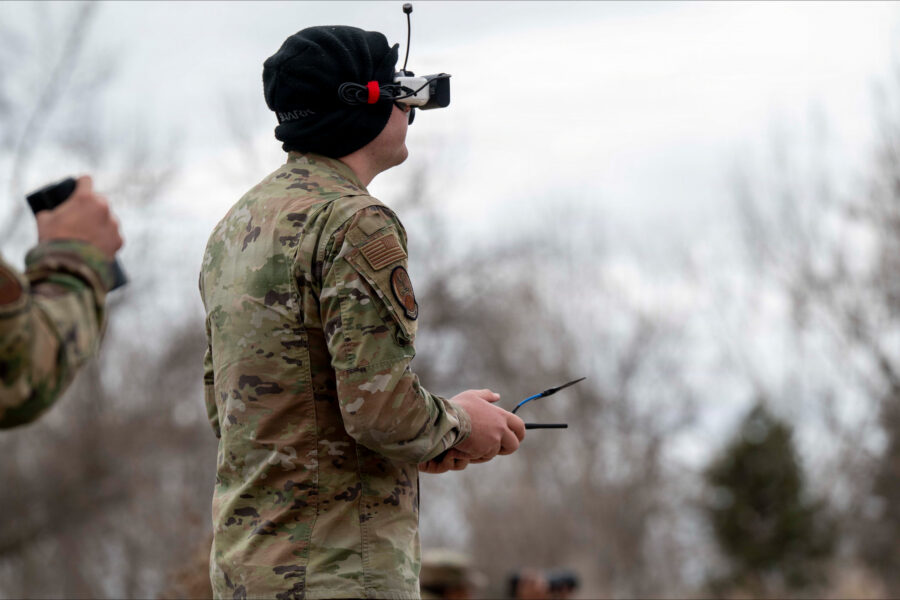
Exercises to date featured Airmen operating as “Red-Air” attackers, piloting small Group 1 and 2 drones on a test range against competing C-sUAS systems.
“The team is gaining a lot of really valuable data,” said Sachs. “They have a whole data analysis team that’s developing the tactics, techniques, and procedures—like what do Airmen do if they see a drone, what does that process look like?”
The resulting TTPs will be compiled into a report that includes evaluations of how commercial technology performed during the exercises, Sachs said. The report is to be presented to ACC Commander Gen. Adrian L. Spain by the end of the calendar year.
Security forces specialists are the likeliest to operate counter-drone systems at Air Force and Space Force installations in the U.S. But Air Force leaders announced recently that a new enlisted job specialty for airbase air defense is needed. Also, new “Point Defense Flights” at specific Air Force installations are being stood up to train for air defense responsibilities. These latest moves come as the U.S. military races to were to cope with the proliferation of low-cost quadcopter and jet-powered drones like Iran’s Shahed that have increased the threat of attacks on air bases and other military installations.
Both of the RFIs are looking for rapidly deployable systems that can be set up by small teams of up to four Airmen within two hours to counter Groups 1-3 drone. Each system should be capable of operating in extreme temperatures and in winds up to 30 miles per hour.
Vendors have until July 31 to respond to either solicitation, and Sachs said additional opportunities will likely follow forcompanies whose solutions don’t match current criteria. Innovations are welcome, he said.
“We have a dozen different forms for different kinds of technology that vendors can fill out,” Sachs said. “If a vendor doesn’t perfectly fit either one of those, we do have a way for them to apply. And then if we have an exercise come up that’s more specialized than those two RFIs, we have their information.”