
For former Air Force Secretary Frank Kendall, building Airmen’s trust in Collaborative Combat Aircraft is a crucial step in the fast-moving development and deployment of the semi-autonomous drones.
Kendall, who oversaw the Department of the Air Force under former President Joe Biden and is a strong proponent of semi-autonomous weaponry such as CCAs, said in a July 16 visit to the Mitchell Institute for Aerospace Studies that trust will naturally build over time as Airmen get more experience using CCAs.
That experience will soon ramp up as CCAs appear in major exercises such as Red Flag, the service’s premier aerial combat exercise series.
“I think that’s going to be fascinating, when we start using CCAs at Red Flag,” Kendall said. “When the guys with the CCAs are beating the crap out of the guys without them, and not losing any manned fighters, that’s going to be pretty obvious, right?”
The Air Force wants a fleet of around 1,000 CCAs to extend the reach of crewed fighters and carry out missions including strike operations, reconnaissance, and electronic warfare. General Atomics Aeronautical Systems and Anduril Industries are building their own CCAs known as the FQ-42A and FQ-44A as the first increment, or iteration, of the program. More increments will follow.
Kendall said battle simulations consistently show decisive victories for the side armed with CCAs. However, he noted simulations also show CCAs tend to take heavy losses in battle, so the Air Force needs to continue to refine tactics to make them more survivable.
“But they’re also protecting crewed fighters very, very effectively,” Kendall said. “When the CCAs get their missiles off and they kill a couple of the other guys’ aircraft, even if [the CCAs] die, they’ve really contributed a lot to the battle.”

Photo by Jud McCrehin/ Air & Space Forces Association
Kendall said he saw operators were enthusiastic about the CCA concept for that reason.
“I asked [an Air Combat Command pilot working on developing CCA tactics] why there wasn’t more resistance to this, and his answer was, ‘Sir, these things are going to save our lives,’” Kendall said.
That enthusiasm and confidence in CCAs has with pilots getting in cockpit simulators to see what flying alongside the drones is like. Then the service’s Experimental Operations Unit began flying a series of sorties with CCAs in April at Edwards Air Force Base, Calif., to hone the operational and logistical procedures that would be needed to deploy and sustain them in a contested environment.
Another milestone came in June and early July when the Air Force flew with a CCA it is not currently producing, a Boeing MQ-28 Ghost Bat, in a major Pacific exercise. That Ghost Bat operated alongside aircraft such as the F-35A and B, F-15EX, E-3 Sentry, and HC-130J Combat King II in Exercise Valiant Shield 26.
The Air Force has yet to announce other upcoming exercises that will incorporate CCAs. A spokesperson told Air & Space Forces Magazine that “the CCA program is deliberately structured to get aircraft into the hands of the EOU’s operators early and often to create a tight feedback loop between the warfighter and the developer.”
Kendall did say that he worries that initial setbacks in exercises or other parts of the CCA program might prompt the Air Force to back off of the concept. That would be a mistake, he said.
“When I initiated the CCA program, I made it very clear this is a one-way door,” Kendall said. “We’re going to field this at scale as a real operational capability. Not an experiment, it’s not a prototype. We’re going to do this.”
One of the reasons exercises could prove so important in CCA development is that they will validate just how many drones a human pilot can direct. Kendall said simulations have shown the number is greater than once than originally expected.
“The answer was very, very encouraging,” Kendall said. He would not say how many CCAs pilots were able to handle, but said “when I started this, I thought … three [CCAs] at the bottom, maybe five at the upper end. The answer is actually bigger than that, because [the controls] are fairly simple and they’re very intuitive. People who have been playing video games as kids, it’s easy for them to do this.”
This allowed pilots to use their squad of CCAs “as a tactical formation, essentially,” Kendall said. Part of what makes that possible, he said, is that there are “default behaviors” an operator could simultaneously program multiple CCAs to perform, instead of programming CCAs one at a time.
Even as CCAs move toward production, the autonomy technology underpinning them continues to advance. The same day Kendall spoke at the Mitchell Institute, the Air Force and Defense Advanced Research Projects Agency announced that a research effort to create autonomous F-16s has advanced to flight tests at Eglin Air Force Base, Fla.
That program, called VENOM for Viper Experimentation and Next-gen Operations Model, began carrying out in-air testing this month of an F-16 loaded with an artificial intelligence agent to autonomously control its flight, the Air Force and DARPA said.
As the planes fly autonomously, pilots are in the cockpit under a concept called “human-on-the-loop.” Those pilots monitor the AI agents and ensure flight and mission systems test objectives are met, the Air Force said.
This autonomous F-16 has a modification known as the VENOM Autonomy Kit installed, which allows a pilot aboard to flip AI control off and on with a switch, DARPA said, creating a safe and reliable environment to experiment with autonomy while still having a human overseeing it and able to intervene if something goes wrong.
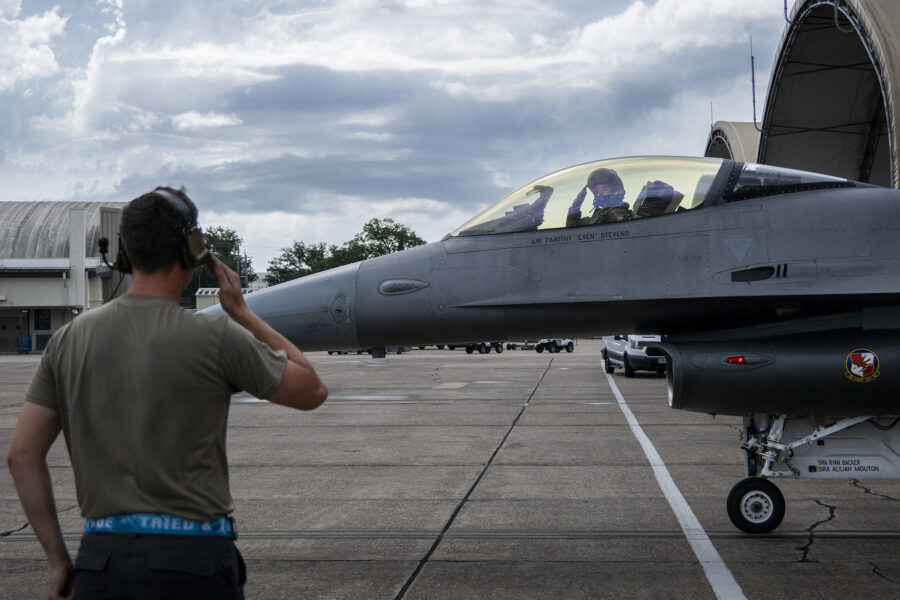
“Getting the aircraft into the air is always a monumental milestone for a complex test program,” Tim Stevens, a VENOM test pilot with the 40th Flight Test Squadron, said. “It represents years of design, modificaiton and test planning poured into this project by a dedicated team of hundreds. As we cross this starting line, we are excited to watch VENOM redefine the boundaries of autonomous flight.”
The VENOM program is building on previous experiments with a plane called the X-62A VISTA, which showed an AI system on its own could pilot a fighter jet in a dogfight. Kendall flew in the VISTA, which stands for Variable In-flight Simulation Test Aircraft, at Edwards Air Force Base in May 2024.
As autonomy advances, the Air Force expected to pursue new increments of CCAs. Kendall said he thinks the second increment should be more elaborate than the first, with sensors and other capabilities alongside being able to carry weapons.
This would be an advantage in battle, he said, because enemy forces seeing a wave of CCAs coming at them—and not knowing what capabilities they might be carrying—could feel compelled to shoot all of them down to be safe.
“His best tactic is to try to kill them all,” Kendall said. “That’s actually good from our perspective.”
