


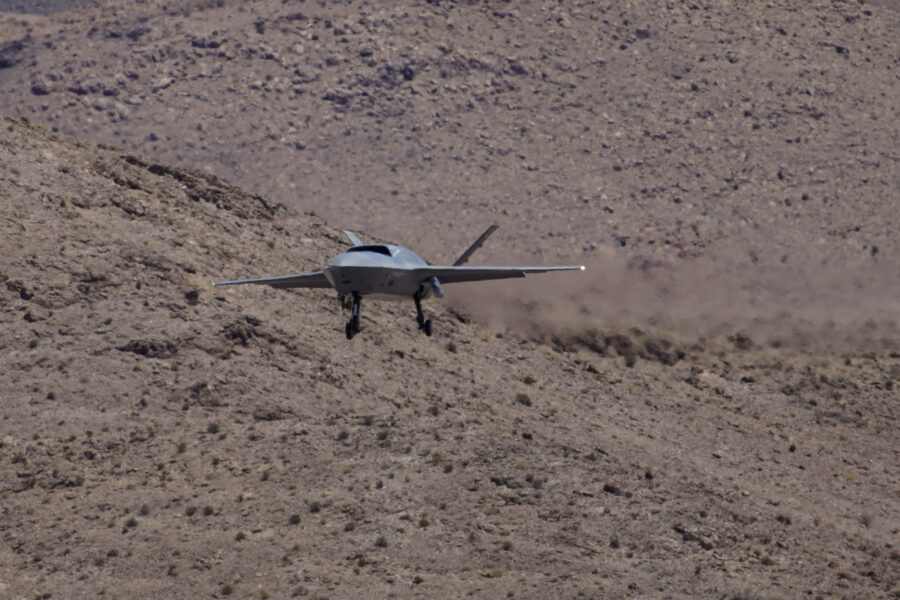
DAYTON, Ohio—The Air Force’s new Collaborative Combat Aircraft may fly scores of missions over many years or only a few if commanders decide a mission is worth the risk of losing one, a top official said this week—a middle ground approach he called “optionally attritable.”
The July 28 comments by Col. Timothy Helfrich, the portfolio acquisition executive for fighters and advanced aircraft, are the latest in a yearslong back-and-forth discussion over how the Air Force should treat the semi-autonomous “loyal wingman” drones. Whatever approach the service takes carries implications for the kinds of missions CCAs fly, their sustainment enterprise, and more.
“We’ve actually never treated CCA as attritable,” Helfrich told reporters at the Life Cycle Industry Days conference. “We have treated CCA as optionally attritable.”
“Attritable” is the Pentagon’s term for platforms that are cheap, plentiful, and easily replaced if lost in combat. The CCA program evolved in part from Air Force programs exploring low-cost, attritable aircraft and was envisioned as a way to provide “affordable mass.”
Former Air Force Secretary Frank Kendall, as well as Gen. Charles Q. Brown Jr. and Gen. David W. Allvin, who served back-to-back as Air Force Chief of Staff, talked in the early days of the CCA concept about keeping the drones simple and replacing them frequently with newer models.
“These have got to be cheaper platforms, and one of their features is that they’re at least attritable, if not expendable,” Kendall said in 2022 at the Center for a New American Security. “That opens up a whole range of tactics that we currently would not contemplate because we’d be sacrificing manned aircraft, and we’re not going to do that.”
In 2023, Brown warned that putting too much capability on a CCA would mean “this is no longer ‘attritable.’” And in 2024, Allvin said he envisioned the CCA fleet as something that could be regularly replaced instead of being flown for generations and thus wouldn’t need depot maintenance.
“I don’t want a set of Collaborative Combat Aircraft that’s going to last for 25 to 30 years,” Allvin said. “If it’s going to last 25 or 30 years, then it’s gotta do everything but make you toast in the morning.”
At the same time, leaders said the drones wouldn’t be entirely disposable. Maj. Gen. Scott R. Jobe, then-director of plans, programs, and requirements at Air Combat Command, said in 2023 it was a “common misconception” that CCAs would be completely attritable.
Helfrich, for his part, left the door open to CCAs staying in service for a long time or being lost in battle if an operational commander on the ground feels it’s necessary to send one into a riskier situation.
“CCA will have a very long service life, if they need to, or they could be attritable if that’s what the operational commander needs to happen,” Helfrich said.
Helfrich’s comments echoed what Air Force Secretary Troy Meink told the Senate Appropriations defense subcommittee in June: “I don’t know that any of those things would be considered truly attritable.”
Helfrich declined to discuss the potential defensive systems that might be included on a CCA.
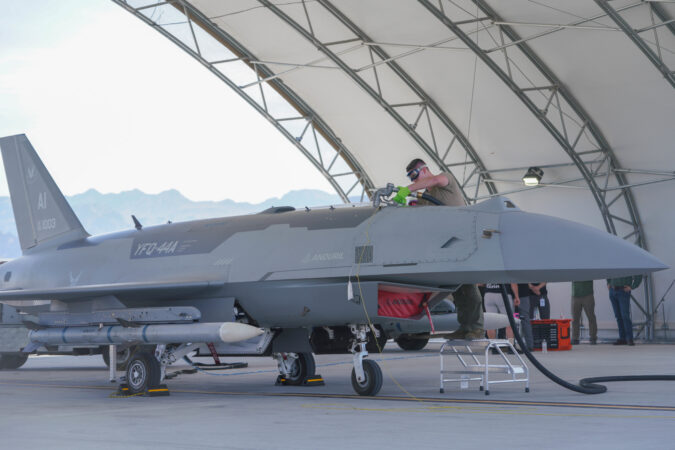
Helfrich said that as General Atomics’ FQ-42A and Anduril Industries’ FQ-44A—the two air-to-air CCAs making up the first increment of the program—move into production, both are beating the Air Force’s price goals of costing less than an F-35. That cost goal works out to roughly $30 million or less.
The Air Force also announced July 15 that Anduril’s developmental CCA, the YFQ-44A, had fired a live missile for the first time. Helfrich said General Atomics’ CCA is expected to conduct its own air-to-air weapons test in the next few months.
Helfrich said most weapons integration efforts on both CCAs are similar, although the key difference is how each aircraft carries their weapons. General Atomics’ CCA has an internal weapons bay, but Anduril’s CCA has no internal carriage and will mount its missiles under its wings.
Helfrich said the CCA program is now working with industry and Air Combat Command to hone the requirements for the second increment, or iteration, of CCAs and come up with conceptual designs. That concept refinement process is expected to wrap up in about 10 months, he said, after which the Air Force plans to whittle the number of potential vendors with workable designs to as many as six.
But that doesn’t mean companies who don’t make that cut will be completely frozen out from CCA’s second iteration. Helfrich said the program could add entrants later that were not part of the initial concept refinement.
That approach echoes the CCA program’s “software sold separately” approach to increment one’s mission autonomy programming.
While the Air Force in June chose three mission autonomy software vendors out of a pool of six, which will be reduced to one winner over the next year, that may not be the end of the story. Three years from now, the Air Force plans to hold a “fly-off,” allowing all six vendors to load their mission autonomy software into CCAs and conduct an in-flight demonstration. This could allow a company that was previously eliminated to come back and be ultimately selected to provide CCA’s first mission autonomy software.
Helfrich emphasized that this approach, which the Air Force calls continuous competition, will continue as CCA moves forward.
“We will continue to maximize competition through all the phases of CCA increment two,” he said. “We will not limit, going into the next phase, to just those vendors that we are doing concept refinement with right now. We will open back up to have competition.”