


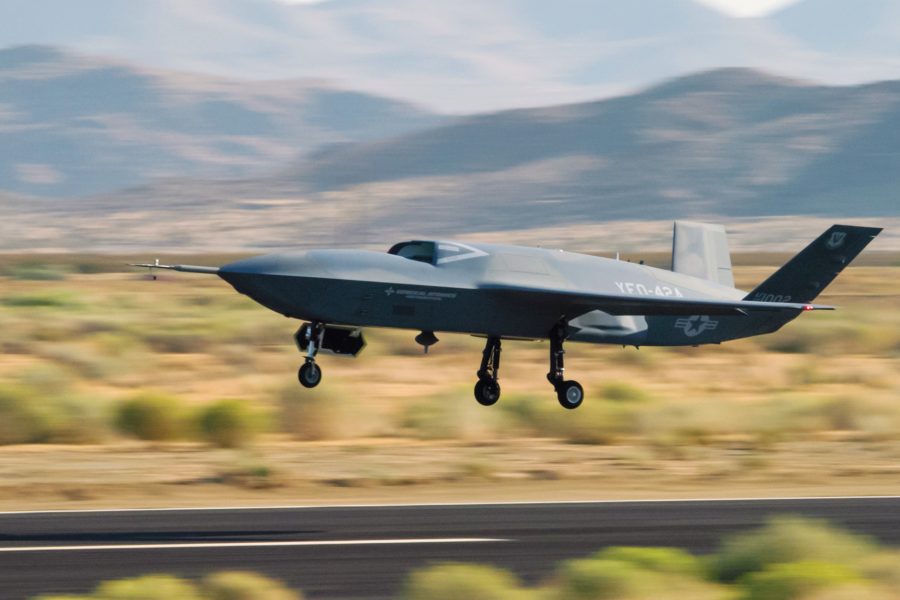
The Netherlands has agreed to fund the purchase of two of the first Collaborative Combat Aircraft being developed for the U.S. Air Force, under a “landmark” international partnership inked before the semi-autonomous drones are even fully developed.
The U.S. Air Force announced the partnership formed with the Netherlands Ministry of Defense on April 23, and said it will move forward both nations’ shared strategy to create “affordable mass” capabilities that can deter and defeat adversaries at a relatively lower cost than traditional crewed fighters.
USAF said under the collaboration with the Royal Netherlands Air Force, the partners will work together to develop autonomous capabilities that are based on an open architecture system, and will allow seamless data sharing and be interoperable with partners in combined operations.
“The future fight will be fought [in collaboration] with allies and partners,” Air Force Secretary Troy Meink said in an April 23 statement. “By aligning our approaches early, we ensure interoperability and shared advantage in the era of human-machine teaming.”
The Air Force has said it is pursuing a fleet of 1,000 CCAs—advanced unmanned aircraft designed to fly semi-autonomously in collaboration with crewed fighters such as the F-22, F-35 or F-47. CCAs would become a means of expanding combat capacity at a cost below that of adding more manned fighter jets. The drones could be equipped for a variety of missions, such as strike, reconnaissance, or electronic warfare.
An Air Force spokesperson said in an email to Air & Space Forces Magazine that the two CCAs acquired by the Dutch could be either the General Atomics YFQ-42A or Anduril Industries’ YFQ-44A, or one of each. Those CCAs will be delivered to USAF’s Experimental Operations Unit at Nellis Air Force Base in Nevada.
Dutch airmen will learn how best to operate CCAs along with the U.S. Air Force at the EOU, which is part of Air Combat Command and is now flying CCAs to develop tactics, techniques, and procedures during the development process to ease the drones’ adoption into operational units. The Air Force said the EOU will help create “a tight feedback loop between the warfighter and developer” and allow the service to refine autonomous systems in realistic scenarios, demonstrating safe and effective ways for humans and machines to work together.
The YFQ-42 and YFQ-44 make up “increment one” of the CCA program. Other aircraft, such as Northrop Grumman’s Talon drone, dubbed the YFQ-48A, could be funded in subsequent increments.
“CCA will fundamental change how we project air power,” said Col. Timothy Helfrich, the portfolio acquisition executive for fighters and advanced aircraft, in the statement. “Working with trusted allies allows us to field the capabilities more effectively. The collaboration on open architecture-based autonomous platforms is critical to ensuring our forces are interoperable and ready for combined operations.”