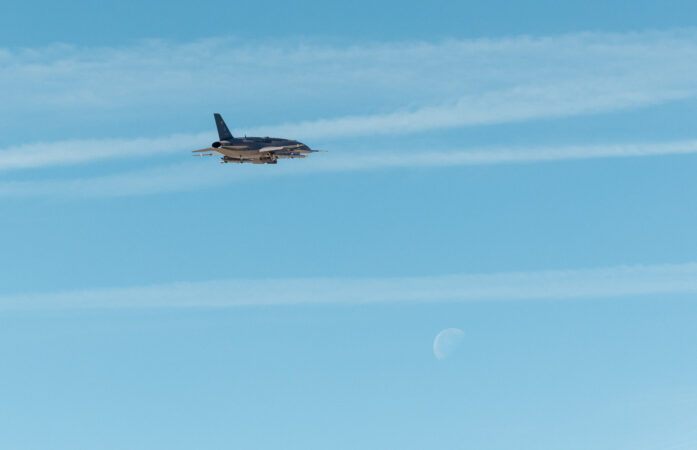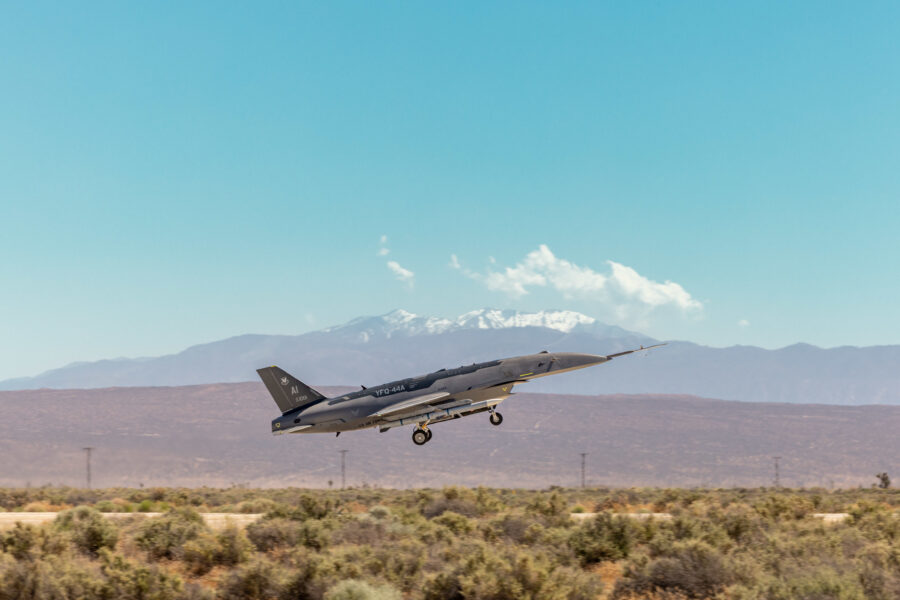
The Air Force put its semi-autonomous Collaborative Combat Aircraft in the hands of operators, not just engineers or test pilots, for a groundbreaking exercise last week.
Anduril Industries’ YFQ-44A flew from Edwards Air Force Base in California, controlled by Airmen from the new Experimental Operations Unit, the Air Force announced April 16. The service says the exercise represents a key milestone in the push to quickly deliver fully operational CCAs to the combat fleet.
“This experimental operations event was executed by EOU members from start to finish,” unit commander Lt. Col. Matthew Jensen said in a statement. “Every sortie generated and flown was done with a warfighter, not an engineer or test pilot, kicking the tires and controlling the prototypes. We are learning by doing, at a speed and risk tolerance accepted by the USAF’s most senior leaders, to ensure CCA is ready to operate and win in the most demanding combat environments.”
CCAs are advanced drones that are designed to fly semi-autonomously—sometimes alongside crewed fighters such as the F-22 or F-35—and carry out missions including strike operations, reconnaissance, and electronic warfare. The Air Force has made creating a fleet of at least 1,000 CCAs a cornerstone of its future airpower strategy and sees them as a way to extend the reach of crewed fighters at a lower cost and reduced risk to human operators.
Anduril’s YFQ-44A and General Atomics’ YFQ-42A are the first two CCAs the Air Force began evaluating as potential additions to its fleet. The Air Force also in January said Northrop Grumman’s Talon drone is a “strong contender” to join a later increment of the CCA program and dubbed it the YFQ-48A.
The Experimental Operations Unit, which is part of Air Combat Command, stood up in 2024 to help develop a “playbook” of tactics, techniques, and procedures for CCAs. The goal is to speed and smooth the drones’ transition into operations, when human aviators will be tasked with managing them.
Airmen from the EOU worked alongside personnel from Air Force Materiel Command’s 412th Test Wing to carry out a series of sorties with the YFQ-44, the Air Force said April 16. Those sorties helped Airmen refine the most important operational and logistical procedures for deploying and sustaining a CCA in a contested environment, per the service announcement.
The dates of the sorties were not included in the Air Force release, but Anduril’s vice president of autonomous airpower Mark Shushnar said in a blog post that the flights took place sometime last week, from April 5-12.
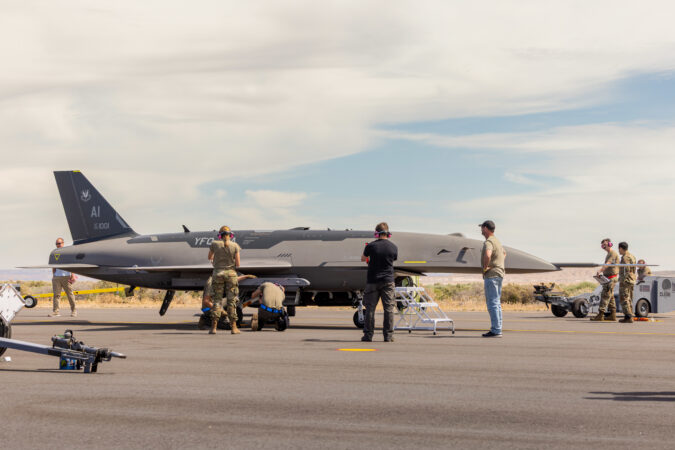
Anduril said the YFQ-44A first flew from the company’s test site in Southern California to Edwards, where the EOU took over operations for its daily sorties at a simulated forward operating base. Those included pre- and post-flight checks and clearances, weapons loading and unloading, and tasking of the CCA during taxi and flight.
Maintainers and ground crew from the EOU also played a part in sustaining the YFQ-44A’s flight operations, Anduril said—requiring just “a handful” of maintainers with a few days of training instead of the much larger manpower needs of a traditional drone. The YFQ-44A flew back to Anduril’s Southern California facility after the exercise concluded.
Photographs released by the Air Force showed a YFQ-44A flying over Edwards with a pair of inert munitions under each wing. The design and markings on the munitions match that of the AIM-120 AMRAAM, or advanced medium-range air-to-air missile.
Operators used a ruggedized laptop to upload mission plans, start autonomous taxi and takeoff procedures, send new orders to the drone in-flight, and manage data and checks once the flight was done. Anduril’s Menace-T command, control, communications and computing solution was the main ground element for flight operations and did not require a large fixed infrastructure to run.
Anduril said the high tempo of those flight operations “represented a critical, early test of the processes, procedures and logistics footprint required to sustain regular operational testing and, ultimately, deployed combat operations.”
This will be important for CCAs to contribute to the Air Force’s Agile Combat Employment concept for distributed operations during a future war, Anduril said. The simulated base at Edwards did not have the infrastructure of a large, established base to support the EOU Airmen.
The Air Force said the “hands-on” testing conducted at Edwards is a central part of its rapid acquisition strategy to field combat-ready CCAs quickly and in significant numbers.
Back at AFA’s Warfare Symposium in February, Gen. Dale R. White explained that the approach not only helps Air Force operators understand how they will use CCAs—it also gives acquisition officials better insight into the advantages and weaknesses of specific systems, and helps requirements personnel refine their approach for the next increment of CCAs.
Helfrich said embedding EOU operators with acquisition personnel “create[s] a tight feedback loop that lets us trade operational risk with acquisition risk in real time.”
These flights took place about six months after the first flight of the YFQ-44A in October 2025, which Anduril carried out semi-autonomously. Shushnar said their CCA’s quick advancement since its first flight shows why it was important to have autonomy—which Anduril called one of the hardest parts of creating a CCA—working right from the beginning.
“The start of experimental testing with the EOU just six months after the first semi-autonomous first flight of YFQ-44A is clear proof that our early bets are already paying dividends,” Shushnar said. “That early focus on autonomy is what enabled the EOU to operate and maintain the aircraft with minimal testing.”
More EOU flights are likely coming—Jensen said in February that his team will take CCAs to major exercises “as soon as we can.”
“[That] will probably surprise some people when they show up to Red Flag and they’re like, ‘why are the robots flying with us?’” Jensen said. “But you know, we’ll drive it and see what happens.”