
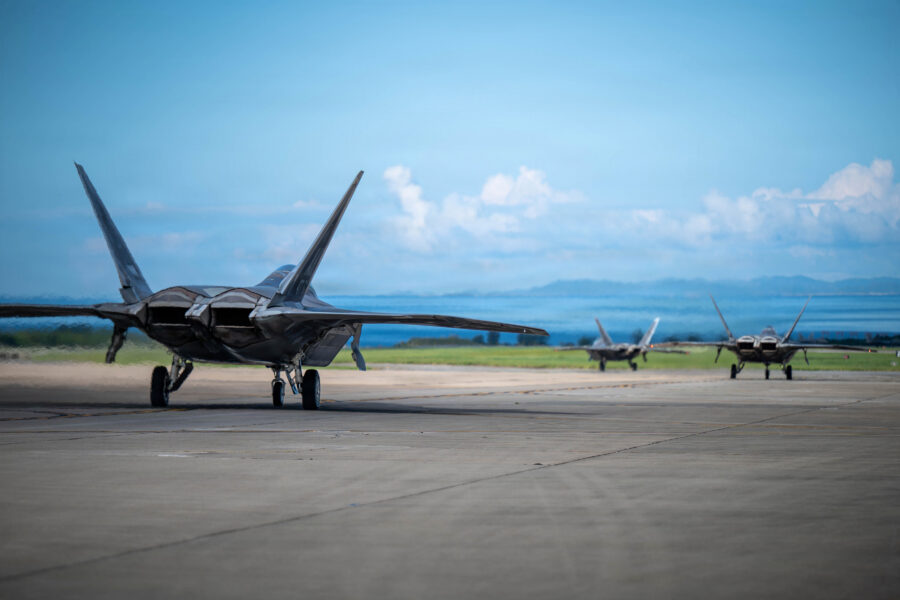
Kadena Air Base’s 18th Wing is conducting a readiness exercise with two rotational fifth-generation fighter squadrons, as the base awaits its delayed stationed F-15EX fighters.
The wing conducted Beverly Beach 26-1 as Kadena prepped for typhoon operations starting Aug. 3.
The readiness exercise with F-22 Raptors from 27th and 90th Expeditionary Fighter Squadrons aims to “rapidly generate combat airpower through agile combat employment principles,” according to an 18th Wing release.
“We’re getting a lot of local flying to build our combat readiness,” said U.S. Air Force Lt. Col. Brenden Torphy, 27th Expeditionary Fighter Squadron director of operations. “Exercises like this allow us to train under realistic conditions and ensure we’re ready to defend Kadena, our allies and our partners whenever we’re called upon.”
The last of the 18th Wing’s F-15Cs departed the base in March 2025. The Air Force has rotated fighter units at the base since before then, and once expected to have new F-15EX Eagle II jets operating from the base by now. An Air Force spokesperson told Air & Space Forces Magazine in February that those deliveries were delayed.
Air Force Secretary Troy Meink said that the first permanent F-15EXs would arrive at Kadena in 2027, with a full complement in place in 2028. A single F-15EX from the 85th Test and Evaluation Squadron, Eglin Air Force Base, Fla., visited Kadena in June.
The 18th Wing’s 48 F-15C/D jets had patrolled the air around Okinawa, Japan, and the South China Sea for years; the base is the closest USAF operating location to Taiwan, which is about 450 miles away.
The Eagle II is a major upgrade from the F-15C, with more processing power and a powerful electronic warfare system for self protection—advanced enough for some to dub it a 4.5-generation fighter. But it lacks the stealth inherent to the F-22 and F-35, the Air Force’s fifth-generation fighters.
“There is no substitute for a fifth-generation fighter” said retired Col. J.V. Venable, senior resident fellow at the Mitchell Institute for Aerospace Studies. “It is a complete package of collection, computation power and the ability to disseminate that and then employ in a way that no other fighter in the world can do.”
The Air Force has F-35As at Misawa Air Base, Japan, which are co-located tbere with 40 more F-35As from the Japanese Air Self-Defense Force.
Venable, a former F-16 pilot who commanded at both the squadron and group level, said the F-15EXs will provide firepower, but will not operate alone in combat. “Any fourth-generation fighter can carry pretty substantial firepower, but it’s going to be riding on the skirts of fifth generation, and the fifth-generation [feature] that people kind of miss out on is … what those airplanes can see from a distance is just amazing,” he said.
The Airmen exercising at Kadena hail from the 90th Expeditionary Fighter Squadron out of Joint Base Elmendorf-Richardson, Alaska and the 27th Expeditionary Fighter Squadron from Joint Base Langley-Eustis, Va. Both arrived in Okinawa in May for a six-month rotation due to end in November. Both squadrons fly the fifth-generation Lockheed Martin F-22 Raptor.
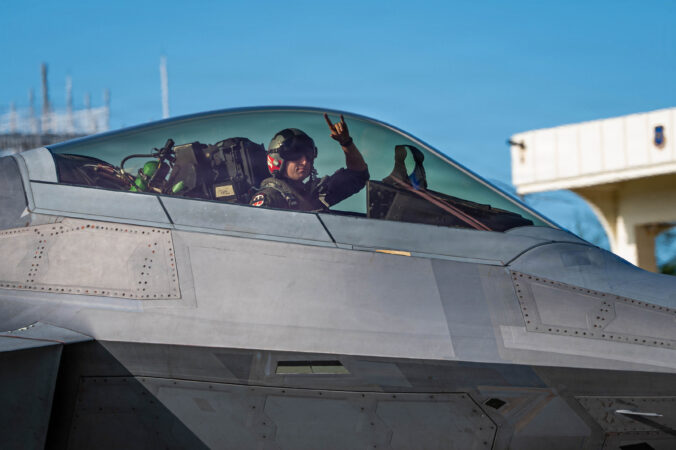
Elements of the 27th deployed earlier this year for Operation Epic Fury. Rotating to Okinawa after a combat deployment is demanding.
“Six-month deployments, those are bone crushers, particularly if you just came off of another deployment,” Venable said. “The rotations aren’t just bone crushers; they’re also less combat effective when it comes to flying the requisite number of fighters needed.”
In decades past, fighter squadrons deployed with 24 aircraft, but today the number is typically 12. That means a squadron commander might at times only be able to put six or eight jets in the fight when called, Venable said.
New F-15EXs should sport higher mission capable rates than the F-22s once they arrive. The 123rd Fighter Squadron at Portland Air National Guard Base, Ore., is the first USAF unit to field the F-15EX, but has received just nine jets to date. A squadron will number 12 aircraft.
The Senate Armed Services Committee’s version of the 2027 National Defense Authorization bill, clears for the Air Force to negotiate multi-year procurement contracts for the F-15EX, potentially ramping up the rate of production and driving down cost—but only if Boeing can meet delivery schedules. A Boeing spokesman deferred questions to the Air Force, and Air Force public affairs did not respond to a request for comment by press time Aug. 3.