


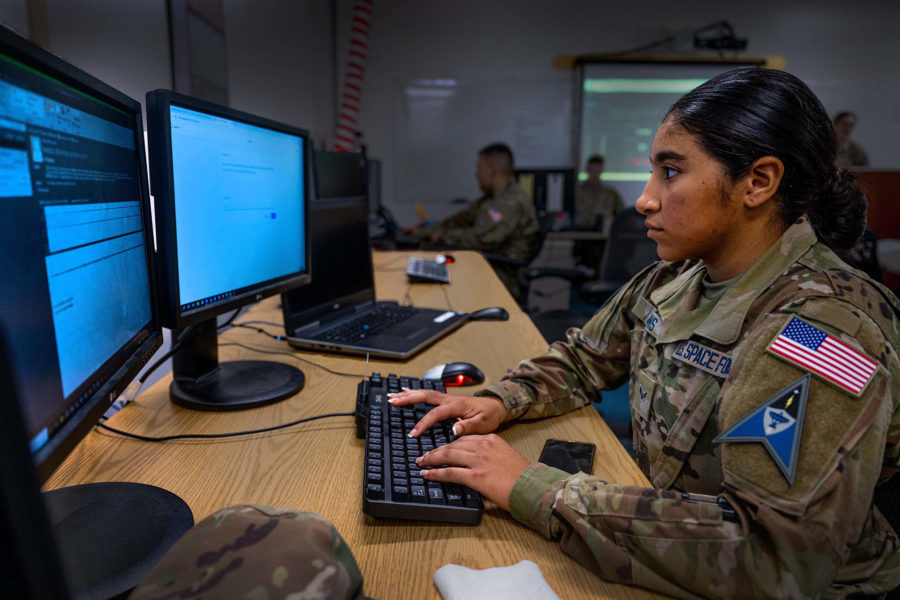
The Space Force chose 15 companies to compete to build out its advanced live and simulated test and training range—a high priority for service officials who say they lack the equipment and infrastructure to prepare Guardians to operate in an increasingly contested space environment.
Space Systems Command on July 31 established a $981 million ceiling for the 10-year effort dubbed the National Space Test and Training Complex Innovative Technology and Engineering—Space Test and Range, or NITE-STAR. The service will use the contract to issue task orders for elements of the physical training environment on the ground as well as a future live, on-orbit range. That could include things like simulators, satellites, and instrumentation.
“This initiative will target advancement of the sophisticated systems and technologies required to keep Guardians ahead of the complexities of a contested space domain,” SSC said in a statement. “NITE-STAR ensures the Space Force remains prepared for high-stakes scenarios.”
For the last few years, the service has been working closely with commercial companies to field quick solutions to meet its near-term test and training needs, awarding one-off contracts through various rapid acquisition contract mechanisms. While that piecemeal approach has served the service well, officials have said it’s not sustainable for the long term. Contracts like NITE-STAR are meant to lay the longer-term foundation for more high-fidelity live and virtual training capabilities.
“The [contract] establishes a highly specialized contractor pool to accelerate the development of future technology,” SSC stated. “It also ensures the USSF can continuously integrate the best available technology from across the innovative ecosystem for years to come.”
The 15 companies chose for NITE-STAR are: Amentum Technology, BAE Systems, Lockheed Martin, Firefly Aerospace, CACI, Pacific Crest Alliance, Northrop Grumman, Sierra Space Corporation, Viasat, York Space Systems, L3Harris Technologies, Parsons Government Services, Redwire Space Systems, Rocket Lab, and Boeing.
Space test and training infrastructure has been a top priority for Space Force leaders as they look to mature the service, as space training equipment has long lagged behind that of the other military branches. In a briefing with reporters last December, Combat Forces Command Commander Lt. Gen. Gregory Gagnon estimated that around 40% of his units lack realistic trainers.
Speaking at a July 17 Mitchell Institute event, Gagnon said the Space Force is making a concerted effort to field simulators to the missions that need them most, particularly orbital warfare, intelligence, space domain awareness, and electronic warfare.
For several of these missions, because the service lacks simulators, it relies on active systems for training.
“What we’re lacking is full up trainers all the time,” he said. “What we use is full up mission systems to do that kind of stuff. The positive of using real mission systems is it’s procedurally 100% accurate.”
The Space Force does envision eventually having more live training assets and instrumentation in orbit—either provided by commercial companies as a service or as purpose-built platforms—but Gagnon said that capability is still nascent. For now, the service’s live, on-orbit training is largely limited to whatever residual capability is left on formerly active satellites after they’ve finished their mission.
“We’re using those to train,” he said. “That’s just a way to get the most out of it before it runs out of energy.”