


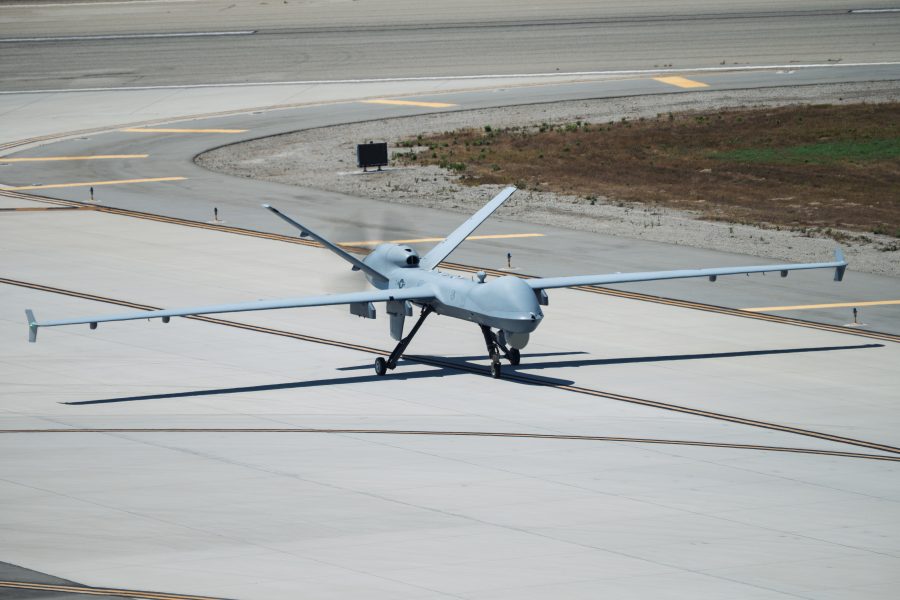
DAYTON, Ohio—The Air Force plans to select vendors by the end of 2026 to help develop concepts for cheap, attritable drones that could perform the MQ-9 Reaper mission—providing persistent intelligence, surveillance, and reconnaissance, as well as strike capabilities—in a new way.
The Defense Innovation Unit calls this concept “massed modular aircraft,” or MMA, and imagines a fleet of uncrewed aircraft operating in groups, but remaining effective even as some are shot down. Its July 7 solicitation stressed the need to keep prices low.
It’s too soon to tell how many MMA drones the Air Force might want to acquire, said Col. John Dayton, the portfolio acquisition executive for intelligence, surveillance and reconnaissance and special operations forces, in a July 27 roundtable with reporters at the Life Cycle Industry Days conference in Dayton, Ohio.
The MMA fleet should be large enough to absorb losses, he said, and inexpensive enough that losses can be replaced without difficulty. That would put the drones between a sophisticated munition and a small aircraft.
Dayton said the Air Force plans to pattern its MMA contracting process similarly to its Collaborative Combat Aircraft program for semi-autonomous autonomous fighter jets. The CCA program identified competitors, fostered multiple alternatives, and even after down-selects left the door open for losers to re-enter competition later.
For MMA, the Air Force aims to award multiple contracts late this year.
“We’re still early, we’re still seeing what industry can support,” Dayton said. “But I do think that it is more kind of that CCA mentality of, set a large target … for what this could become across the right portfolio, at the right price point, so that we can have that attrition tolerance.”
Dayton said both traditional and nontraditional vendors expressed interest in the MMA program. And as potential vendors come back with their pitches, Dayton said, the Air Force plans to compare them to operational analyses and “find whether there’s a sweet spot in that cost curve to make sure that they both provide the capabilities we need, and that they are attrition or loss tolerant, so that we can use them in the right environment going forward.”
General Atomics, which makes the MQ-9, has already indicated it plans to offer a brand new design for MMA.
Unlike the remotely operated MQ-9 and not typically flown in formation, MMAs could be used in “massed” formations, Dayton said, but they could also be operated individually. The potential for semi-autonomous operation similar to a CCA, is also a future possibility.
“My focus … would be to leverage the autonomy government reference architecture into how a massed modular aircraft is flown and operated,” Dayton said. “Maybe initially … I am still flying a in a more traditional way,” as with the remote MQ-9 control. “But by getting the architecture right from the beginning, that allows over time … to build that mission autonomy” into the aircraft.
Asked to differentiate MMAs from CCAs, Dayton cited the mission set. MMAs are intended for intelligence, surveillance and reconnaissance missions, with added strike capability, while the first CCAs are designed for air-to-air combat.
As a model for the MMAs, the MQ-9 Reaper has been used for persistent ISR, air-to-ground strikes on mobile targets, and to designate targets for other aircraft. The MQ-9 was “the most valuable player” of Operation Epic Fury against Iran, Air Force Chief of Staff Gen. Kenneth S. Wilsbach said in May.
The Reapers’ ability to stay on station, wait for mobile targets to emerge, and then strike was unparalleled, and they operated without putting human operators at risk. At the same time, roughly 30 aircraft were lost against Iran. At $16 million or more per copy—and new MQ-9s no longer in production—those losses were more costly than the Air Force would have liked, however. General Atomics’ next generation of Reaper is larger and more expensive; the company says the larger MQ-9B would cost around $30 million, but could be more or less expensive depending on sensors on board and whether spares and other equipment are included in the price.
As for MMA, Dayton did not specifiy a preferred price point, saying only that DIU’s notice indicated $30 million was too expensive. DIU’s solicitation was blunt in its assessment: “The Joint Force’s reliance on low-density, high-value ‘exquisite’ (>$30 million) manned and unmanned aircraft is unsustainable against adversaries utilizing layered defenses enabled by increasingly low-cost antiaircraft capabilities.”
“We’re really trying to engage with industry, engage with nontraditional [companies] with a very broad requirement set,” Dayton said. The goal, he added, is to “capture and better understand … what’s in the realm of possible.”