
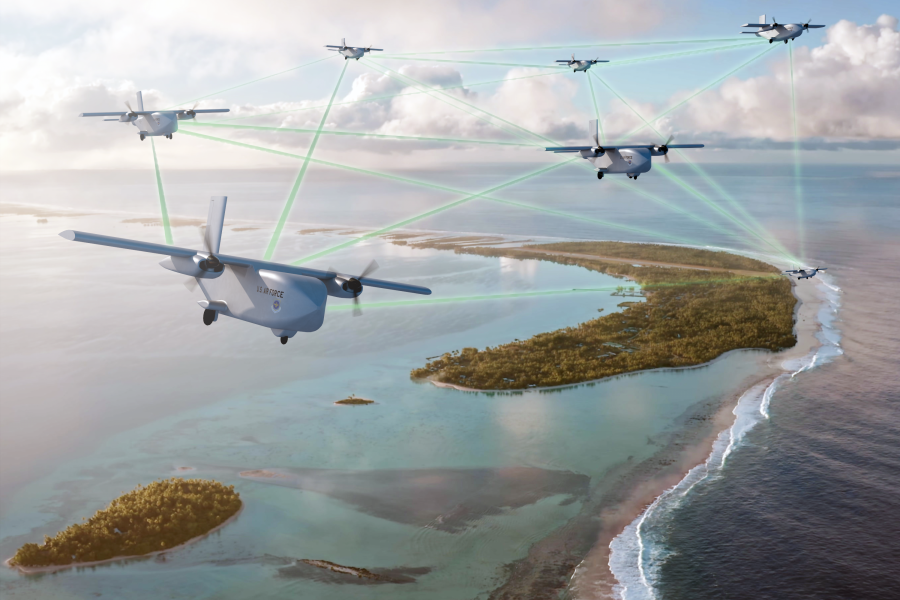
Lawmakers want to know more about how the Air Force and Pentagon might employ autonomous cargo drones to resupply troops in remote locations in the future, according to reports attached to the House Armed Services Committee’s draft version of the fiscal 2027 National Defense Authorization bill.
The Air Force’s agile combat employment concept for operating in contested areas entails small teams of Airmen dispersing to remote locations in the Pacific, then operating from ad hoc airfields in a bid to make it harder for adversaries to locate and target them. But resupplying small, spread-out airfields so they can continue to generate airpower won’t be easy.
Several companies are working on the challenge. Grid Aero unveiled its “Lifter Lite” drone last August, a “flying pickup truck” that could carry up to 8,000 pounds of cargo for distances up to about 1,500 miles. The firm said it received $6 million in seed funding and a small business innovation research Phase II contract from AFWERX, the Air Force’s innovation arm.
The low-cost, attritable Lifter Lite drone could be flown in groups to absorb combat losses and still deliver vital supplies, Grid Aero Chief Executive Officer Arthur Dubois told Air & Space Forces Magazine.
Other firms working on autonomous airlift include Joby Aviation, which acquired Xwing in June 2024. It announced a partnership with L3Harris to develop an autonomous vertical takeoff-and-landing aircraft for defense missions like contested logistics, officials have said. And Reliable Robotics, another autonomy startup, has outfitted Cessnas of its own that are capable of conducting resupply missions.
If the draft bill is approved, the seapower and projection forces subcommittee would require the Air Force to present a briefing to lawmakers before March 1 that would include an anticipated testing schedule for commercially available unmanned airlift prototypes. Lawmakers would also expect a proposed timeline for developing an acquisition strategy that could include rapid prototyping, according to the document.
Meanwhile, the tactical air and land forces subcommittee wants the Pentagon to develop a strategy for the use of “low-cost and attritable Group 4 and 5 unmanned aircraft systems in contested logistics operations.”
The Defense Department sorts drones into five “groups” based on weight, speed, and operating altitude. The Pentagon intends to spend $1.1 billion on Drone Dominance, a program launched in December that’s aimed at testing and purchasing more than 200,000 drones of various sizes by January 2028, Owen West, the Pentagon’s senior advisor on the program, said during a March 5 congressional hearing. Group 4 and 5 drones would be the largest drones, capable of longer ranges and higher payloads.
The strategy would include an assessment of current and projected airlift capabilities for contested environments, communications challenges during contested logistics missions, and whether unmanned airlift could solve such a challenge. The strategy would also need an evaluation of acceptable loss rates and how fast battlefield losses can be replenished, according to the document.
