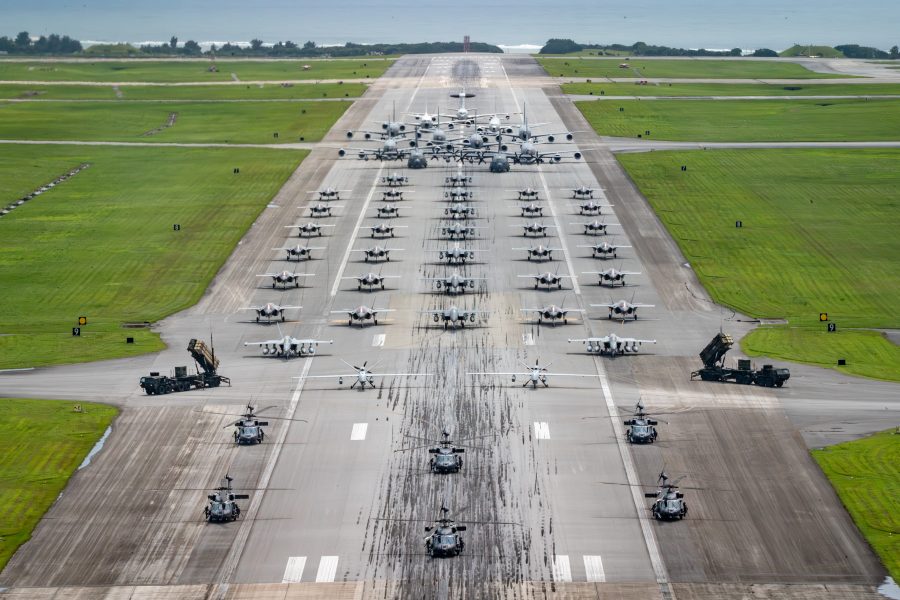
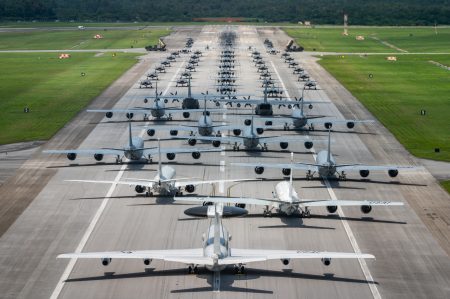
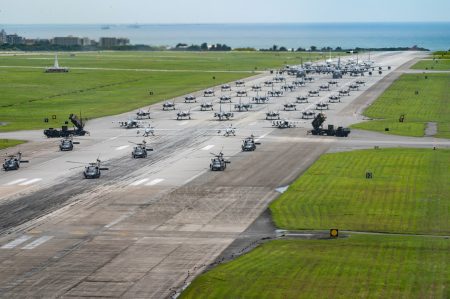
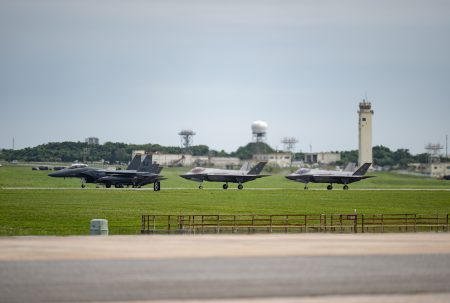
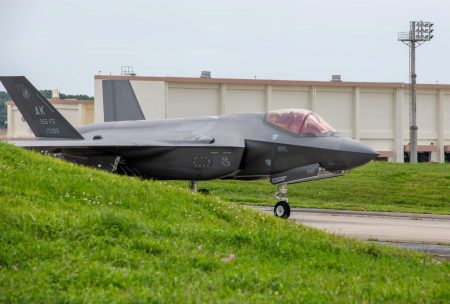
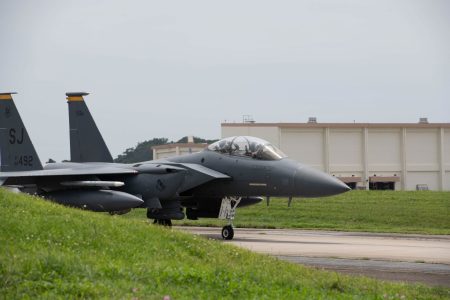
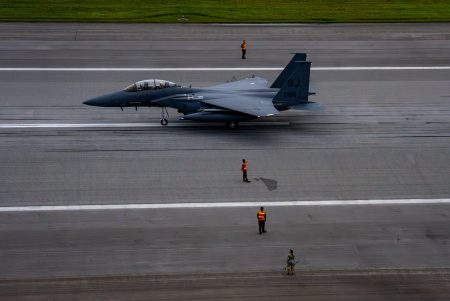
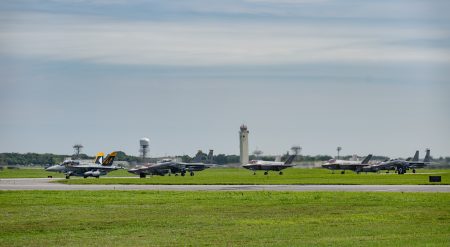
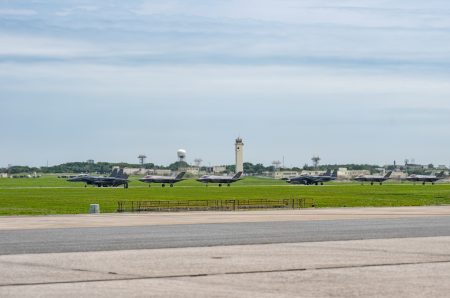
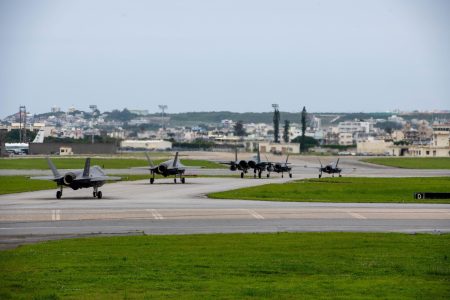
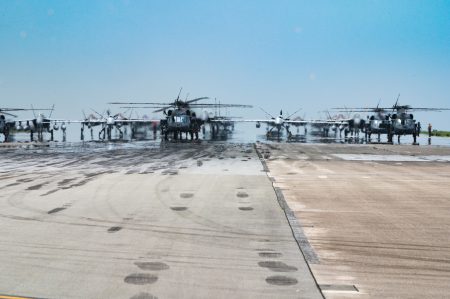
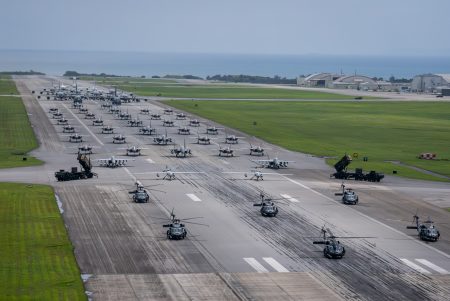
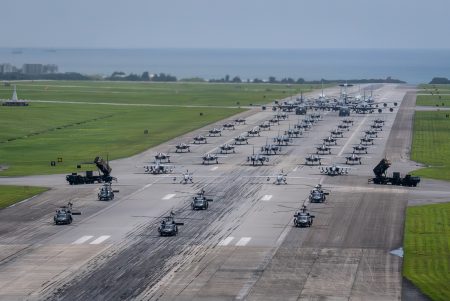
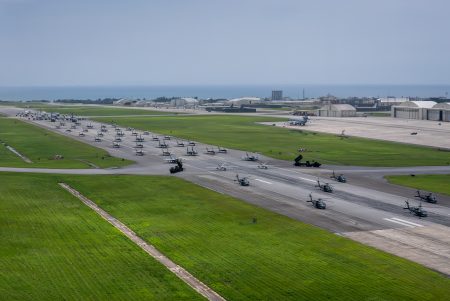
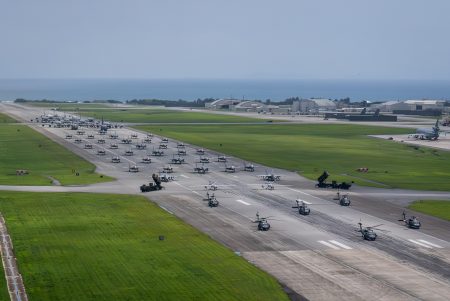
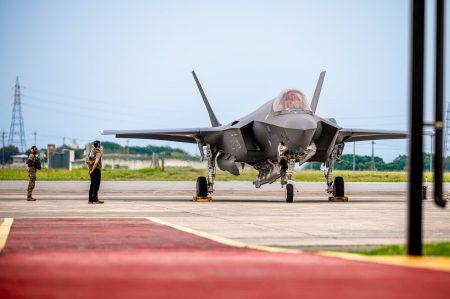
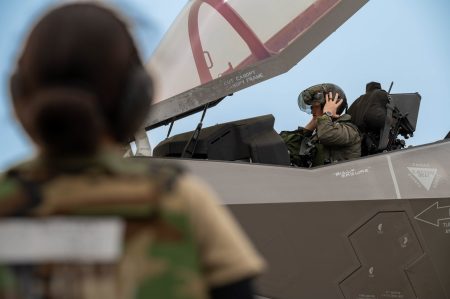
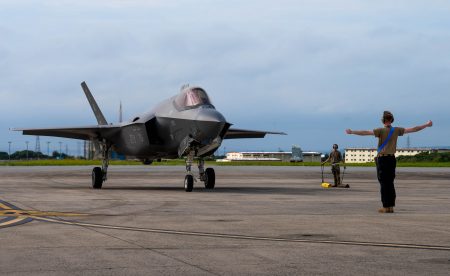
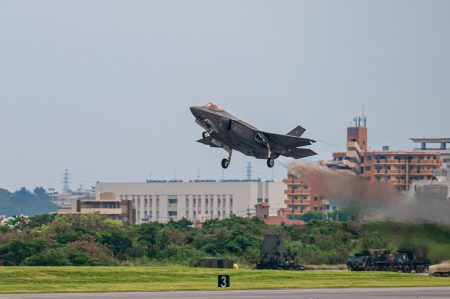
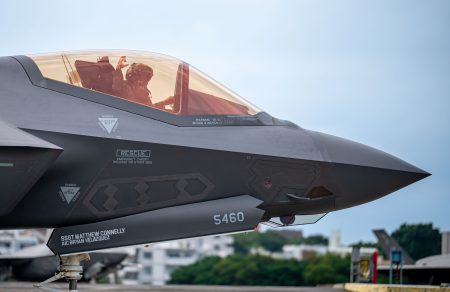
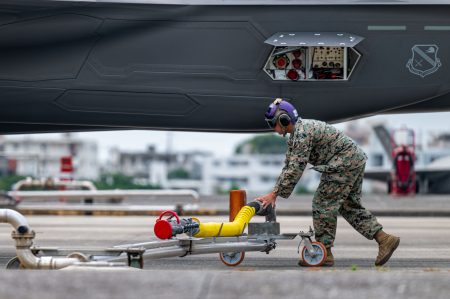
U.S. Air Force, U.S. Army and U.S. Navy assets line up on the runway for an elephant walk during a routine operational readiness exercise at Kadena Air Base, Japan, May 6, 2025. U.S. Air Force photo by Senior Airman Tylir Meyer
Audio of this article is brought to you by the Air & Space Forces Association, honoring and supporting our Airmen, Guardians, and their families. Find out more at afa.org
The Air Force displayed all the firepower it has amassed on Okinawa in an unusually diverse show of force this week.
In a May 6 “Elephant Walk,” Kadena Air Base showcased 24 F-35A Lightning II stealth fighters, drawn from multiple fighter squadrons rotating through the region; eight F-15E Strike Eagles; and two U.S. Army Patriot anti-missile batteries near the runway.
The Patriot system, owned by the U.S. or foreign partners, is deployed to hotspots around the world with significant missile threats, including Ukraine and the Middle East. Their inclusion appeared intended to send the message that the U.S. was not only prepared to operate from the base but to defend it against Chinese missile attacks.
On Okinawa, Kadena is located in the so-called First Island Chain off the coast of mainland China, which includes Japan; Taiwan, the self-governing island China claims as its own; and the Philippines, a U.S. ally that has territorial disputes with Beijing.
In a release, Kadena’s 18th Wing said the “Elephant Walk” of aircraft and missile defense systems was a showcase of “combat readiness and regional deterrence” as part of the exercise Beverly High.
Other platforms also represented in the display:
An Air Force RC-135 Rivet Joint signals intelligence gathering aircraft;
A Navy P-8 Poseidon maritime patrol, reconnaissance, and anti-submarine warfare aircraft;
Two Navy EA-18 Growler electronic warfare attack planes;
The 18th Wing’s release called the display a “testament to the lethality Kadena AB can leverage to deter adversarial aggression in the Indo-Pacific region.” Chief Master Sgt. Brandon Wolfgang, the 18th Wing command chief master sergeant, said it “sends a message you can’t ignore.”
Obvious but unstated was who that message was for—China and North Korea.
Eventually, Kadena plans to receive F-15EX Eagle II advanced fourth-generation aircraft that will be permanently stationed at the base.
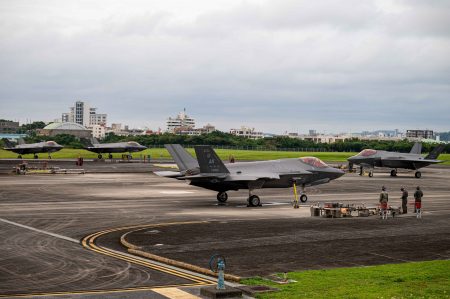
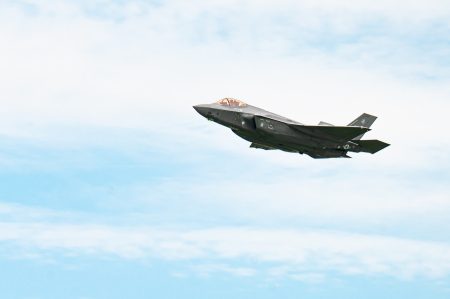
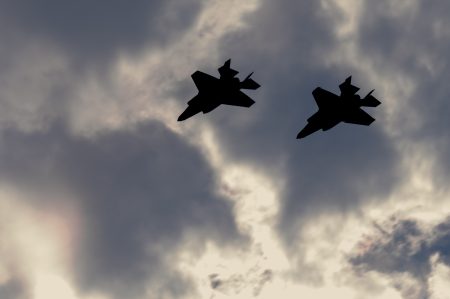
The aircraft from Kadena didn’t stay still. To practice the Air Force concept of Agile Combat Employment, under which aircraft will disperse to elude attack, Airmen and F-35s assigned to Eielson’s 355th Fighter Squadron and 355th Fighter Generation Squadron are staging out of Marine Corps Air Station Futenma, which is also on Okinawa, from May 6-9.
Marine Corps Air Station Futenma hosts its own F-35Bs, the short takeoff and vertical landing (STOVL) variant flown by the service. The USMC also operates the carrier-based F-35C.
Audio of this article is brought to you by the Air & Space Forces Association, honoring and supporting our Airmen, Guardians, and their families. Find out more at afa.org
Repeated delays to critical F-35 upgrades helped drive the Air Force to more than double its planned fleet of F-15EX Eagle II fighters, a top official said May 12.
The Air Force plans to start buying thousands of advanced new handheld radios in 2027 for downed aircrew to communicate with search-and-rescue forces, a capability spotlighted earlier this year during the recovery of two aviators shot down in Iran.
The Air Force says it has formed a plan with Boeing to get key upgrades deployed across the KC-46 tanker fleet faster—but the service acknowledged it won't start fielding the refueler’s upgraded vision system until 2028, a slight schedule slip.
There's a growing consensus among experts, lawmakers, and Pentagon leaders that the Air Force should buy more than the planned minimum of 100 B-21 stealth bombers. Exactly how many more is a question USAF will likely answer in its 2028 budget request, the service’s top planner said May 13.
The Pentagon announced new long-term agreements with four defense companies May 13 to develop and produce large numbers of low-cost cruise missiles. And while the effort will focus mostly on the Army to start, it pairs with Air Force efforts to find more affordable munitions.
The Air Force wants to rapidly replace about two dozen MQ-9A Reaper drones lost during Operation Epic Fury against Iran, top service officials told lawmakers May 12.
The Air Force is placing Air Combat Command in charge of teaching combat tactics to fighter and remotely-piloted aircraft units, according to a May 12 announcement. Beginning this summer, the service will reassign the formal training units for the F-35, F-16, and MQ-9 from Air Education and Training Command to…