


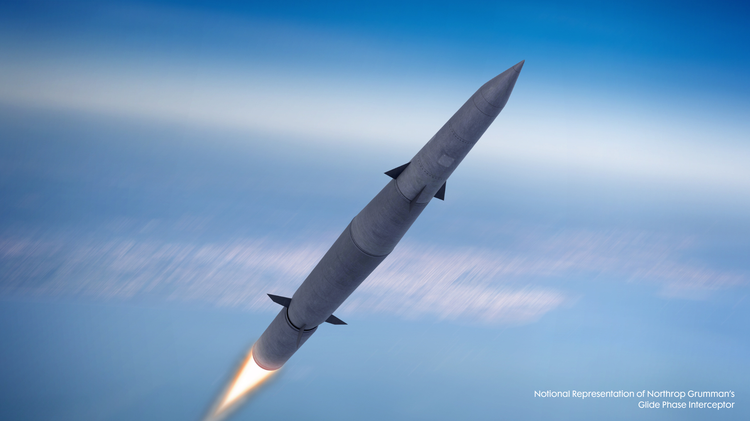
A recent injection of $475 million has reversed delayed delivery timelines for the Pentagon’s hypersonic missile interceptor by several years.
Air Force Lt. Gen. Heath Collins, director of the Missile Defense Agency, told congressional leaders in an April 15 hearing that the money, which came from the 2025 reconciliation bill, also called the One Big Beautiful Bill Act, was awarded to Northrop Grumman for development of the Glide Phase Interceptor, or GPI.
The interceptor’s originally anticipated delivery deadline was 2035 when the program was first conceived in 2022. But Congress told the Pentagon in 2024 that the missile should hit initial operational capability by 2029, with at least a dozen missiles for testing and full operational capability by 2032.
Yet reduced funding for the program in the fiscal 2025 budget delayed it by up to three years, back to the 2035 deadline, officials said at the time.
Now, this latest contract award to Northrop has pushed the delivery date up to 2031, Collins said. The added funding also pushes the program’s total cost to $1.31 billion from its previous price tag of $832.8 million.
The GPI is a missile system launched from U.S. Navy surface warships to intercept hypersonic weapons during their most vulnerable glide phase, which happens post-launch and before atmosphere re-entry.
Both Russia and China have made significant investments in hypersonic technology. A 2023 Pentagon report stated that China had the world’s leading hypersonic weapons.
Air Force Gen. Gregory M. Guillot, head of U.S. Northern Command and North American Aerospace Defense Command, has in previous hearings called hypersonics “probably the most technologically challenging threat we’re facing, as well as the most destabilizing.”
The United States and Japan announced a joint effort in 2023 with RTX and Northrop Grumman to develop the interceptor. MDA selected Northrop Grumman for the project in 2024.
Japan and the United States conducted a similar interceptor collaboration with the Standard Missile-3 Block IIA. The SM-3 Block IIA operates from the Aegis Ballistic Missile Defense system to defeat medium- and intermediate-range ballistic missiles.
Japan is the lead developer of rocket motors and propulsion components for the GPI.
Northrop’s duties were to refine the preliminary design, demonstrate system performance in hypersonic environments, complete flight experiments, and use digital engineering practices to connect the program to accelerate design processes.
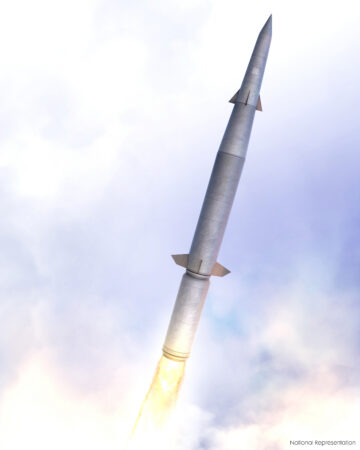
In an April 15 release announcing the contract modification, Northrop stated that the company should reach preliminary design review by 2028.
In the meantime, Northrop is slated to conduct flight tests, expand its multimission capabilities, and explore additional launch strategies, according to the release.
“Northrop Grumman is moving with speed to streamline and deliver a first-of-a-kind countermeasure against hypersonic threats,” said Wendy Williams, vice president and general manager for Northrop’s launch and exploration. “This award underscores the critical need for missile defense technologies, which Northrop Grumman is uniquely equipped to provide.”
In the same hearing, another major missile defense project—space-based interceptors to take out missiles during their boost phase—came under scrutiny.
Gen. Michael A. Guetlein, director of the Pentagon’s Golden Dome missile defense program, told congressional leaders that the boost-phase intercept mission is particularly challenging due to shorter decision timelines.
The Space Force awarded prototype contracts for the space-based interceptors in November.
President Donald Trump originally estimated the cost of the Golden Dome at $175 billion over the next three years. That figure rose to $185 billion, following a $10 billion increase to accelerate space-based technology. But the Congressional Budget Office estimated that the project will cost $542 billion. And the American Enterprise Institute, a Washington think tank, put the price tag ranging from $252 billion to $3.6 trillion over the next two decades.
Guetlein has pushed back against those high-cost estimates.
“They’re estimating the modernization of legacy systems that I have,” Guetlein said. “That is not what Golden Dome is doing. We’re doing business differently, with different authorities, disaggregating architecture and integrating [artificial intelligence].”
The four-star said defeating a missile launched in the boost phase from space is an “incredible challenge,” but the technology exists to accomplish that feat.
What he doesn’t yet know, he said, is if it can be done at scale or affordably, he said. The entire Golden Dome system needs affordable magazine depth. And cost is driving program development.
“If boost-phase intercept from space is not affordable and scalable, we will not produce it, because we have other options to get after it,” Guetlein said.
Guetlein noted progress on a complementary piece to the GPI—the hypersonic ballistic missile tracking system. He said his team is working with the Space Development Agency to accelerate its development.
L3Harris announced in an April 13 release that the company had completed production of all 16 payloads for the SDA’s tracking layer.
The company already has four missile tracking satellites in orbit from Tranche 0 of the effort and another 52 satellites in development across the next three tranches. The goal is to have 158 missile tracking satellites in orbit.