
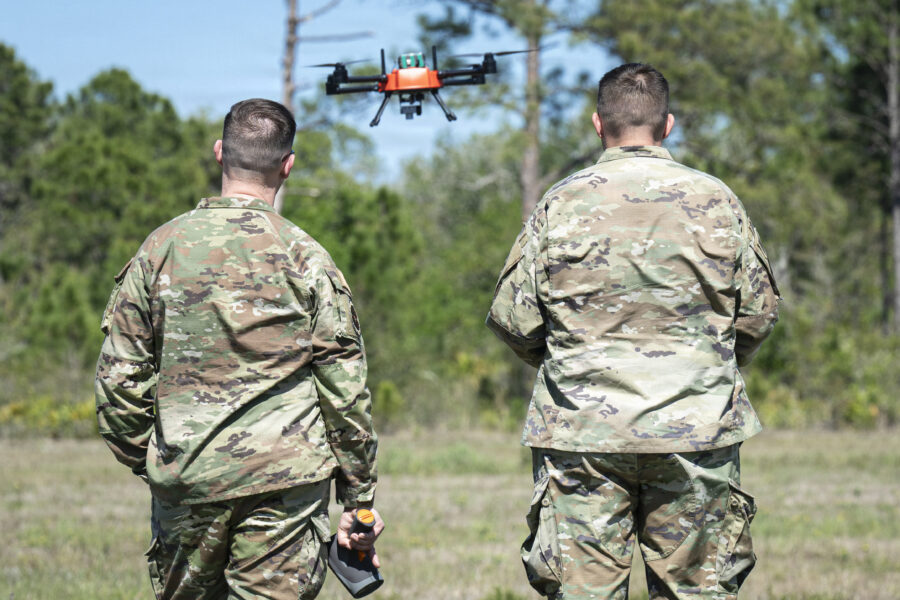
The Air Force wants to step up its ability to field unmanned systems with deployable manufacturing equipment for turning out small drones in austere terrain.
The service’s Rapid Sustainment Office, or RSO, is asking industry to submit ideas for creating expeditionary manufacturing equipment for producing and maintaining Group 1 and 2 drones—quadcopter-sized systems weighing up to 55 pounds—for reconnaissance, attack, and counter-drone missions.
The RSO, which is part of the Air Force Life Cycle Management Center, is searching for “existing solutions for an on-demand manufacturing capability for ready-to-fly Unmanned Aerial Systems, purpose-built attritable systems, first-person-view drone build kits, counter UAS systems—such as interceptors—accessories, spare parts and supplies that can be operated in remote and austere environments,” according to an Aug. 7 request for information.
“This will allow for the rapid, persistent, and distributed production of unmanned air systems near the point of need reducing reliance on traditional supply chains and enabling forces to quickly replenish critical assets in contested areas.”
The RFI, which requires interested firms to submit a response by Aug. 28, is another step in the Air Force’s march to become more self-sufficient at defending its air bases from drones and other aerial threats. Currently, the service relies primarily on the Small Unmanned Air Defense Systems. SUADS is designed to identify, track, and down drones and is available in two variants, one for fixed air bases and one that can be rapidly deployed on an aircraft pallet for rapid-deployment missions to austere areas of the battlefield.
SUADS is also designed to accept add-on counter-drone technologies, ranging from kinetic effectors to high-power microwave systems. The service is acquiring and fielding different types of counter-drone effectors as well as command and control systems through the Joint Interagency Task Force 401, Michael Sheehy, director of future operations under the Air Force deputy chief of staff for operations, told Air & Space Forces Magazine in July.
But beyond SUADS, the Air Force is eyeing more small expendable drone systems faster that can be quickly replaced on remote battlefields.
Currently, the Air Force “does not have a preferred production capacity” but instead is interested in “scalable” expeditionary manufacturing equipment that can be loaded into a shipping container and transported by “C-130, cargo ship, and helicopter sling-load,” according to the RFI.
Interested defense firms should provide detailed descriptions of their expeditionary manufacturing capabilities such as “additive manufacturing/3D printing” and rapid assembly as well as “concepts for effective assembly solutions to include but not limited to soldering, battery wiring, and motor assembly,” the RFI states.
The Rapid Sustainment Office wants to hear from companies that can adapt to multiple “vendor agnostic compatible materials” and components with minimal reconfiguration, the solicitation states.
“This capability is aimed at being as agile as possible or to be drone agnostic but compatible with highly desirable materials commonly used in additive manufacturing,” the RFI states.
Each vendor’s manufacturing equipment and the components for assembling small drones should be compatible with standard military generators or tactical microgrids and must be able operate despite extreme environmental factors such as dust, humidity, temperatures ranging from minus 40 degrees to 125 degrees Fahrenheit, the solicitation states.
The office also wants to vendors to detail their “supply chain and logistics capabilities to maintain a continual UAS manufacturing stream that is free of components or software from China, Russia, Iran, North Korea, or any country that is a state sponsor of terrorism,” the RFI states.
The Air Force began focusing on creating a point defense strategy to deal with drone threats in late 2023 when unidentified drones flew unchecked for days over Langley Air Force Base, Va. More drone incursions followed at bases in Ohio, Utah, and the United Kingdom.
Since then, the service has launched initiatives such as publishing a new doctrine on the “Point Defense of Air Bases,” to ensure the service plays a more active role in air defense, a mission that has traditionally been an Army responsibility. The Air Force also stood up the Point Defense Task Force and Point Defense Battle Lab to develop to identify new training, equipment and tactics needed for the new mission.
The service has also created its first point defense flights, specialized units of Airmen trained to rapidly deploy to the Pacific and other hotspots and defend future remote air bases from drone attack. In the long-term, the service is developing a new job specialty code for base defense as the first step in developing this new career field.
