


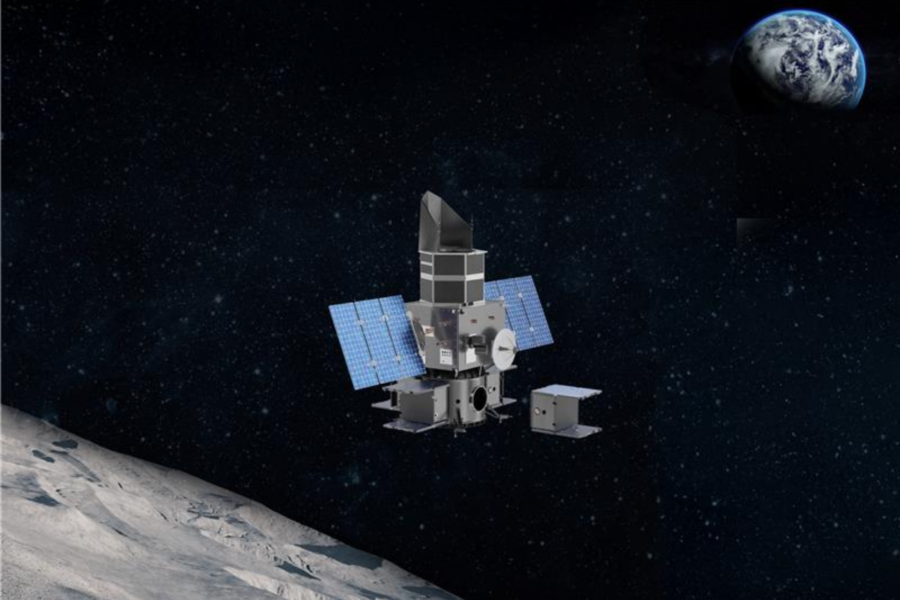
COLORADO SPRINGS, Colo.—BAE Systems unveiled a new high-thrust, refuelable satellite designed to support dynamic space operations–a demand company officials say is coming not only from the Space Force, but from commercial and civil customers as well.
The satellite, called Ascent, is part of BAE’s “Elevation” line of small spacecraft designed to operate in a range of orbits and carry payloads of varying sizes. The company has an initial, unnamed customer for Ascent and plans to deliver its first spacecraft in 2027. That satellite will serve as a pathfinder, demonstrating refueling as well as the ability to maneuver within different orbits, including medium-Earth orbit, geosynchronous orbit, and even cislunar space.
“The addition of Ascent to our Elevation spacecraft line delivers new dynamic space operations capabilities to counter cislunar threats,” BAE’s Vice President of Military Space Thai Sheridan said in an April 14 press release. “Ascent supports multi-mission mobility capabilities and spacecraft logistics in expanded orbital environments, featuring a highly maneuverable platform.”
Sheridan told reporters April 13 at the Space Symposium here that BAE developed Ascent over the last few years in response to the Space Force and U.S. Space Command’s stated need for more agile, maneuverable spacecraft that can incorporate high thrust and velocity—satellites that can change orbits to evade enemy aggression or observe unusual activity. That degree of mobility, however, puts strain on a satellite’s fuel tank, which is why the company designed Ascent to be refuelable.
The Space Force hasn’t committed to requiring refuelable satellites in the future, though the service is considering that requirement for a space domain awareness program called RG-XX. It also has a number of demonstrations scheduled for the next two years that will inform its plans. Asked why BAE opted to commit to a refuelable satellite despite an unclear demand signal from the service, Sheridan said the Space Force isn’t the only customer the company has in mind.
“I don’t think it is just the Space Force,” he said. “We’re seeing commercial interest in what we’re doing as well as government interest as well as civil interest. So, I think the demand signal is starting to ramp up in all three of those areas. We’re positioned because we’ve been investing in this over the last five years. I think it’s the perfect time to accelerate what we’re doing.”
BAE also envisions Ascent as a rideshare platform that can efficiently host several payloads and serve a “space tug,” according to Bonnie Patterson, vice president of civil space at the company.
“Ascent enables the opportunity to integrate multi-manifest launches and host a wide range of payloads, which enables our customers’ vision for deep-space exploration and cislunar operations,” Patterson said.