


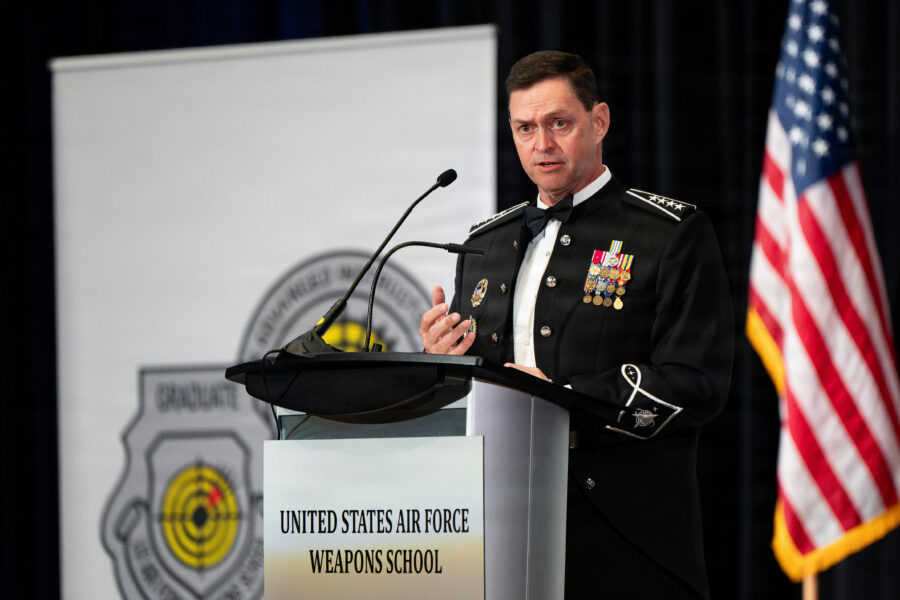
Chief of Space Operations Gen. Chance Saltzman graduated from the Air Force Weapons School in 2001 equipped with academic knowledge about how to integrate space capabilities into Air Force operations. But as he describes it, he received limited hands-on experience with the systems themselves.
The weapons school at Nellis Air Force Base, Nev., has a legacy of providing practical training for Department of the Air Force advisors and tacticians. But at the turn of the century, it didn’t have the resources to provide that level of training through its space-specific course.
“The vast majority of our training back then was primarily academic,” Saltzman told Air & Space Forces Magazine in a recent interview. “Our primary role was to take space into air operations and try to educate people on how space could be integrated into their plans and operations more effectively.”
The Space Superiority Weapons Instructor Course looks a lot different today than it did 25 years ago—a reflection of the growing importance of space to joint operations and the elevation of what was then a small cadre within the Air Force to its own separate service. Saltzman, who spoke at the Air Force Weapons School graduation June 13, said the Guardians who move through the course today are trained on offensive and defensive operations with a focus on integrated mission planning. And, as he put it, they’re part of a team rather than “an educator about the team.”
“That’s a pretty big shift,” he said.
The Space WIC has changed in other ways, too, said Col. Agustin Carrero, commander of Space Delta 11, which oversees the 328th Weapons Squadron at Nellis. While it was established in 1996 primarily for weapons officers, today the Space WIC is geared toward both officer and enlisted Guardians. Most of the students come into the class with either a solid understanding of Space Force systems and the operating environment or some “tactical knowledge under their belt,” Carrero said.
“The focus, especially since the creation of the [Space Force] is more on honing our warfighting skills and making sure that as a service we can meet our moral obligation to contest the domain in support of joint operations,” he told Air & Space Forces Magazine.
To do that, the course leans heavily on aggressor training in a virtual environment, allowing Guardians to hone their tactics operating against a simulated adversary.
Carrero said he expects the course to continue to evolve as the Space Force prepares to potentially double in size in the coming years. That kind of expansion means more investment will be needed across the service’s training enterprise, including to grow the weapons instructor course.
Some of expansion is already occurring, as the school is renovating an existing facility at Nellis to accommodate more students. Construction will start later this year, and the 328th expects to move into the building full time in summer 2028. Carrero said the extra facility will allow the course to train as many as 100 students per year. Today, the Space WIC graduates about 25 students each year across two 23-week sessions.
It’s also planning to launch two new course tracks in the coming years: an intelligence track that is projected to come online in 2028 and a cyber-focused track in 2029.
Alongside that growth, Carrero said the course will continue to increase its focus on training Guardians to operate in a contested domain, especially as the Space Force brings on new missions in the coming years. And while today, Space WICs primarily train in a virtual environment, Carrero said he expects more training in the future could be performed using live satellites.
“One of the ways that the course is evolving is to develop those additional warfighting skills that we’re going to need as we bring on board additional capabilities,” he said. “We definitely see the need to evolve the course.”
Saltzman’s speech last weekend marks the first time a Guardian has addressed a weapons school graduating class—a moment Carrero described as a “monumental event” for the space community and further evidence of the growing importance of space.
“I think it’s going to reinforce for the Guardians that are going through this very difficult course how the other services and the Department of War have fully embraced this new service,” Carrero said.