
The Air Force is asking Congress for an additional $3.2 billion for spares as part of a larger push to increase aircraft readiness, Vice Chief Gen. John D. Lamontagne told Congress on April 15.
Early budget figures for fiscal 2027 don’t specify that figure, but do include substantial increases the Air Force is seeking for operations and maintenance and its revolving Working Capital Fund. USAF is asking to increase O&M funding by $15.4 billion over fiscal 2026, an increase of nearly 20 percent. The Working Capital Fund would get an injection of more than $4 billion, and some of that investment could also contribute to improving readiness.
Air Force leaders have been prioritizing readiness for the past year, and both Air Force Secretary Troy E. Meink and Chief of Staff Gen. Kenneth S. Wilsbach have made readiness their focus since taking their jobs last year.
The April 15 House Armed Services Readiness subcommittee hearing put military readiness in the spotlight. Lamontagne told lawmakers the Air Force is leveraging the White House’s ambitious $1.5 trillion budget threshold for fiscal 2027 to reduce problems like parts shortfalls that contribute to aircraft downtime.
“We are redoubling our efforts to invest in our ability to maintain the airplanes,” Lamontagne said. Weapons sustainment accounts, which include spare parts, will be more richly funded in 2027.
Historically, the Air Force has funded weapons systems sustainment “to about an 85 percent level” versus requirements, Lamontagne said. “Last year it was an 86 percent level, so some improvement—but not enough. This year’s budget, in 2027, takes us to 93 percent—an additional $3.2 billion—to help us sustain those airplanes over time.”
In fiscal 2026, the Air Force requested $36.5 billion for readiness, which includes weapon system sustainment.
But readiness funding alone can’t solve the problem. Lawmakers and Lamontagne also discussed the government’s “right to repair” military systems, and how restrictions on intellectual property can bar the government from doing some work. Consumer right-to-repair laws have worked to make it easier for people to repair their own cars or phones; a government right-to-repair law could force defense contractors to surrender technical data rights, enabling competition for service and support contracts, including enabling Airmen and Air Force civilians to do more of that work. Contract restrictions can make such repairs impossible today.
“We need data that gets down to the component and subcomponent systems so that our Airmen can affect repairs a lot of times,” Lamontagne told lawmakers
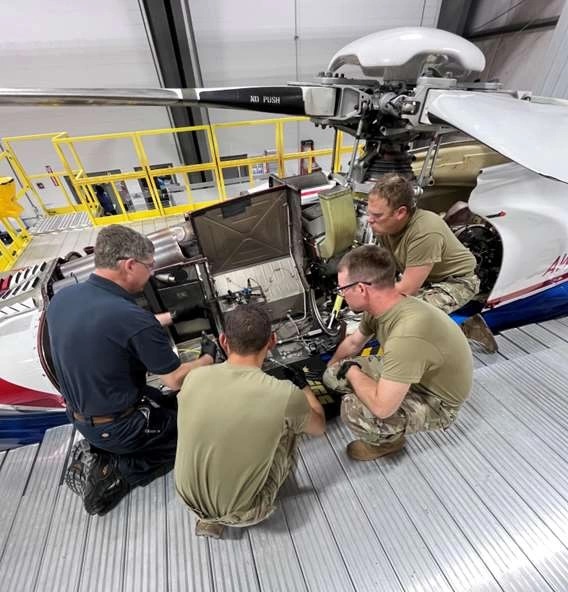
A broken auxiliary power unit or other part might be repairable, but contractual restrictions might limit Airman from doing more than removing the part and then swapping in a spare or taking one from another aircraft. Having spares on hand can help, but being able to service the component rather than only the plane would also make a difference.
“The part’s not on the shelf, so that is a critical issue,” Lamontagne said. “They [have to] get that part off another airplane—let’s say it’s a two-hour job—two hours to get it off that airplane, two hours to put it in the second airplane, and when the part shows up, two hours to put it in the third airplane.”
Leaders from the Army, Navy, Marine Corps, and Space Force all agreed that right-to-repair legislation would be helpful if included in the next National Defense Authorization Act.
Rep. Pat Harrigan (R-N.C.) said Congress came close to achieving that in the last budget cycle, and promised to continue to work the issue.
“This committee wants to give it to you, but for some reason, there is some force that is out there that is preventing that from happening,” he said. “I’m going to start getting very agitated about this this year. … We have to deliver right to repair to the services.”
Bipartisan right-to-repair legislation was among the last sticking points in NDAA negotiations last fall, a measure that had the support of both Sen. Elizabeth Warren (D-Mass.) and Sen. Tim Sheehy (R-Mont.) But it also has its share of opponents, including Aerospace Industries Association President Eric Fanning, a former Army Secretary during the Obama administration, who criticized the plan in the Washington Times in November.
“Forcing the Pentagon to buy intellectual property on every contract, whether it actually needs it or not, means the department could end up paying for intellectual property it never uses,” Fanning wrote in an op-ed column. “Mandating broad intellectual property access will drive up costs, slow modernization and make it harder for the Pentagon to attract the next generation of tech leaders [to work for the Pentagon]. We will end up with fewer new ideas, more reliance on aging equipment and a smaller, less dynamic industrial base.”
Yet those in the government disagree. The Air Force has increasingly sought to build future systems, such as its Collaborative Combat Aircraft, around government reference architectures to better equip the service to manage and upgrade its platforms.
And last April, Defense Secretary Pete Hegseth directed the Army to “identify and propose contract modifications for right to repair provisions where intellectual property constraints limit the Army’s ability to conduct maintenance and access the appropriate maintenance tools, software, and technical data.”