
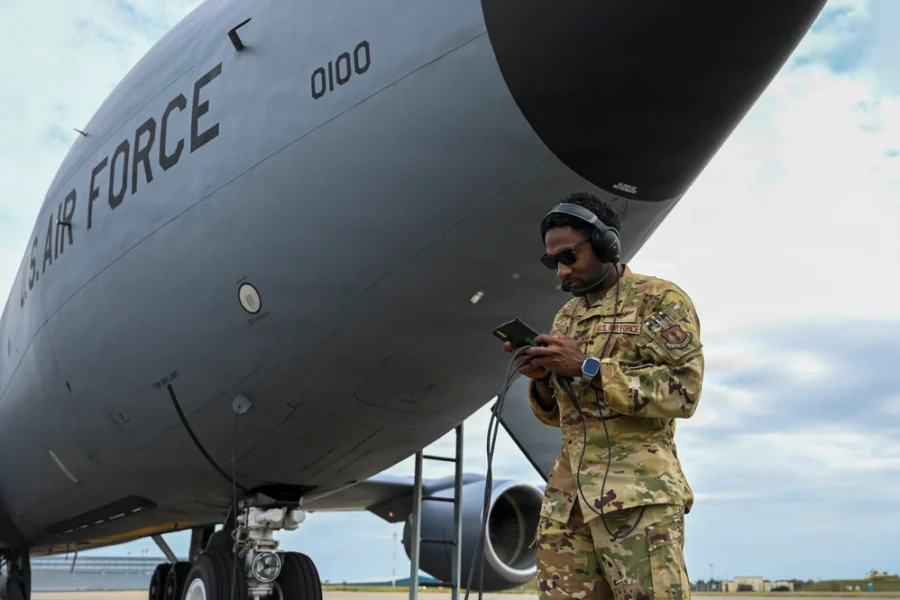
NATIONAL HARBOR, Md.—Air Force depots are not typically meant for quick repair jobs—aircraft can stay in depot for weeks and months getting repairs—but during Operation Epic Fury, the service moved some of its stateside heavy maintenance capability forward to fix battle-damaged aircraft closer to the fight.
As the war with Iran stretched from its projected timeline of weeks into several months, Air Force leaders were forced to adapt its aircraft maintenance strategy for a prolonged conflict.
The service relies on three maintenance depots at Hill Air Force Base, Utah; Robins Air Force Base, Ga.; and Tinker Air Force Base, Okla.—to conduct major maintenance overhauls and inspections on fighters, bombers, airlifters, and other aircraft.
During Epic Fury, barrages of Iranian missile and drone attacks on U.S. forces operating out of Middle East resulted in levels of battle damage that normally would have required the aircraft to be transported back stateside for repairs.
Instead, Air Force Materiel Command temporarily surged a depot capability to RAF Mildenhall in the United Kingdom so damaged aircraft could be patched up and sent back into combat, AFMC Commander Lt. Gen. Linda Hurry told an audience this week at AFA’s 2026 Air, Space & Cyber conference.
“Most people think of depots as Tinker, Robbins, and Hill; well, it doesn’t need to be just there,” Hurry said. “We knew you needed a capability out at Mildenhall … what if we push that forward?”
“That’s what we’ve been asking all of our Airmen—how do we do things smarter? How do we deliver capability faster? It doesn’t have to be 7,000 miles away.”
Air Mobility Command’s new boss, Lt. Gen. Daniel Tulley, said Hurry’s move paid off, describing how the depot operation quickly repaired damaged aerial refueling booms on KC-135 Stratotankers.
“I think we turned 30 [booms] instead of bringing them all the way back to the states,” Tulley said, adding it was a great example of “generating readiness in contact.”
Air Force Secretary Troy E. Meink and Chief of Staff Gen. Kenneth S. Wilsbach made readiness a defining priority soon after taking their jobs last year. The intense pace of operations against Iran will stress that focus, with much of the fleet likely to need heavy maintenance overhauls to reset.
The Air Force’s proposed 2027 budget includes $4.2 billion for the Consolidated Sustainment Activity Group, which is responsible for managing spare parts.
“We absolutely need additional funding for spares,” Hurry said, adding “right now, we have a $14 billion hole in supply.”
“I know we’re not going to get it all at once, … but once we get even a penny, we have to be ready to execute it,” Hurry said. That will mean securing long-term contracts to inject stability into the supply chain.
“The other thing is, we’re looking for is multiple sources of supply; gone are the days of monopolies. We can’t just have one person producing the one critical part,” Hurry said. “I need five of you producing them because if we get down to the crunch, we’re going to have to have a healthy shelf so that we can fight globally.”
Meanwhile, Hurry said AFMC has started using artificial intelligence tools to improve forecasting accuracy. “We’re using all sorts of things to try to make sure we better understand where the needs are and where we can position those critical assets globally around the world,” she said.
Additive manufacturing is another tool AFMC has started to use to “reverse engineer some of the parts that we need,” she added.
But technology alone isn’t enough, she said, adding that “process improvement” can solve a lot of challenges.
“Quite frankly, if we can understand the process and break it down into constraint and mitigate that constrain, the collective throughput of the entire system goes so much better,” Hurry said. “That’s exactly what’s going on in the depot. That’s exactly what we did when we surged operations for [Epic Fury].”
