
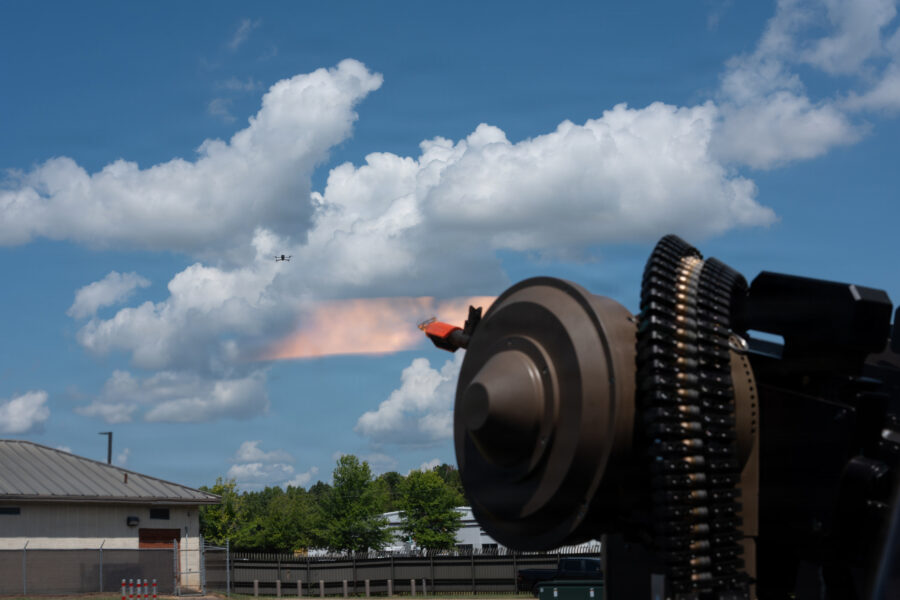
Air Combat Command is looking for defense firms capable of providing a private counter-drone service, complete with the personnel to operate it, for defending air bases across the Air Force.
ACC, which oversees the service’s Point Defense Task Force, is conducting a market survey to identify companies specializing in counter-small unmanned aerial systems defense technology that can provide “C-sUAS as a Service,” according to an Oct. 13 solicitation.
According to the solicitation, the intent of the service model is to:
- Provide organic, resilient, sustainable, and agile Point Defense capabilities across Department of the Air Force installations
- Implement a flexible, scalable architecture allowing installations to scale operational capacity up or down based on dynamic threat levels
- Leverage mature, commercially available or rapidly adaptable systems rather than initiating high-risk developmental programs
The market survey comes as the Air Force races to develop an arsenal of capabilities to defend its installations against drone threat.
“The Government envisions an initial prototype deployment at two designated Continental United States Air Force installations, with option mechanisms to scale across additional ACC installations upon proven performance,” the document states.
Interested firms have until Oct. 31 to respond to the solicitation. ACC is interested in companies that can provide technology for detecting, tracking, and identifying drones—ranging from small quadcopters to larger, Group 3 systems like the Iranian Shahed one-way attack drones that weight up to 1,320 pounds—at distances of up to five miles from a base perimeter, the document states.
Firms should also be capable of incorporating “government-approved kinetic and/or nonkinetic” effectors that range from radio frequency jamming to directed-energy such as lasers and high-powered microwave systems, the document states. Interested defense firms would also have to show they would continuously refresh software and hardware “within a multiyear service contract without frequent contract modifications,” according to the document.
ACC would also want a commercial capability to have the built-in logistical support to be self-sufficient for up to 96 hours, the document states.
The concept would require the contractor to “provide a complete, integrated, turn-key service solution covering materiel, personnel, training, sustainment, and ongoing modernization,” the solicitation states.
It’s unclear how this commercial service would align with the service’s intent to create a new point defense career field for enlisted Airmen, training and equipping them to defend air bases from drone and missile attack. The Air Force is slated to start designating Airmen with the new specialty within two years. As a short-term fix, the service has established point defense flights, specialized units of roughly 20 Airmen each, trained to rapidly deploy to hotspots and defend air bases against drone attacks.
Currently, the Air Force is equipping installations with the Small Unmanned Air Defense Systems, or SUADS, for countering drones. The system is capable of identifying and tracking enemy missiles or drones of multiple sizes, and downing incoming drones with an electronic warfare weapon. To stop missiles, it uses both electronic warfare and kinetic effectors. It can also interface with commercial counter-drone systems and other air defense systems, depending on the needs of a commander.
The service is also acquiring additional counter-drone systems through the Pentagon’s Joint Interagency Task Force 401. In the future, counter-drone technology will fall under the “point defense weapon system,” a classification to manage multiple counter-drone systems that range from sensors, radars, and command and control architecture to kinetic and non-kinetic effectors for disabling or destroying incoming drones.