
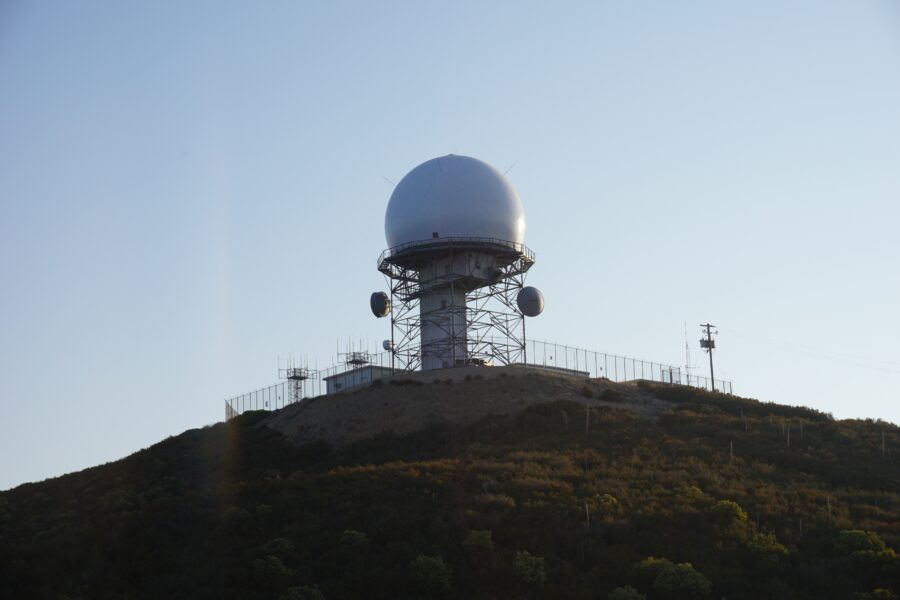
The Air Force is looking to replace the three-decade-old radar warning system that protects the coastlines and borders of the United States and a few remote locations.
A Sept. 21 notice from the Air Force Life Cycle Management Center seeks sources for new technology to continue the Air Route Surveillance Radar-4’s mission and potentially improve its technology.
The notice’s details are classified, but AFLCMC updated the original notice Oct. 13, according to Sam.gov.
The number of radars needed to replace the 44-radar network and the price for those replacements has not yet been determined and will come via market research, Air Force Materiel Command spokesperson Mark Wyatt told Air & Space Forces Magazine.
There is also no development timeline publicly available, though responses to the sources sought notice are due by Oct. 21.
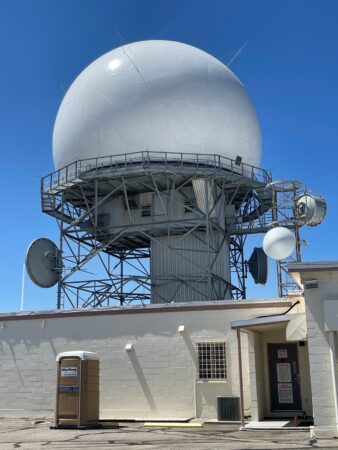
Wyatt said AFLCMC is requesting an instrumented range of 250 nautical miles, identical to the current ARSR-4.
ARSR-4 helps operators distinguish aircraft or potential missile threats from other radar “clutter,” which is more prevalent at lower altitudes. While historically the radar has been very effective at this task, newer additions to the cluttered landscape, namely wind farms, can distort the radar’s ability to “see” clearly.
“Wind farms are one of many sources of clutter that any solution would have to address,” Wyatt said. “The Air Force is not prescribing any technique to solve this long-standing challenge for radars.”
Interested industry parties can continue to pair their replacement option with the existing Monopulse Maintenance Surveillance Radar or replace that radar with another solution, Wyatt said.
The MMSR works with the ARSR-4 to “interrogate” aircraft transponders it detects by sending out coded radio frequency pulses that the transponder then responds to.
Using the monopulse method, the MMSR can determine an aircraft’s azimuth from a single pulse received from the transponder, instead of needing multiple hits when sweeping the area.
The MMSR is mounted on the ARSR-4, and they rotate together as they monitor the skies.
ARSR-4 Locations
- Ajo, Ariz.
- Bootlegger Ridge, Mont.
- Bucks Harbor, Maine
- Caribou, Maine
- Cross City, Fla.
- Deming, N.M.
- Eagle Peak, Texas
- Empire, Mich.
- FAA Academy (Training Site), Okla.
- Falls City, Ore.
- Finley, N.D.
- Fort Fisher, N.C.
- Fort Green, Fla.
- Gibbsboro, N.J.
- Jedburg, S.C.
- King Mountain, Texas
- Lake Charles, La.
- Lakeside, Mont.
- Makah, Wash.
- Melbourne, Fla.
- Mica Peak, Wash.
- Mill Valley, Calif.
- Morales, Texas
- Mount Kaala, Hawaii
- Mount Laguna, Calif.
- Key West, Fla.
- Nashwauk, Minn.
- North Truro, Mass.
- Oceana Naval Air Station, Va.
- Oilton, Texas
- Mount Santa Rosa, Guam
- Paso Robles, Calif.
- Rainbow Ridge, Calif.
- Remsen, N.Y.
- Riverhead, N.Y.
- Rocksprings, Texas
- San Clemente Island, Calif.
- Slidell, La.
- Tamiami, Fla.
- Tyndall Air Force Base, Fla.
- Vandenberg Space Force Base, Calif.
- Watford City, N.D.
- Whitehouse, Fla.
- Guantanamo Bay Naval Base, Cuba
An Aging Platform
The Air Force purchased most of the existing 44 radars in the 1990s, upgrading the previous 1, 2, and 3 models that have monitored the skies since the late 1950s.
The Raytheon-built ARSR-1 entered service in 1958 and was first used to manage the exploding growth of civil aviation. It had a 170-200 nautical mile range. That early system used the Army/Navy/Fixed Radar Surveillance-20 and later variants of the AN/FPS-66. In the 1960s, Raytheon produced the ARSR-2, which improved maintenance and reliability factors. That radar was the AN/FPS-115.
Both the ARSR-1 and -2 ran on vacuum tubes.
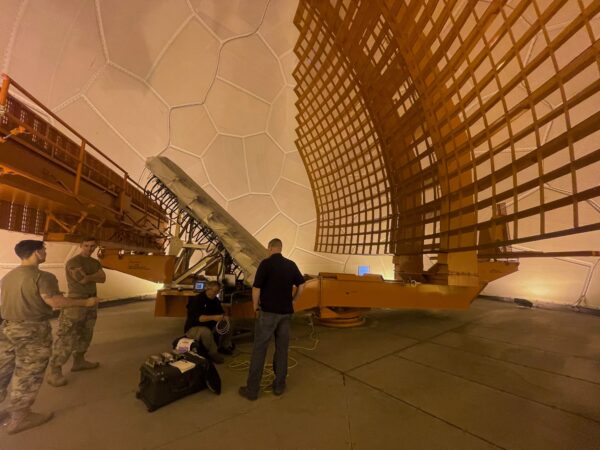
Westinghouse Electric Corporation built the AN/FPS-130, the radar base of the ARSR-3, fielding it in the 1970s and extending detection ranges beyond 240 nautical miles; it was incorporated into joint military-civil air defense networks.
The ARSR-4, also built by Westinghouse and commissioned in the 1990s, was the first radar in the family to offer three-dimensional target tracking. That capability allows users to simultaneously measure a target’s range, azimuth, and altitude. The system also provided advanced look-down/clutter rejection capabilities for military operations.
Northrop Grumman acquired Westinghouse in 1996, rolling the company’s radar and electronic warfare programs into its Electronic Systems sector.
While the ARSR-4s monitor the perimeter of the country, Guam, and Guantanamo Bay, Cuba, for the U.S. interior, the FAA manages a network of Common Air Route Surveillance Radars. The CARSR has an estimated 200 nautical mile range.
The complete CARSR system replacement rollout concluded in 2015. The rollout maintained the legacy sites, towers, and mechanical controls while refitting the internal electronics of the radars.
One ARSR-4 location has a strategically vital area to protect: Watford City, N.D., is 165 miles from Minot Air Force Base, N.D., home of the 91st Missile Wing, and 263 miles from Malmstrom Air Force Base, Mont.—putting hundreds of ICBM silos in its range.
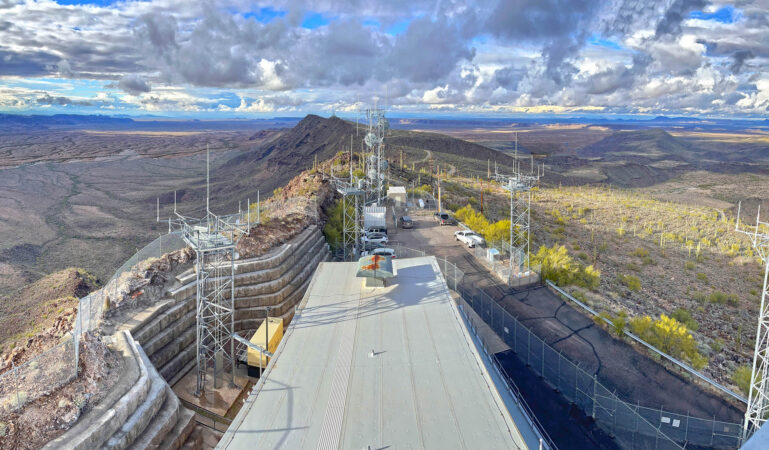
A Larger Network
The ARSR-4 system is one piece of a larger detection system used to track incoming threats.
The Air Force and NORAD used the AN/FPS-117 and AN/Transportable Phased Array System-77, both of which serve as northern warning systems out to 250 nautical miles. These systems are specifically designed for extreme cold weather, such as in their locations in Alaska and northern Canada.
The Space Force operates the AN/Frequency Precision and Quantization-16 Perimeter Acquisition Radar Attack Characterization System, which tracks missiles and precision space objects out to about 2,000 miles. USSF also operates the AN/FPS-108 COBRA DANE to track missiles out to 2,000 miles and high-altitude space objects at 25,000 miles.
The Space Force’s 20th Space Surveillance Squadron at Elgin Air Force Base, Fla., operates the AN/FPS-85 Phased Array Radar, which can track objects beyond 22,000 miles.
NORAD is also currently building and deploying high-frequency systems to detect hypersonic missiles with over-the-horizon radar, modernizing the Northern Warning System and building a polar over-the-horizon radar network.
The Homeland Defense OTHR, which kicked off in 2022, is being funded by both the United States and Canada at an estimated $6-7 billion and $3.1 billion, respectively. Initial Operating Capability is slated for 2028-29, with Full Operational Capability targeted for 2031.
Canada’s Polar OTHR is expected to cost up to $3.5 billion and is a slice of the nation’s estimated $38.6 billion overhaul of its portion of NORAD.
The polar project is currently in the site procurement phase, with operational deployment planned for 2029 and FOC by 2033.
The U.S. Northern Warning System Modernization project “Crossbow” could cost up to $6 billion, and the system rollout is expected to last until 2028, with the project concluding in 2035.
The High-Altitude and Mobile Near-Space Surveillance Systems has a $4.2 billion contract ceiling and is currently in field testing and initial low-altitude deployments. It is expected to achieve full cloud-based command-and-control network integration by 2028.