
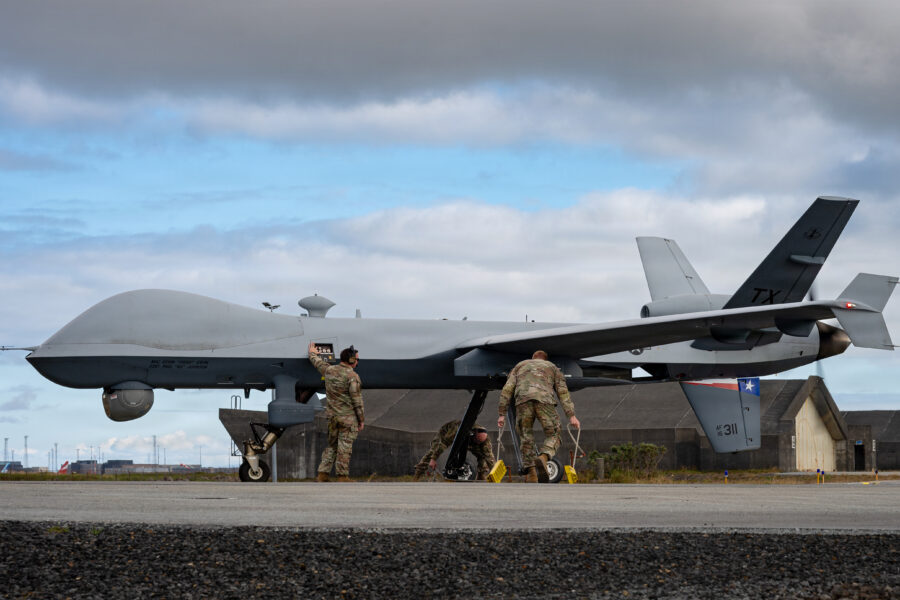
The Air Force will field operational prototypes for an autonomous drone to replace its MQ-9 Reaper in 2028, Secretary of the Air Force Troy Meink said Oct. 14.
“We’re going to be fielding operational prototypes by ’28, and we’re just awarding the contract now,” Meink said during a panel discussion with Secretary of Defense Pete Hegseth, other service secretaries, and senior Pentagon officials at the annual AUSA conference in Washington. “That’s the speed of what we’re fielding capability, and into production—large-scale production—starting in ’29. That is the goal.”
An Air Force spokesperson confirmed to Air & Space Forces Magazine that Meink was referring to the Massed Modular Aircraft, the planned successor to the Reaper.
“The autonomous fighters are already in production,” Meink said, in reference to the Air Force’s Collaborative Combat Aircraft program. General Atomics’ FQ-42A Vengeance and Anduril Industries’ FQ-44A Fury have been selected for production and are undergoing testing with the Air Force’s Experimental Operations Unit at Creech Air Force Base, Nev.
“Now we’re looking at essentially the autonomous strike platform, the autonomous bomber,” Meink said, referring to MMA. The aircraft is envisioned as a multimission aircraft, like the MQ-9, that can conduct strike missions as well as intelligence, surveillance, and reconnaissance. In contrast, CCAs are currently focused on an air-to-air role paired with crewed fighters.
Meink previously announced at AFA’s Air, Space & Cyber conference that the Air Force would field 100 MMAs by 2029 and 500 by 2032.
Air & Space Forces Magazine reported Sept. 30 that the Air Force and Pentagon’s Defense Innovation Unit had narrowed the field for MMA down to seven companies. An Air Force spokesperson declined to confirm any selections, but Meink said Oct. 14 that “we just awarded those contracts … in collaboration with DIU.” He did not name the specific companies or say how many finalists there are.
Sources have told Air & Space Force Magazine the seven companies still in contention are Anduril, Chaos Industries, General Atomics, Grid Aero, Otto Aerospace, Shield AI, and Swarm Aero. They will develop their MMA candidates and submit a proposal to build a prototype.
The Air Force and DIU want each MMA drone to cost $10 million for the base aircraft, not counting the sensors, weapons, or other equipment it may carry. That’s half the $20 million target price the Air Force envisions for CCAs. MMAs will also use open architecture so they could be more easily upgraded with new sensor packages or weapons capabilities.
But while MMAs will have some autonomous capabilities, they won’t be built with all the latest cutting-edge technology in a bid to keep their price down below that of CCAs. They will likely be powered by turboprop engines, for example.
MMA drones are intended to be able to fly about 4,000 miles, twice the range of CCAs, and carry a heavier payload than CCAs. But they will be slower than CCAs.
The MMA effort is part of the broader push by the Pentagon and the Air Force to field more autonomous systems at a lower cost than crewed platforms, or even the drones that are in service today. The goal is to build “combat mass” to counter China’s growing military, which Meink said is going through “the largest weapons buildup probably in the history of the world,” and to respond to the proliferation of autonomous systems in conflicts of today, and the Pentagon’s view, tomorrow.
“There’s no question that there’s a shift coming,” Meink said. “It’s adaptability, scalability, and affordability. The only way we’re going to meet the threat is with autonomous systems.”
Meink said the Pentagon will work with Congress to secure the funding needed for MMA. The Trump administration’s $1.5 trillion fiscal 2027 budget request for the Department of Defense is currently stalled on Capitol Hill. With midterm elections approaching next month, Democrats could take control of one or both chambers, which could lead to congressional gridlock, particularly surrounding the Pentagon’s request for a massive budget increase—and plans to continue that—amid the war with Iran. The DOD plans to devote tens of billions to autonomous warfare just this fiscal year.
Meink acknowledged the uncertainty surrounding the Pentagon’s budget, but expressed confidence the Air Force would be able to hit its targets for MMA.
“It is heavily dependent upon the resources we get from the Hill, but I think we are not only going to deliver significant combat capability, but we’re going to deliver quickly and efficiently,” Meink said.
“We’ve got to make sure this stuff is affordable,” Meink added, referring to efforts across the Air Force and Space Force. “We’ve got to make sure we’re buying it efficiently. And depending on how you do the comparisons, we’re talking five to 10 times cheaper to field some combat power with these autonomous systems compared to not. So it’s critically important. The good news is, in my mind, there’s no question that the leadership we have in the Air Force, in the Space Force, both military and civilian, is ready to do that. And you see that with the results already. We are integrating autonomous fighters into experimental ops units out at Creech right now, from a year from when they first flew to when we were integrating them into experimental ops units. That’s unheard of. And it only took two years to build the first one.”
The goal for MMA is similarly ambitious.
“It’s in the scalability and the producibility,” Meink said. “In many ways, cost goes with schedule. If something is super expensive, there’s a reason for it, which means it’s probably going to take a long time to build, so we’re really focusing on rapid production and scalability, which means we have to get the cost down on these systems as well.”
Meink’s comments came during a panel focused on the Pentagon’s Project Agincourt, a drive to accelerate the fielding of autonomous systems and create a new four-star Autonomous Warfare Command, or AUTOWARCOM, which Hegseth announced during a speech late last month.
“The folks who acquire it need to be right there up with the warfighter at the same time who understand how to iterate it and change on and innovate on it,” Hegseth said.
Adversaries such as Russia and Iran have fielded one-way drone attacks to wreak havoc in Ukraine and across the Middle East. Ukraine has used autonomous systems to great effect to defend against Russia’s invasion. Kyiv’s ongoing and thus far successful Operation Vivaldi offensive has relied heavily on the innovative use of drones, including dropping uncrewed ground vehicles behind enemy lines.
“That’s a different battlefield,” Hegseth said. “We’ve learned a lot from Ukraine, but you can’t use everything that’s in Ukraine because of all the Chinese components involved in it. So you’ve got to be able to ensure that we take the best of that and the lessons learned … and then push it through [with] an AUTOWARCOM commander with four stars who has the ability to drive that change. So we’ve done a lot with acquisitions and a lot with industry from day one to modernize, realizing this is the future of warfare.”