
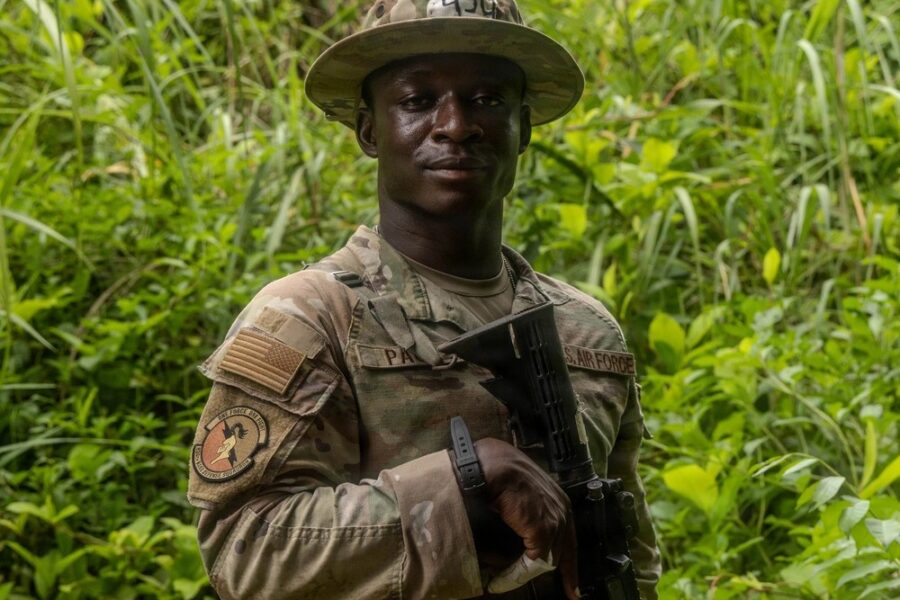
The U.S. military’s newest jungle school has been an “embrace the suck” course for Marines and Soldiers since opening in January—not anymore. Staff Sgt. Duchaine Paul just became the first Airmen to graduate the rebooted jungle warfare course in the punishing Panamanian jungle.
A Security Force Airman assigned to the 824th Base Defense Squadron at Moody Air Force Base, Ga., Paul struggled alongside Soldiers, Marines, and Panamanian security forces personnel for 18 grueling days in April and May, learning jungle survival and combat tactics at the Jungle Operations Training Center-Panama, according to an Air Force press release.
Two more “defenders” from the 824th are scheduled to attend the next class, and Tactical Air Control Party and Pararescue Jumper Airmen assigned to XVIII Airborne Corps units at Fort Bragg, N.C., Fort Campbell, Ky., and Fort Drum, N.Y. have submitted packets to attend future rotations of the course, officials at JOTC-P told Air & Space Forces Magazine.
The new U.S.-Panamanian jungle warfare course was reestablished in 2025 and officially opened in January to prepare service members for the rigors of combat in jungle environments, like those found in the Pacific theater. It’s an updated version of the original U.S. Army course that was held at the Jungle Operations Training Center at Fort Sherman, Panama, from 1953 until Sherman was turned back over to the Panamanian government in 1999. The new course is held at Fort Sherman’s former location, now called Aeronaval Base Cristóbal Colón, Panama.
The Panamanian jungle is known for its extreme heat and humidity, heavy rainfall, swarming insects, poisonous snakes, and dense, rugged terrain that is impassible in some places.
The three-phase course is similar to the original course except that Panamanian instructors now teach phase one, which focuses on jungle skills such as knot-tying, shelter-making, and water purification that are critical for operations in demanding, triple-canopy jungle conditions.
Phase one also requires students to complete a series of swim tasks in the Combat Water Survival Assessment, wearing standard combat uniform, boots, fighting load carrying equipment, and a rubber M4. In the same uniform, students must complete a timed land navigation course as well as a five-kilometer, or three-mile, run in under 40 minutes.
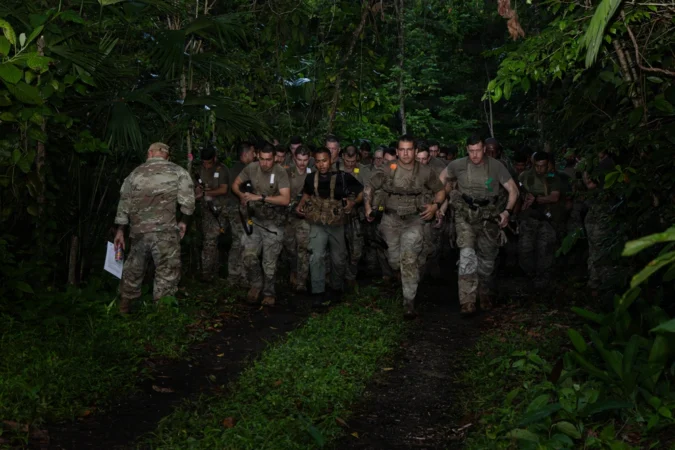
U.S. instructors lead phase two of the course, which covers individual movement techniques and small-unit infantry tactics adapted for limited visibility conditions and restrictive jungle terrain. The phase covers ambushes, casualty evacuations, and waterborne operations such as river crossings. The scenarios challenge teams of U.S. and Panamanian students’ decision-making under stress, according to the course’s fact sheet.
In phase three, student squads go through a three-day jungle exercise that includes tasks such as attacking an enemy mortar position, conducting ambush and reconnaissance missions, and finally the “Green Mile” course—which is actually about three miles long—that features obstacles and other challenges that require teamwork to complete.
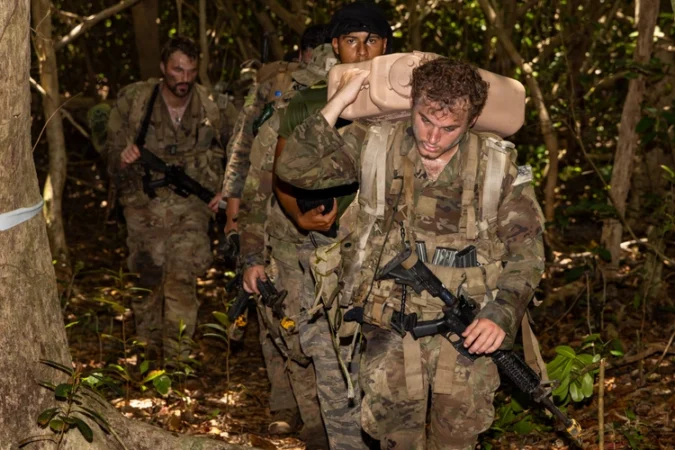
Throughout the experience, students cope with traversing a landscape of steep hills and hanging vines and branches, often covered in needle-like thorns that tear uniforms and puncture leather gloves. The jungle floor is either covered with thick, sticky mud or numerous hidden trip hazards. Large, aggressive ants and other biting insects add to the misery.
“You’re struggling,” Paul said in the press release. “You see your buddy just barely making it; it’s a good option to just laugh at each other like, ‘yeah, I cannot believe we’re here right now.’ You just keep pushing.”
“Those difficult moments of the course are what kept me going through every single day,” he added.
Before attending the course, Paul was in Panama attached to the 474th Air Expeditionary Group, Detachment 1, training with Panama’s presidential security force. Paul’s unit, the 824th, is part of the 820th Base Defense Group that’s tasked with providing “specialized light maneuver forces to enable global airpower operations in high-threat environments,” Col. Megan Hall, commander of the 820th BDG, said.
“The difference between security forces Airmen and 820th BDG defenders is their primary in-garrison mission is to train to deploy. This priority drives training opportunities available to them such as Ranger School, Pathfinder School and the Combined Jungle Operations Course in Panama. These training [courses] enable our defenders to better integrate with joint forces downrange.”
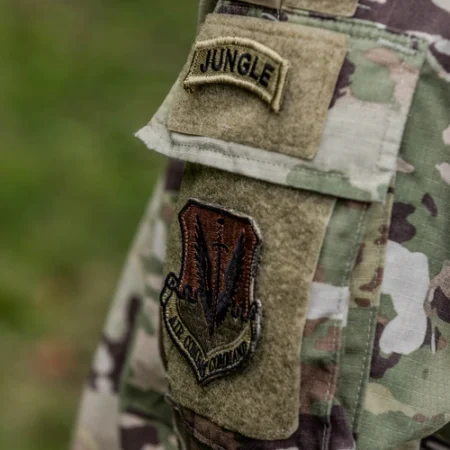
Paul is actually the second Airmen to go through the course. The first did not meet all the criteria to graduate and receive the Jungle Tab, course officials said.
Air Force 1st Lt. Jeanna Daessleer, the mission commander of the 474th’s Detachment 1, was not surprised that Paul made the cut to graduate.
“He was absolutely the right Airman for this opportunity and excelled throughout the course,” Daessleer said in the press release. “While several members were medically and physically qualified to attend the course, he distinguished himself through his professionalism, teamwork, and the relationships he built with our partner force.”
So far, the JOTC-P has held three official courses since February. Out of the 115 U.S. service members who have attended the course, 71 have met all requirements and graduated. Another 36 students were allowed to complete the course and received a certificate of training, course officials said.
Airman and Guardians who are interested in attending JOTC-P can visit the Army Security Cooperation Group-South websire for the course for details about requirements and information on how to submit an application package. Slots are approved as they come in, course officials said, stressing that the main challenge that delays students is failing to follow all the required steps for being granted country clearance into Panama.