
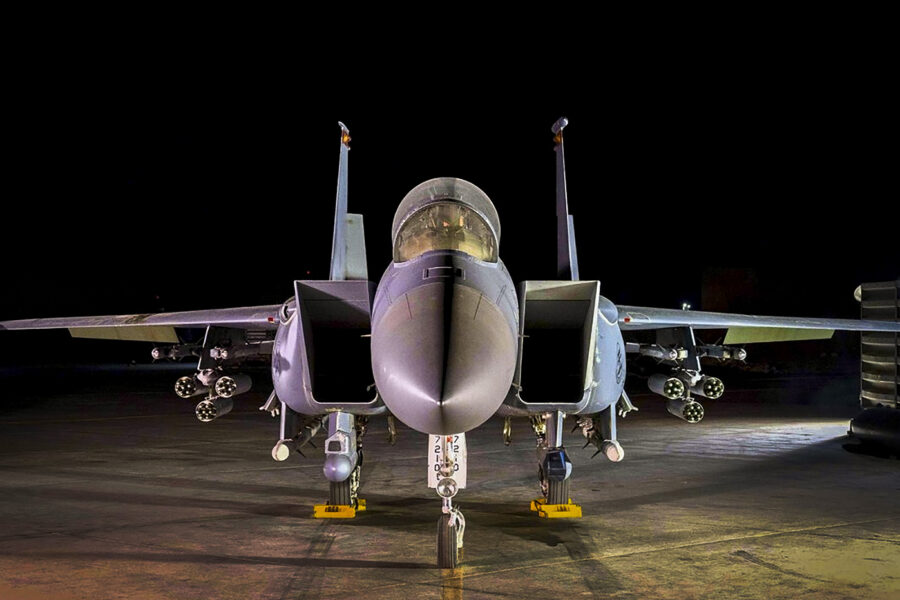
NATIONAL HARBOR, Md.—As the threat of Iranian-made drones rose in recent conflicts, the Air Force rushed last year to equip F-15E Strike Eagles in the Middle East with a cheap, cost-effective way of defeating them.
The Air Force Test Center was able to field the new capability—laser-guided rockets—in roughly a week, the head of the center revealed at AFA’s Air, Space & Cyber Conference here Sept. 16.
It’s not the first time the Air Force has turned to this solution, known as the Advanced Precision Kill Weapon System, to neutralize enemy one-way attack drones and cruise missiles.
APKWS was originally designed as an air-to-ground capability, with a laser-guided kit added to Hydra-70 rockets to turn the system into a precision-guided munition.
The Air Force explored using the rockets in an air-to-air role in 2019, testing the system on the F-16 Fighting Falcon. For a few years, the experiment was considered nothing more than a proof of concept, not a real-world capability.
But as the use of Iranian drones was expanded, the program gained new urgency. The system was rushed first to F-16s in 2024 and then prioritized for F-15Es in 2025. Nine days after testing began in May of last year, the system was being equipped on Strike Eagles overseas, said Brig. Gen. Mark A. Massaro.
“At the end of the first week, we had demonstrated, both in a developmental and an operational sense, that it was a usable capability, and we deployed that capability at the end of the first week,” Massaro said. “We deployed that capability into theater. We deployed some of our maintainers and some of our testers into theater to help the first week.”
The initiative is an example of the Air Force Test Center’s ability to quickly “bridge between raw concept and decisive combat-credible power,” said Massaro. He was involved in tests of APKWS in his previous role as commander of the 96th Test Wing, which conducts developmental testing of weapons for the service, and worked alongside the 53rd Wing, which conducts operational tests.
The need for the system was clear. The Air Force had relied on expensive, radar-guided AIM-120 AMRAAM missiles and infrared-guided AIM-9 Sidewinders against Tehran’s relatively cheap Shahed one-way attack drones. AMRAAMs cost roughly $1 million each, and AIM-9s cost hundreds of thousands of dollars depending on the variant. The most capable model is the AIM-9X, which costs around $500,000.
The issue came to a head with a mass Iranian drone and ballistic missile attack aimed at Israel on April 13, 2024. Tehran, which sought to flood the zone, launched a barrage of drones, ballistic missiles, and cruise missiles to confuse and overwhelm Israel’s air defenses—some 300 projectiles in all.
The U.S. had anticipated the engagement, and F-15Es from the 335th Fighter Squadron and 494th Fighter Squadron carried up to eight air-to-air missiles each as they sought to intercept the drones over Iraq along with F-16s from the 121st Fighter Squadron. The Iranian drone barrage was so heavy that many fighters quickly exhausted their air-to-air missiles, and three F-15E crews attempted—unsuccessfully—to drop laser-guided JDAM bombs on drones.
While U.S. fighters had helped to defeat the barrage, it was an expensive proposition, which led to the effort to adapt APKWS rockets, which cost roughly $35,000 according to Air Force officials.
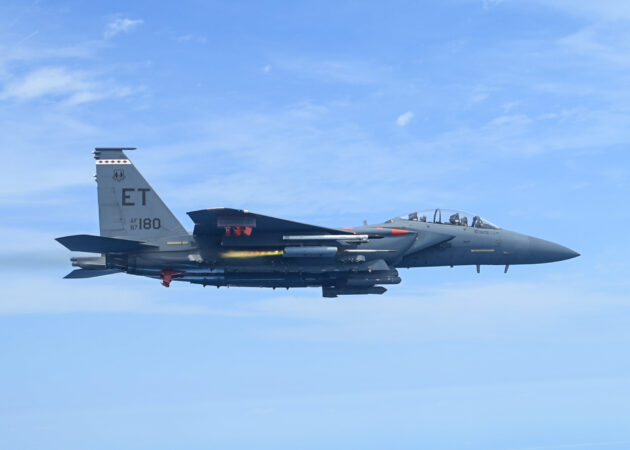
Dubbed the AGR-20F FALCO, the air-to-air APKWS rockets were first used in an air-to-air configuration on F-16s in 2024.
After that, work began at Eglin Air Force Base, Fla., to equip the system on F-15Es. That occurred in mid-2025, led by 96th Wing’s Air Force Seek Eagle Office, known as AFSEO, which had earlier integrated the system into F-16s.
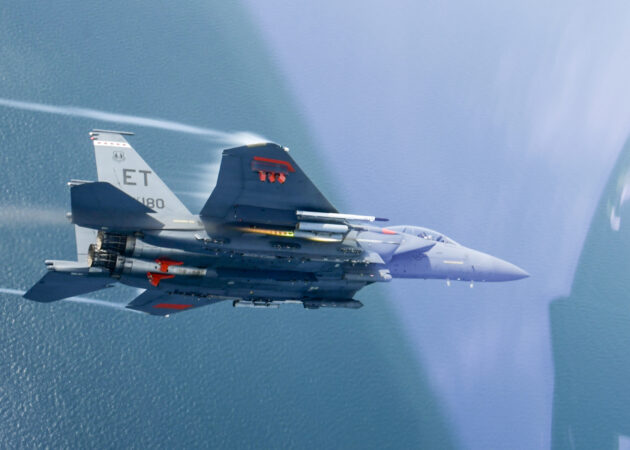
“This was a very integrated test approach between operational and developmental,” Massaro said. “We were overlaying … missions on exactly the same day with each other and flying them together. That second week, where we have our maintainers and some pilots in theater, our operational testers are still refining some of the tactics, and we’re able to then through phone and digital means transmit the upgraded tactics. And then, so at the end of that second week, they had updated tactics, they had equipment, they had everything ready to go, and they were able to use it very quickly after that.”
Early last year, the team initially struggled to find a way to mount the rockets on the F-15E and connect them to the aircraft so they could be fired. In May 2025, a solution was found, and the integration became the top priority for the 96th Test Wing and 53rd Wing at the base, according to Air Force officials.
Aircrew from the 40th Flight Test Squadron and the 85th and 422nd Test and Evaluation Squadrons flew test missions and conducted live-fire tests at targets over land and water.
After the initial demonstrations, the 53rd Wing and 96th Test Wing deployed to deliver equipment and provide training to Airmen to use the new weapons. While the Air Force has declined to identify the location where the system was first fielded, U.S. officials confirmed to Air & Space Forces Magazine that air-to-air APKWS was first used in the Middle East, which is part of U.S. Central Command.
In 2024, Air Forces Central began to equip its F-16s to shoot down drones in the Middle East with APKWS rockets, which were employed to defeat threats from the Houthis in Yemen.
A U.S. F-16 scored its first rocket kill of a drone that year. In October 2024, the 480th Expeditionary Fighter Squadron from Spangdahlem Air Base, Germany, deployed to the Middle East with an advance but limited heads-up that they would be equipped with APKWS for air-to-air use against drones and cruise missiles.
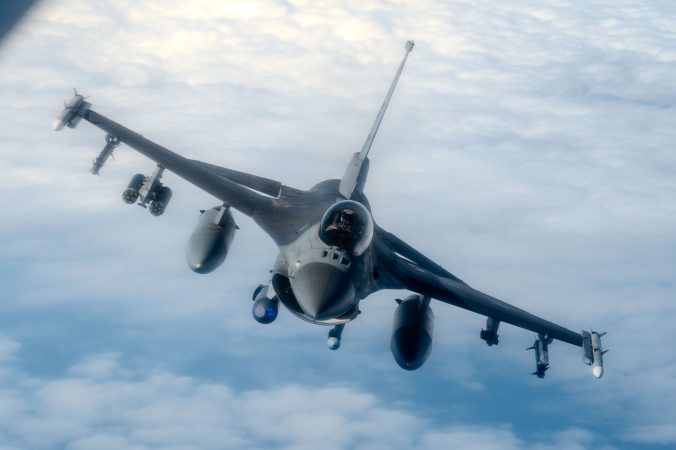
“The first rocket kill was announced just prior to getting there. This was all new and innovative,” Lt. Col. William “Skate” Parks, the unit’s commander, recounted in a December 2025 interview with Air & Space Forces Magazine. “We have these rockets come online. It’s a brand new thing, and we’re the ones doing it. And it’s with guys who are now spending every minute of their day when they’re not flying actual combat missions, preparing and improving on this. It showed because that success rate just started really becoming amazing with these rockets as we’re defending partners and our own forces.”
The 480th scored dozens of kills using the rockets. It also used older AIM-9M Sidewinders, claiming the first air-to-air kill by an AIM-9M in over 30 years, and 108 total aerial kills of drones and cruise missiles during the deployment. News of the success quickly trickled across the Air Force.
By April 2025, U.S. Air Forces in Europe incorporated the APKWS into its air-to-air training for F-16s, Air & Space Forces Magazine previously reported. U.S. fighters based on the continent not only routinely deploy to the Middle East, but also increasingly must be wary of Russian drone incursions into NATO airspace. The F-16 experience helped speed up the use of the APKWS as a drone-buster on the F-15E, Massaro said.
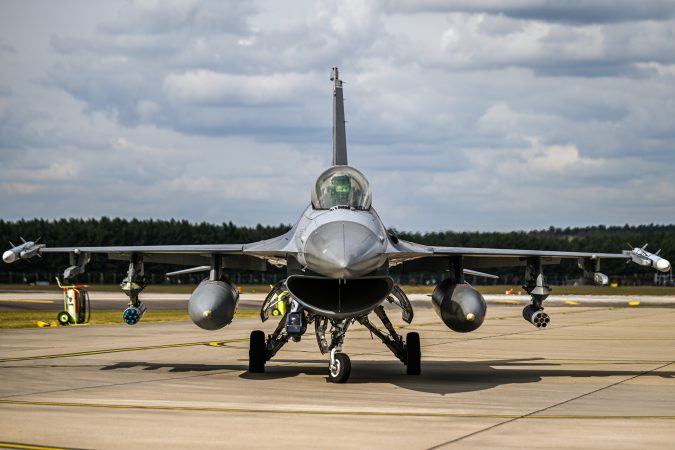
“A lot of things had already occurred,” he said. “The F-16 had already integrated APKWS and was flying with that for about a year, so we knew how the system itself worked. We had that knowledge. The F-15E is a known quantity.”
APKWS rockets come in pods of seven, and multiple rocket pods can be fitted. F-15Es can carry up to 42 APKWS rockets. To guide an APKWS rocket, the target must be laser-designated or “lased,” unlike more expensive “fire-and-forget” missiles. This means air-to-air use of the rocket pods is best suited to defeating slow-flying targets such as one-way attack drones.
The work to put APKWS on the F-16 and F-15E would pay off in more than just cost savings for the Air Force. After the start of Operation Epic Fury on Feb. 28, Iran has fired more than 6,000 drones and 1,500 ballistic missiles, with numbers growing, U.S. officials said. What two years ago was an extreme outlier is now a routine threat.
F-16s flying in the area around the Strait of Hormuz, Persian Gulf, and Gulf of Oman, where Iran has repeatedly used drones and missiles to attack ships including U.S. Navy vessels, are flying with APKWS rocket pods to hunt down drones. U.S. Army Apache helicopters can fire APKWS rockets in an air-to-air role too, another recent capability fielded by the military. The U.S. also needs to protect its bases in the Middle East.
The former head of Air Forces Central, Lt. Gen. Derek C. France, said the use of APKWS was a key development during his tenure, which ended last month.
“From a technical aspect, it’s ‘Hey, I need more weapons on my jet,’ and that’s what the APKWS gives you: a pod of seven of those things versus a single AIM-9. You can shoot down a lot more drones when they’re coming in swarms,” France said in a recent interview with Air & Space Forces Magazine. “From an operational perspective, there’s not just the magazine depth of an individual airplane, which I care about, but I care about the magazine depth of the theater and making sure that, across the theater, I’ve got wings with the right weapons in the right place and get them in the air where they can defend their bases. … There’s the cost curve, which is significant as well.”
And the proliferation of the drone threat is only increasing, U.S. military officials and experts say, making further advancements necessary.
“I would say that APKWS is a step in the right direction, but it can’t be the final step,” France said. “The two things that we need to focus on are air domain awareness at range: where are the drones coming from? How many are there? What’s their target? What do I know about them? And then magazine depth, both individual airplanes and theater-wise, to have enough to shoot them down in a layered defense kind of way. So both of those are important.”
“This drone problem is not going away. It’s accelerating in tactics, speed, advancements, and the numbers,” France added. “That’s the direction that we’re going.”
