


Operation Epic Fury marked the U.S. military’s largest air campaign in a generation, with strikes on 13,000 targets in Iran before the first in a series of shaky ceasefires began in April. Now, even as hostilities continue to flare up, the former commander of Air Forces Central sees several clear lessons that highlight the challenges of major combat operations today, compared to decades of counterterrorism operations in the Middle East.
“A lot of things surprised me in a good way,” said Lt. Gen. Derek C. France, who completed his tour last month as Air Forces Central commander and the Combined Forces Air Component Commander for U.S. Central Command on Aug. 4. “The joint partnership is actually really strong.”
The close coordination between Airmen and the Soldiers operating Patriot anti-missile defenses was a bright spot in the face of Iranian missiles and drones launched at air bases across the Middle East. He was impressed by wings’ ability to quickly resume flight operations after those attacks.
“We had bases generating sorties,” France told Air & Space Forces Magazine. “Occasionally, we’d have to make some adjustments on tankers to make an effective sortie. But I never had a base that said, ‘We are not effective and we can’t meet the next three or four [windows] of ATO tasking.’ … At a macro sense, it was not a factor.”
One area France singled out for improvement: the logistical system for supplying munitions, which was insufficient in the early days of the war, forcing France to “meter the use of weapons over time.”
“Our logistics system needs some serious revamping as far as its flexibility,” France said. “You would have cases where bases say, ‘Hey, I’ve got all these bomb bodies, but I can’t use them because I don’t have the tail kits yet.’”
The need to augment base self-defense was another key lesson from the conflict. CENTCOM had not had to contend with such threats since the 1991 Desert Shield/Desert Storm campaign, when Saddam Hussein launched the notoriously unreliable Scud missiles against the allies arrayed against him. The modern threat, defined by repeated waves of attacks featuring multiple missiles and drones, is entirely different. U.S. Patriot missiles and THAAD interceptors successfully defeated most threats, but some weapons got through, leaving room for improvement in U.S. defenses.
“From a base defense standpoint, we’ve still got some gaps as far as long-range air domain awareness, so you’re not surprised by things once they’re in your base defense zone,” France said. “We need to focus on air domain awareness at range. Where are drones coming from? How many are there? What’s their target? What do I know about them? … This drone problem is not going away. It’s accelerating in tactics, speed, advancements, and the numbers. That’s the direction that we’re going.”
Building command centers underground, so they have some inherent self-protection, deserves consideration, France said.
“You have to have some C2 element that’s survivable underground, and if you’re going to generate airpower, you need something where your aircrew can actually get some sleep and extract themselves from that potential,” France said. “You can’t harden everything. But I do think your critical C2 nodes and your prioritized way of being able to get underground is huge.”
France took over command of AFCENT on April 18, 2024. It was a memorable debut: Expecting to fly commercial to Doha, Qatar, on April 13, his flight was canceled after Iran launched a barrage of ballistic and cruise missiles against Israel. American F-16s, F-15Es, and coalition fighters defended the U.S. and regional allies, blasting Iranian drones out of the sky.
Then Israel launched its counter-attack, and the U.S. had to move assets around the region. “After doing the change of command that [first] morning, I got to bed at 7 a.m. the next morning,” France recalled.
France was still Combined Forces Air Component Commander for Operation Rough Rider in spring 2025 against the Houthis and for Operation Midnight Hammer in June 2025, when U.S. B-2 bombers attacked Iran’s nuclear sites. Then came Operation Epic Fury, which raised the stakes beginning Feb. 28 when the U.S. launched what would become the biggest air offensive in 35 years.
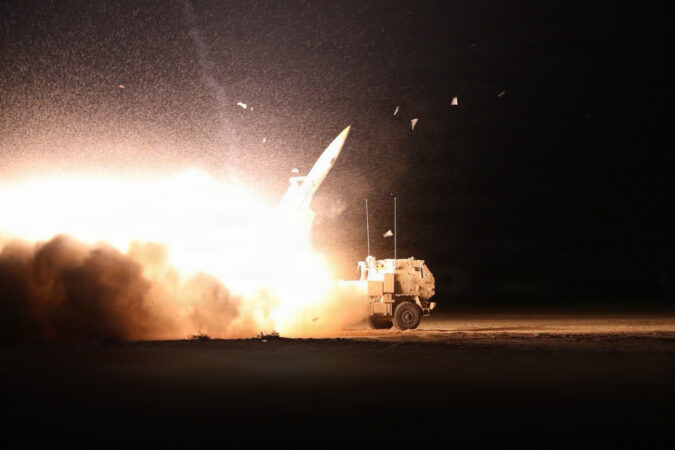
As the CFACC, France and the Combined Air Operations Center directed the strikes into Iran, including from Navy aircraft, ships using sea-launched Tomahawk land-attack cruise missiles, and Army HIMARS launchers firing ATACMS and PrSM surface-to-surface missiles.
“The scope and scale of this forced a single, what I would term an ‘integrator’ of fires,” France said. “I think the CAOC over time got much better at integrating fires.”
Operating from a safe CAOC at Shaw Air Force Base, S.C., France and his staff rapidly generated Air Tasking Orders to keep up with the pace of the war.
“It’s got to have a procedure to have those numbers of very deliberate, thought-out, planned targets, and then there are emerging things that are dynamic that show up at the last minute inside that cycle, and the trick is to be flexible enough to prioritize those and to execute against those if warranted, or if it’s not a high priority, feed it back into the bigger cycle,” France said.
The punishing waves of airstrikes continued for a time but have now been largely supplanted by an American economic pressure campaign as Iran tries to assert control over the Strait of Hormuz. Now in its seventh month, the conflict demonstrates the challenge the U.S. military faces in recalibrating its thinking from decades of counterterrorism operations to a major theater war against a reasonably sophisticated adversary with ties to Russia and China.
The U.S. struck more than 13,000 targets, 4,000 of which were dynamic, from Feb. 28 to an initial ceasefire in early April. Iran has fired more than 1,500 ballistic missiles and 6,000 drones, with numbers growing as Tehran continues to attack ships in the Strait of Hormuz, U.S. officials said. Air Force Chief of Staff Gen. Kenneth S. Wilsbach said Sept. 14 at AFA’s Air, Space & Cyber conference that around 500 combat aircraft executed around 250 sorties a day, adding up to about 10,000 sorties over 38 days at the height of the conflict.
“The technical aspect, intelligence aspect, and logistics requirements of the Global War on Terror are hugely different from having large numbers of forces executing major combat operations,” France said.
”It’s a drop in the bucket,” he added.
Over years of fighting militant groups in Iraq, Afghanistan, Syria, and Yemen, the U.S. honed its ability to find, track, and attack “high-value targets,” such as terrorist leaders, while operating largely without risk of airborne attack. Fighting Iran, which has proven able to launch wave after wave of attack, is on a completely different scale.
“I use the analogy with the other component commanders of the difference between using a sniper rifle and a belt-fed machine gun,” France recalled. Being a sniper, he said, “is a very patient game of finding a pattern of life against something that has a high payoff.” But Iran is something different. Against Iran, U.S. airpower had to operate at a “scope and scale to make sure we’re taking care of the ballistic missile threat,” France said. “We’re servicing a high volume of targets of the defense industrial base. We’re looking at coastal defense cruise missiles, radars, all those things that have to do with the industrial base, and the Strait of Hormuz.”
Balancing control and flexibility for air wings was one of his challenges. “The goal of the air component commander and the CAOC is to put out guidance that’s specific enough that it gives them something to hang their hat on, but isn’t so specific that it ties their hands,” France said. “It is something I worked through as conditions changed.”
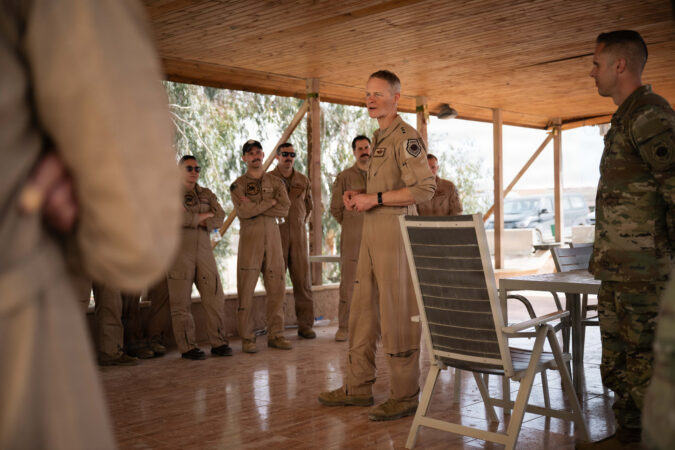
“What I challenged the CAOC to do is plan—have some flexibility for a mission commander, but don’t make him do all the planning,” France added. “You’re shooting for a pretty tight gap there because if you don’t give enough flexibility, the mission commander has no plan and may not have crew rest or time to plan it. If you overplan it now you’ve painted him into a box, and he goes, ‘Well, I can’t adjust my route, I can’t adjust my timing.’ I got both sets of feedback.”
With frequent confrontations with Iran and the militias supported by Tehran, the Middle East has been the most kinetic of all the U.S. military theaters. And it is also a region in which personal relationships pay dividends in coordinating with partner forces.
Yet the U.S. military continually rotates staff and leaders rapidly through those assignments, with the CFACC on two-year rotations and most staff rotating in and out of roles every six to 12 months.
That should change, France said. “You’d think you would get fresh eyes on the problem and new blood every six months—and so you really should be postured to change,” he added. “But it has the opposite effect: People come in and are like, ‘We do things a certain way. I’m sure it’s for a good reason. I don’t want to come in within six months, figure it out after a month, and then rock the boat for a couple of months.’”
“I struggled to get the needle to move, to actually get permanent party manpower,” he said—without success. Airmen performed admirably, however, doubling down to meet the moment.
“The tenacity, innovation, and courage of Airmen serving in the arena” is noteworthy, France said. “Warfare is a human endeavor, and AFCENT Airmen rose to the occasion—and were the secret weapon needed to win.”