


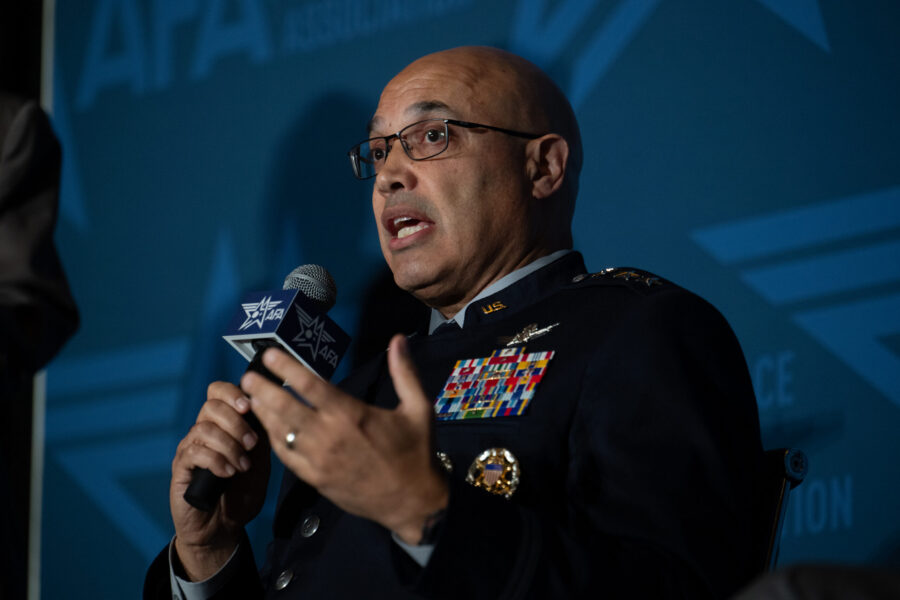
The White House has nominated Lt. Gen. David N. Miller Jr. to lead U.S. Space Command, succeeding Gen. Stephen Whiting, who is expected to retire by January 2027.
A notice of Miller’s nomination for promotion to general appeared in the Congressional Record on Sept. 29, but the notice did not include an assignment. U.S. Space Command and the Space Force both confirmed Sept. 30 that Miller has been tapped for the SPACECOM commander job.
“Congratulations to Lt. Gen. Miller on his nomination to serve as Commander, U.S. Space Command,” Chief of Space Operations Gen. Douglas Schiess said in a statement. “He is an exceptional Guardian who has represented our service with distinction, and we believe he is a strong candidate for this critical joint leadership role.”
Miller, currently the Space Force’s deputy chief of space operations for strategy, plans, programs, and requirements, is a career space operator. He served as commander of Combat Forces Command—then Space Operations Command—from 2024 to 2025, and was director of operations, training, and force development at U.S. Space Command before that. Earlier in his career, he was chief of the Space Control Division within Air Force headquarters, led weapons and tactics development for the 21st Operations Group, and was an intercontinental ballistic missile operator and instructor.
His nomination would make him SPACEOM’s fourth leader since the command was reestablished in 2019, and its third to hail from the Space Force. Charles Galbreath, director of the Mitchell Institute’s Spacepower Advantage Center of Excellence praised Miller as a “straightforward leader” and said he’s glad to see another Guardian in the top SPACECOM job.
“The unique relationship between the space-focused service and combatant command is undeniable,” Galbreath said. “I look forward to seeing that partnership continue to mature under the leadership of Gens. Schiess and Miller.”
If confirmed, Miller would take the reins of the command as the U.S. military’s reliance on space capabilities both in peacetime and in combat takes center stage—and as leaders increasingly emphasize the role of offensive operations in the domain.
Top Pentagon officials have said military space assets and SPACECOM forces played a key role in operations against Iran, providing electronic warfare, navigation, missile warning, and communications capabilities. Speaking at AFA’s Air, Space & Cyber Conference on Sept. 14, Air Force Secretary Troy Meink revealed that the Space Force has “space control weapons”—the Defense Department’s most direct acknowledgement to date that the U.S. operates offensive systems in orbit.
Miller will also oversee construction of SPACECOM’s first purpose-built headquarters at Redstone Arsenal in Huntsville, Ala., and the accompanying relocation of personnel and operations from Peterson Space Force Base, Colo. The new facility is in the midst of a phased transition slated to conclude in 2031.
Whiting, the current SPACECOM commander, has been at the helm since January 2024. During his tenure, he has been a vocal proponent of better space domain awareness capabilities, a stronger space “kill chain,” and more dynamic, maneuverable satellites. In a recent speech at the AMOS Conference in Maui, Hawaii, he advocated for improved space-based target tracking and detection capabilities, which he said are foundational to the military’s ability to effectively perform space control operations.
“To be able to negate threats in space, we must be able to find, fix, track, and target those threats,” Whiting said Sept. 16. “Targeting in the space domain is maturing, but it still has a long way to go.”