
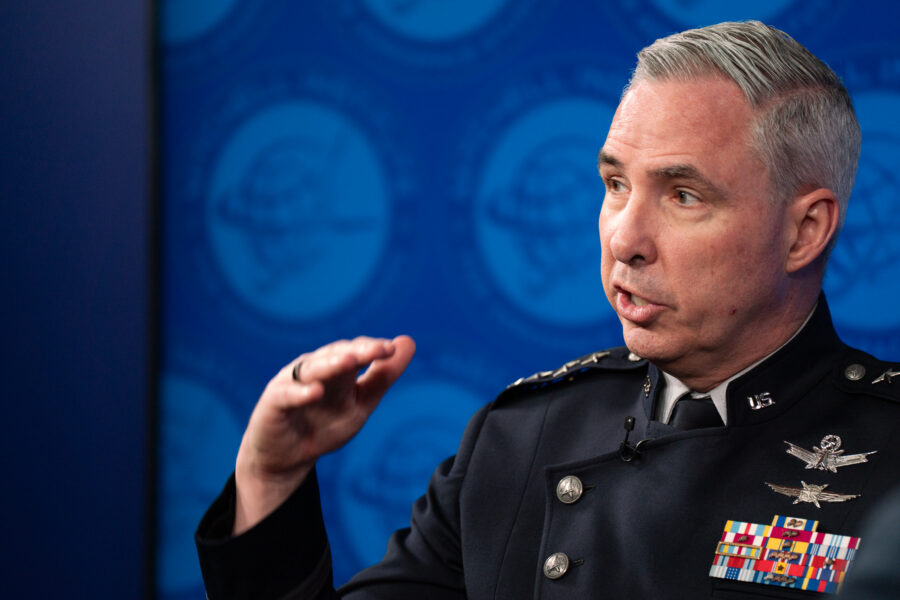
The Space Force revealed this week that it has space control weapons on orbit, but the head of U.S. Space Command said the U.S. still has “a long way to go” in improving its ability to detect and target threats in the domain.
“To be able to negate threats in space, we must be able to find, fix, track, and target those threats,” SPACECOM Commander Gen. Stephen Whiting said Sept. 16 at the AMOS Conference in Maui, Hawaii. “Targeting in the space domain is maturing, but it still has a long way to go. We don’t have robust target folders like the joint force does in other domains.”
Space domain awareness, which is the military’s term for being able to see and understand what’s happening in the environment, is foundational for military operations on orbit. The better the data, the better decisions commanders can make about how to move through the domain and respond to threats that might impede that freedom of maneuver.
In a roundtable with reporters following his speech, Whiting said there has been some progress within the Space Force to improve the quality and quantity of its object tracking data. However, key shortfalls remain, and closing those gaps is a top priority for his command.
“Do I have all the track quality that I need at all times? No,” he said. “And that is why, in my current list of gaps that we every year go through a process to analyze, in my top five, we have a need for improved space domain awareness for space engagements.”
Whiting highlighted three examples of areas for improvement:
- better integration of commercial and allied data
- stronger linkages between sensors, command-and-and control systems, and effectors, including space weapons
- expanded ground- and space-based surveillance capabilities
Whiting said that while data quality from both commercial industry and U.S. allies has improved significantly in recent years, integration issues and unstable funding have made it hard to take full advantage of those improvements.
“I want to be able to take commercial data, data from our allies, and get it into our programs of record today,” he said. “Right now, we can’t do that. We take that commercial and allied data and do an incredible job of processing it, but in a parallel way to our programs of record. We’ve got to be able to close those two together, for example, to make progress here.”
Fixing that integration challenge, he said, would represent “the biggest initial step we could take—and we could take that in the short term.”
Whiting also highlighted longstanding challenges around tying together the sensors that collect and process information, the C2 systems that analyze it, and the “effectors” that act on that intelligence. Combined, that string of systems makes up what’s called a “space kill chain,” and the Space Force has been focused on closing gaps in key parts of that architecture—many of them classified—for the past few years.
“We really need the acquisition organizations in the services who are delivering space domain awareness sensors, command and control systems, and effectors to work horizontally to make sure that we’re closing the kill chain by providing the space domain awareness target-quality track that the command and control systems and the effectors require to be effective,” he said. “We must be able to reach across all of these vertical program offices to make sure they deliver as an intact kill chain.”
Longer term, Whiting said, there’s a need for better surveillance of orbits beyond geosynchronous, to include cislunar pathways between the Earth and the moon.
“We want to see that scale beyond geosynchronous orbit … out to cislunar space and be able to maintain track of objects in those areas so that we’re not operationally surprised,” he said.
