
U.S. Africa Command will soon see if a small, autonomous aircraft can evacuate casualties from austere locations during a demonstration planned for December in Morocco.
Merlin, an autonomous aviation firm, announced Nov. 11 it has received a $500,000 contract from AFRICOM for the demo mission, set for “early fiscal year 2027,” In a subsequent release, the company said it is planned for early December.
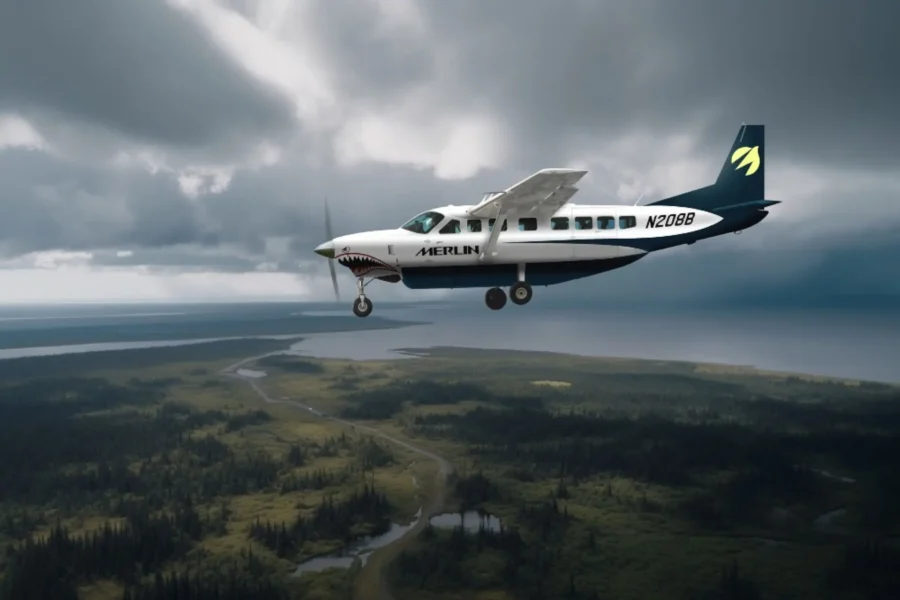
During the demo, a Cessna 208B Grand Caravan modified with Merlin’s autonomy system and an air-ambulance medical module, will take off, fly, and land autonomously at an “austere casualty collection site,” according to a company release. After a “simulated patient loading,” the aircraft will once again fly autonomously back to its home location.
AFRICOM first invited industry and academia to participate in an autonomous casualty evacuation “challenge” in July, noting that it had a “casualty evacuation gap.”
Casualty evacuation, or CASEVAC, refers to the transportation of wounded personnel from the battlefield or their unit’s location to a location that can provide more advanced emergency medical treatment.
AFRICOM “operates across vast distances where terrain, threat, limited infrastructure, weather, competing aviation demands, and long lines of communication can delay casualty movement,” the challenge sheet stated.
While Africa is the second-largest continent in the world, AFRICOM has one of the smaller force postures among the combatant commands and a relatively small budget. Air Force Gen. Dagvin R.M. Anderson, commander of AFRICOM, noted in congressional testimony this May that the command has seen a 75 reduction in its regional posture over the past decade. Since 2024 alone, U.S. forces have withdrawn from bases in Chad, Niger, and Somalia.
Despite this, counterinsurgency operations continue across the continent. In 2026, AFRICOM has launched dozens of airstrikes against the terrorist group al-Shabaab and conducted ground operations in Nigeria.
In such an environment, casualty evacuation can be tricky. Merlin says its autonomy system will be able to plan the optimal route based on a tasking order, replan based on threats or hazards as they pop up, communicate with air traffic control, and continue along its route even if its communications link goes down.
What’s more, because Merlin is using a Cessna, a patient in a litter can be loaded “without rotor wash, winching, or special equipment,” the company noted—the Air Force’s main casualty evacuation platform is currently the HH-60W helicopter.
AFRICOM’s interest in autonomous CASEVAC isn’t just about limited manned platforms—the command also noted that it hopes to “reduce or eliminate exposure of pilots, aircrew, vehicle crews, and medical personnel during casualty movement.”
The Air Force has in recent years explored the idea of unmanned, autonomous aircraft for medical evacuations and search and rescue through its Agility Prime program and a Strategic Funding Initiative program cofunded with the Army. The concept made the leap onto the battlefield in Ukraine recently, with two Ukrainian troops getting airlifted out of the combat zone via specialized drones.
The U.S. military has also expressed an interest in smaller, autonomous cargo aircraft more generally, and industry has responded with a glut of offerings. In September, Merlin and planemaker Textron Aviation unveiled their plan for a cockpit-less Cessna equipped with Merlin’s autonomy software and a nose hatch opening to a cavernous cargo bay. Competitors Reliable Robotics and Joby Aviation have also modified Cessnas.
Merlin touts its autonomy system as “aircraft-agnostic” and said its CASEVAC demo could pave the way to scale the capability on the larger Beechcraft King Air aircraft. The firm also says the demo is building on work it has already done testing autonomy on the even bigger C-130J for another combatant command, U.S. Special Operations Command.
The CASEVAC mission will “serve as a proving ground for autonomous aviation more broadly,” Merlin CEO and Founder Matt George said in a statement. “Long distances, intermittent communications, and austere environments are among the most demanding conditions in which the military operates, and they are not unique to any one theater. A system proven under these conditions could support casualty evacuation, logistics, and personnel movement for other combatant commands, allied forces, and civil operators, as well as disaster response and medical transport missions worldwide.”