
Private investment firm AE Industrial has acquired a majority stake in L3Harris’ space propulsion business and plans to re-establish it as Rocketdyne, reflecting its 61-year heritage building rocket engines.
Kristin Houston, previously president of space propulsion and power systems within L3Harris’ missile solutions portfolio, will be the stand-alone firm’s CEO. Under the terms of the $845 million transaction, which closed Aug. 4, L3Harris will retain a 40% stake in the new company.
“With demand across the company’s markets accelerating, driven by geopolitical competition and record government investment in space, Rocketdyne is meeting this moment with world-class talent, proven technology, and trusted customer relationships already in place,” the company said in a statement. “AE Industrial’s focused investment and active partnership will support Rocketdyne in deepening its role as an indispensable supplier to the space and defense industrial base.”
The company now known as Rocketdyne was originally established in 1955 and ownership has changed multiple times since. Formerly part of Pratt & Whitney Rocketdyne, it was acquired by GenCorp in 2013 to form Aerojet Rocketdyne, becoming a leading producer of solid rocket motors and space propulsion, electronics, and power systems.
Lockheed Martin announced plans to buy the firm in 2020, but withdrew after the Federal Trade Commission filed suit to block the acquisition. The FTC argued the deal would eliminate a key independent source of solid rocket motors at a time when the industrial base was shrinking. Two years later, L3Harris bid for the firm, successfuly closing on the deal for Aerojet Rocketdyne in 2023.
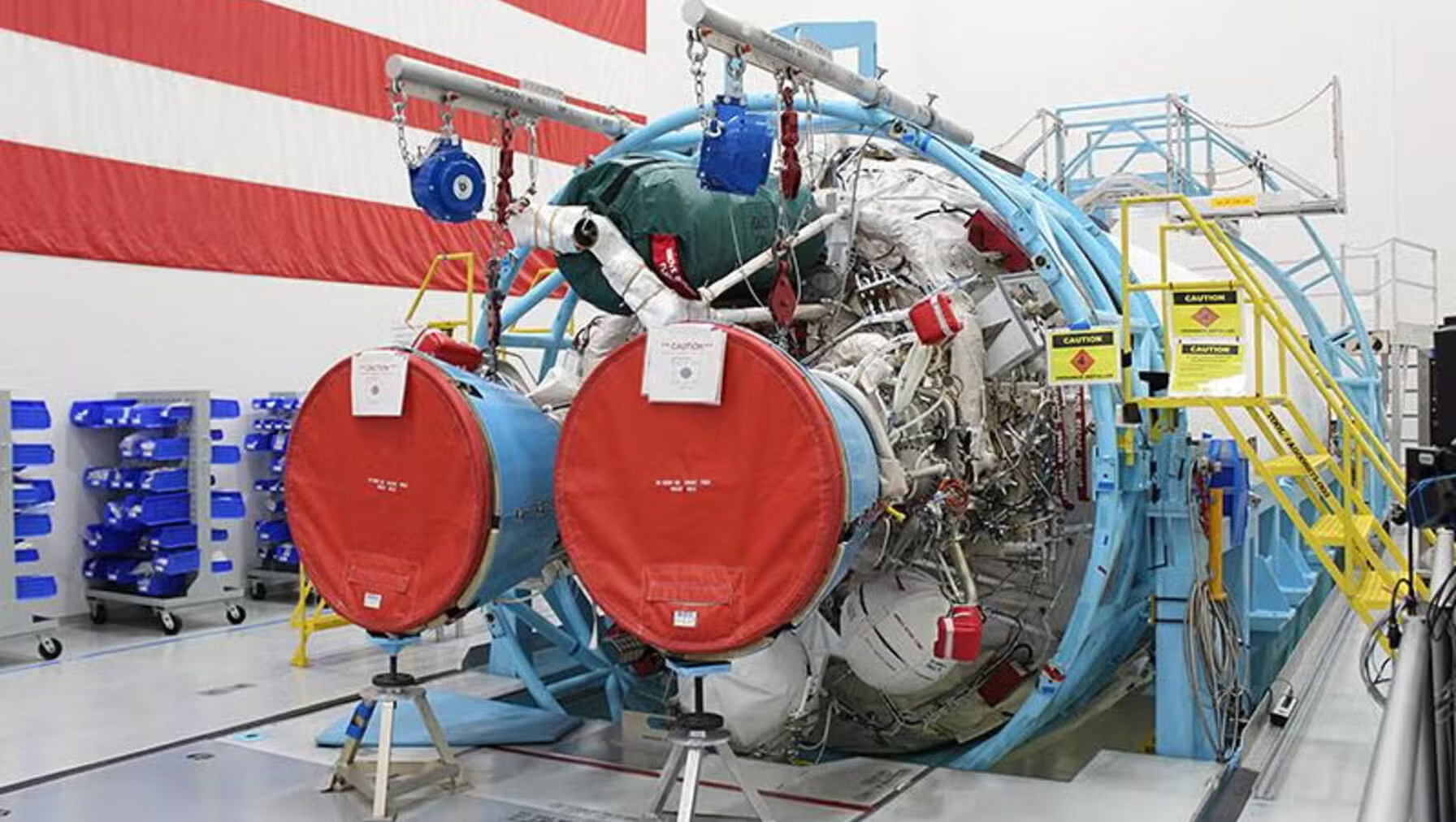
L3Harris announced last year it would sell off its majority stake in Aerojet Rocketdyne’s space propulsion business but maintain ownership of the RS-25 engine, which powers NASA’s Space Launch System. The new Rocketdyne, meanwhile, will focus on its RL10 upper stage engine—which powers United Launch Alliance’s Vulcan rocket—as well as other in-space propulsion products that are becoming a growing focus for the Space Force as it looks for more ways to maneuver satellites across orbital planes and regimes.
Speaking with reporters prior to announcing the deal’s closure, Houston said Rocketdyne’s new independence will make it more agile and adaptable—and allow it to venture into new markets.
“We can move faster, make decisions closer to the customer, and pursue opportunities that simply weren’t available to us inside a larger organization,” she said. “We’re also expanding how people think about what we do. Yes, we’re the proven leader in propulsion, but we also bring world-class space electronics and power systems, including nuclear systems, to the conversation.”
Houston said the company has “very specific plans” to streamline its processes and increase investment in high-demand product lines so it can respond more quickly to customer needs with off-the-shelf capabilities, though she declined to discuss them further.
Rocketdyne’s competitors in the space propulsion market includes established defense prime, such as Northrop Grumman, as well as newer firms, such as Impulse Space, which the Space Force just chose to participate in its National Security Space Launch program.
Houston said the company is well positioned to compete with those firms across a number of growth areas, including dynamic space operations, space control, and cislunar operations. She also highlighted Rocketdyne’s history in nuclear propulsion; in 1965, it launched an experimental nuclear-powered satellite called Snap 10A into Earth orbit.
Houston said Rocketdyne continues to develop nuclear electric and nuclear thermal propulsion technologies, an area of particular interest for both the Defense Department and NASA. In April, the White House’s Office of Science and Technology Policy outlined a strategy to pursue several demonstrations over the next few years to explore in-space nuclear propulsion, directing the Pentagon to “pursue deployment of a mission-enabling mid-power in-space reactor by 2031.”
“We have a lot of solutions today already, and I think really we’re looking to capitalize on these growing areas by getting more efficient, streamlined, faster responsiveness, and then also the continued focus on evolving our products to meet our customers’ needs,” she said.
The company is headquartered in Melbourne, Fla., and will maintain the space propulsion workforce that was formerly part of Aerojet Rocketdyne, approximately 1,300 employees. Houston said the company is developing growth plans to keep up with the demand they see coming from the Pentagon and other customers.
“We’re streamlining our decision making,” she said. “We’re investing for the long term to scale our manufacturing capacity. We’ll continue to invest in our workforce. . . . and then we are working on our plans for how we scale at speed to support the demand coming.”
