
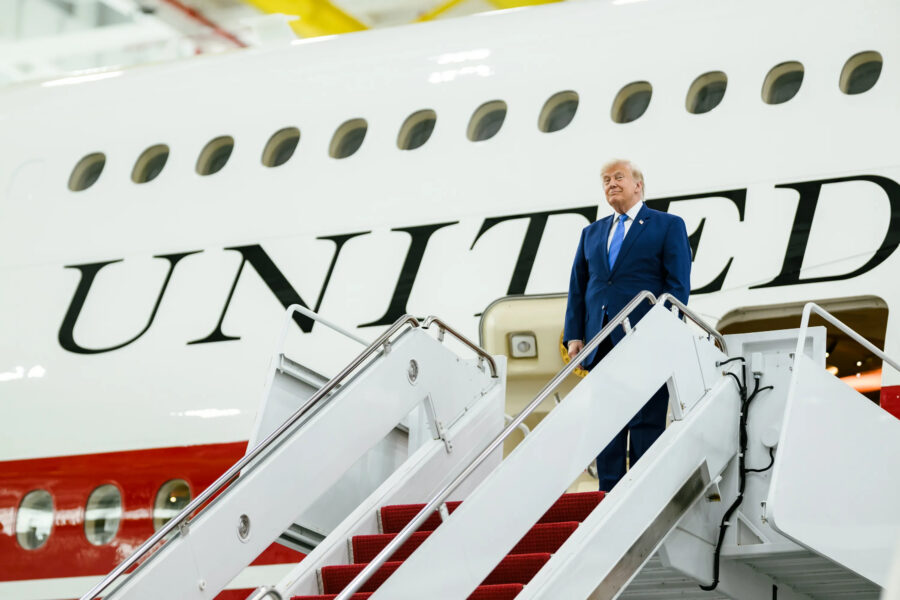
President Donald Trump said July 19 the new “bridge” Air Force One will soon receive additional modifications amid reported concerns about the state of its defensive capabilities.
“It has a lot of capability,” Trump told reporters at Joint Base Andrews, Md., after being asked about a potential lack of defensive measures on the modified Boeing 747-8, controversially gifted by Qatar’s rulers to the United States last year and rapidly transformed into a presidential transport aircraft. “As I understand it, in about a month or so, they’re going to send it to have it be maxed out.”
Trump did not detail what those additional capabilities might entail, though he said “they’ll have it back, I think, in about a month.” An Air Force spokesperson declined to comment to Air & Space Forces Magazine.
Trump’s comments come a month after the so-called Bridge VC-25B” was officially delivered to Andrews for commissioning flights June 19 and about a week and a half after the President’s trip to Turkey in the aircraft raised questions about its level of security.
Boeing has been working on the official replacements for the VC-25A, known as Air Force One when the President is aboard, for about a decade. But that program is years behind schedule amid supply chain crunches, personnel shortages, and other setbacks, stoking Trump’s ire.
Trump pushed to get the Qatar-gifted “Bridge” aircraft ready in time for the nation’s 250th anniversary festivities, and the plane took part in July 4 flyovers in Washington.
All told, the accelerated modification process for the Bridge plane took 10 months, far shorter than retrofits typically take to make a plane into the flying fortress a President typically uses. The Air Force has insisted that “no risk was taken in security, safety or mission communications” during the modification process, but the service has acknowledged that it “made trades on some of the less commonly used mission sets” that Boeing will have to fulfill for the permanent VC-25B.
Former Air Force Secretary Frank Kendall, who served during the Biden administration, told Air & Space Forces Magazine it’s unclear what additional work might be planned for the Bridge VC-25B. If Trump’s comment about this work taking roughly a month is accurate, Kendall said, that significantly limits how much more could be done with the plane.
Doug Birkey, executive director of AFA’s Mitchell Institute for Aerospace Studies, said in an interview that the work could include adding “off-the-shelf” antimissile systems to the plane. That could include a mixture of radio frequency jamming systems and infrared countermeasures designed to protect against heat-seeking missiles, Birkey said.
But adding the full suite of capabilities typically associated with the VC-25 to this plane, under such a time crunch, is likely not feasible, he said.
“They’re not going to do the full plus-up on this thing,” Birkey said. “It wouldn’t be available for his presidency.”
Trump flew on the Bridge aircraft to Turkey on July 6 to attend a NATO summit. But on July 8, as the U.S.-Iran ceasefire frayed and tensions between the two nations spiked, he unexpectedly switched to one of the older VC-25A Air Force One planes to fly out of Ankara. Trump said at the time he took the older plane “for old time’s sake” and had the Bridge VC-25 stop at RAF Mildenhall in England so troops there could see it.
The New York Times reported that day that the Secret Service urged Trump to use the older Air Force One due to security concerns. The Wall Street Journal on July 9 reported that Israel had shared intelligence with the U.S. indicating Iran had formed a new plan to assassinate Trump. Also on July 9, the Times reported the Bridge VC-25B lacks some defensive countermeasures available on the older model, such as advanced antimissile capabilities.
The following day, the Trump administration subpoenaed Times journalists over that story, aiming to force them to testify before a federal grand jury investigation into leaks. The Times reported that the White House put FBI Director Kash Patel in charge of that leak investigation, and Defense Secretary Pete Hegseth on July 13 announced a joint task force with the Justice Department to quash leaks in the Pentagon.
