
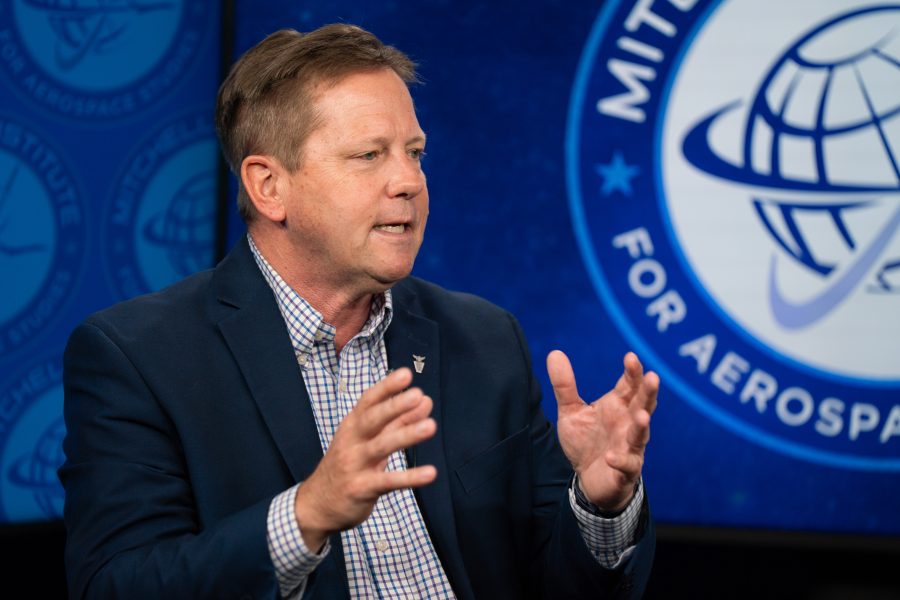
After four years leading the Space Rapid Capabilities Office, Kelly Hammett was named the new executive director of the Air Force Nuclear Weapons Center last week.
The center, headquartered at Kirtland Air Force Base, N.M., oversees the acquisition, sustainment, and modernization of gravity bombs, intercontinental ballistic missile, air-launched cruise missiles, and nuclear command, control, and communication systems. As executive director, Hammett will advise the center’s uniformed commander.
During his tenure at the Space RCO, Hammett managed a largely classified portfolio of high-priority space capabilities. Working closely with combatant commands and other end users, the office quickly develops and fields satellites and ground systems. Among its few publicized programs is the Remote Modular Terminal, a deployable satellite communications jammer.
According to a June 22 social media post from the Space RCO, during Hammett’s tenure the office’s workforce doubled in size, awarded dozens of contracts, and, in June 2023, launched its first payloads.
Hammett’s transition comes amid a major shakeup of the Space Force’s acquisition enterprise that could lead to the entire dissolution of the Space RCO. While the office was established in 2018 by Congressional mandate, the House and Senate Armed Services Committees have approved draft legislation that would allow the Space Force to eliminate both the Space RCO and the Space Development Agency and distribute their programs across the new acquisition structure.
The service appears poised to do so. Speaking in April, Air Force Secretary Troy Meink praised both offices as models for acquisition reform, and said the goal is for all Air Force and Space Force portfolio acquisition executives to operate “in a very similar fashion.”
Hammett has been vocal in his view that the Space RCO has a distinct role to play in space acquisition.
“From my perspective, I spent four years trying to build this world-class organization of highly trained acquisition hunter-killers, and we’re finally there,” he said during a NewSpace Nexus event in May. “I just hope that that is recognized and valued and maintained as this whole journey continues to move forward.”
Prior to leading the Space RCO, Hammett spent 20 years working on directed energy programs. In the early 2000s, he was director engineering for the Airborne Laser Program, a since-canceled effort to field a high-energy laser on an aircraft. He later served as director of the Air Force Research Laboratory’s directed energy directorate from 2016 to 2022.
