


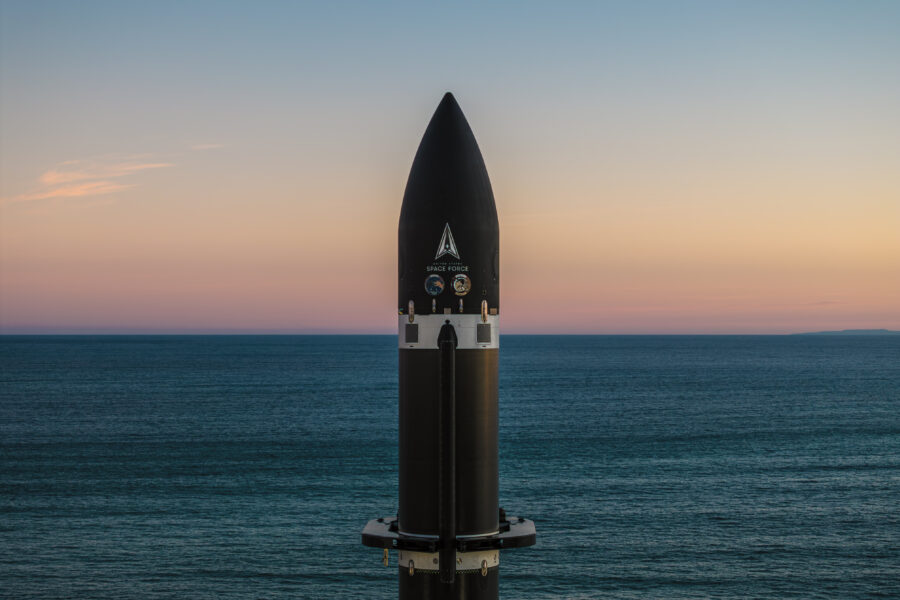
The Space Force started its second live Tactically Responsive Space mission June 19, working with a contractor to launch a satellite to low-Earth orbit in less than 17 hours. That spacecraft will now conduct a series of maneuver demonstrations with another vehicle.
The mission, dubbed Victus Haze, launched from Rocket Lab’s private spaceport on the Mahia Peninsula in New Zealand. In a release, Rocket Lab said its Electron rocket lifted off with its Pioneer satellite to low-Earth orbit early June 19, just 16 hours and 42 minutes after receiving launch orders from the Space Force—shattering USSF’s previous record of 27 hours.
Pioneer will soon begin a multiphased rendezvous operation with a second satellite already on orbit—True Anomaly’s Jackal spacecraft, which launched in early May on a SpaceX Falcon 9.
“With launch complete, the team will now complete on-orbit checkout and vehicle commissioning, after which RPO operations begin,” Space Systems Command said in a June 22 statement. “During these operations, the teams operating both the Rocket Lab and the True Anomaly space vehicles will conduct a variety of scenarios, demonstrating space domain awareness and characterization capabilities, each in dynamic engagements with the other.”
In its own statement, Rocket Lab said it activated and prepared its spacecraft for its first orbital maneuver in 37 hours and 36 minutes, well ahead of the Space Force’s 72-hour deadline. Meanwhile, True Anomaly said in a statement that its Jackal satellite is now fully operational and ready to support RPO missions.
“VICTUS HAZE will generate the data, operational experience, and institutional knowledge the Space Force needs to make TacRS a ready, repeatable capability,” the company said. “Every task that True Anomaly and Rocket Lab complete during this mission advances that goal.”
Although the Space Force confirmed the mission days after it lifted off, the service’s own space object database reported the satellite’s arrival in orbit as soon as June 20, according to Jonathan McDowell, as an astrophysicist who closely tracks on-orbit activity. McDowell reported that Rocket Lab’s satellite appeared to pass within about 100 kilometers of the Jackal satellite on the evening of June 19.
SpaceWERX and the Defense Innovation Unit awarded contracts in 2024 to True Anomaly and Rocket Lab to develop spacecraft for the mission. Rocket Lab provided its own rocket to launch its space vehicle, and True Anomaly contracted with Firefly Aerospace to launch Jackal on its Alpha vehicle. The mission was initially scheduled for 2025 but was delayed after Firefly’s Alpha rocket experienced multiple anomalies last year. Although Alpha returned to flight in March, True Anomaly opted to launch Jackal on a SpaceX rideshare mission.
A Firefly spokesperson told Air & Space Forces Magazine the firm will participate in future TacRS missions with its upgraded Alpha Block II rocket, which incorporates upgrades it developed following the mishaps last year. Firefly is already on contract for an effort called Victus Sol, but the spokesperson indicated it will fly Jackal on a separate mission in the future.
“Firefly continues to actively support the U.S. Space Force and, at the direction of Space Safari, is moving to a future Tactically Responsive Space mission that will utilize Firefly’s upgraded Alpha Block II launch vehicle and True Anomaly’s Jackal platform,” the company said. “This new mission will build on the lessons learned from VICTUS NOX, VICTUS DIEM, and VICTUS HAZE, and help shape the next generation of responsive space missions.”
The Space Force set records in 2023 with its first TacRS mission, Victus Nox, demonstrating that it could work with satellite and launch companies to deliver a spacecraft in a matter of months and deploy it to low-Earth orbit just 27 hours after receiving launch orders. Millennium Space Systems built the satellite and Firefly launched it.
Lt. Col. Lincoln Miller, system program manager for Space Safari, said the success of Victus Haze could lead to “rapid production and fielding of follow-on vehicles” from both companies. In the near-term, though, Space Force operators will have a chance to use the satellites for live training.
“Not only does this mission open the door for acquisition of follow-on vehicles that allow our warfighters to close critical gaps and seams in a conflict scenario, it also presents a more immediate value by giving our current operators a crucial opportunity to exercise and improve LEO RPO tactics, techniques, and procedures,” Miller said.
Beyond Victus Nox and Victus Haze, SSC has scheduled at least three more TacRS missions aimed at further pushing schedule boundaries as well as demonstrating concepts and fielding new capability. Slated to fly this year or next, they include:
- Victus Surgo, a mission cosponsored by the Defense Innovation Unit that will feature a SpaceX Falcon 9 launching a highly maneuverable spacecraft built by Impulse Space
- Victus Salo, another Falcon 9-supported mission that will carry a payload built by the Massachusetts Institute of Technology
- Victus Sol, launched by Firefly’s Alpha, which will carry an operational payload
The service also conducted a two-part tabletop exercise and field excursion called Victus Diem between summer 2025 and early 2026. The effort was designed to help solidify its responsive launch processes, like rapid payload processing.