
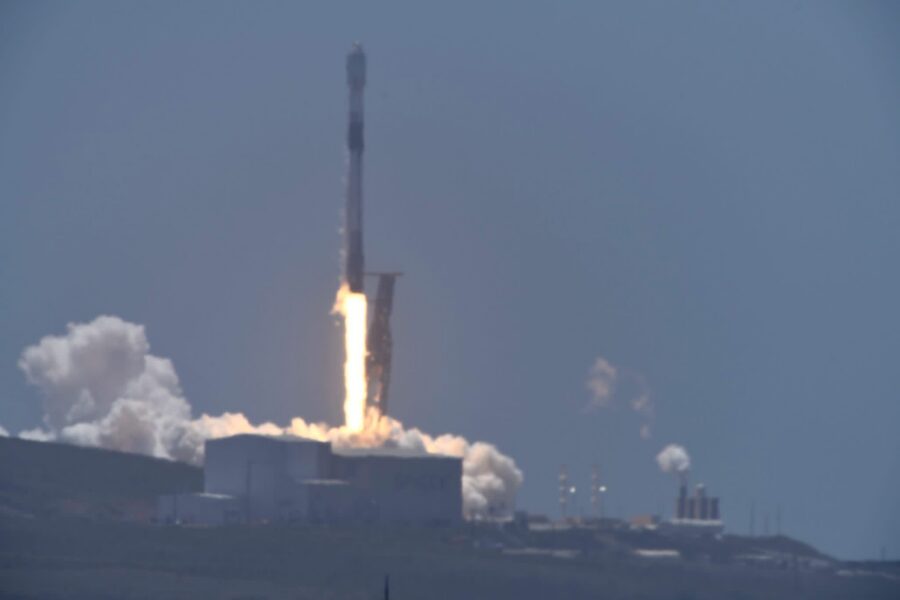
York Space Systems said it has confirmed the health of 21 satellites that launched July 16 as part of the Space Development Agency’s data transport constellation.
The spacecraft flew last week aboard a SpaceX Falcon 9 rocket from Vandenberg Space Force Base, Calif. Within a few hours of launch, York said, it made contact with all 21 satellites. While initial contact is an early step in a monthslong checkout process, it’s welcome news after SDA faced early challenges with its first two Tranche 1 launches last fall.
“Deploying and confirming the health of all satellites within hours of launch continues to demonstrate the scalability and reliability of York’s space vehicle production and operations model, supporting U.S. Government efforts to ensure resilient, low-latency satellite communications are available to U.S. and allied warfighters,” the company said in a July 20 statement.
Space Force Lt. Gen. Gregory J. Gagnon, head of Combat Forces Command, hinted at the rapid early contact with the satellites in a July 17 event with AFA’s Mitchell Institute for Aerospace Studies, saying that SDA and York “checked those satellites out in five hours. It was four times longer for the last tranche.”
SDA’s first Tranche 1 mission launched last September, carrying York’s first 21 satellites, and its second flew in October, with 21 Lockheed Martin-built spacecraft onboard. Due to technical and operational challenges on the ground and in orbit, SDA pressed pause on further launches for about 9 months.
Among those challenges, which SDA attributed to growing pains as it builds out its nascent low-Earth orbit satellite network, was the time it took to make initial contact with the satellites. SDA Director Gurpartap Sandhoo told reporters July 15 that the agency has worked closely with York, Lockheed and its other providers to ensure the checkout process is much smoother moving forward.
“Our current schedule is that this checkout shouldn’t be as long as the first couple of launches were,” Sandhoo said.
Ground stations built by York subsidiary Atlas Space Operations are currently supporting the early checkout phase. The satellites will then perform a series of orbit-raising maneuvers to reach a target altitude of approximately 1,000 kilometers. Operations will ultimately transition to SDA’s ground operations centers.
SDA plans to launch a total of 154 data transport and missile warning satellites as part of Tranche 1, which will provide the first operational capability to military users. While the agency had hoped to have all of its Tranche 1 satellites on orbit by now, Sandhoo said he and his team are focused on ensuring that the next batch of spacecraft have a clear path to operations before launch. That may mean additional delays, and potential overlap between Tranche 1 spacecraft and the forthcoming Tranche 2 satellites, which are scheduled to start flying in fiscal 2027.
“The goal here is not to launch on a monthly cadence,” he said. “The goal is to launch and get quickly through the checkout so we can get to operations. And that requires confidence in a system.”
SDA expects Tranche 1 satellites to begin supporting operations next year, providing persistent, regional tactical data links, missile warning and tracking, beyond-line-of-sight targeting and tactical satellite communications.
