


Editor’s Note: This is the second in a multipart series on military training during the summer at the U.S. Air Force Academy. The first, on Basic Cadet Training, is available here. The third, on the Soaring Program, is available here.
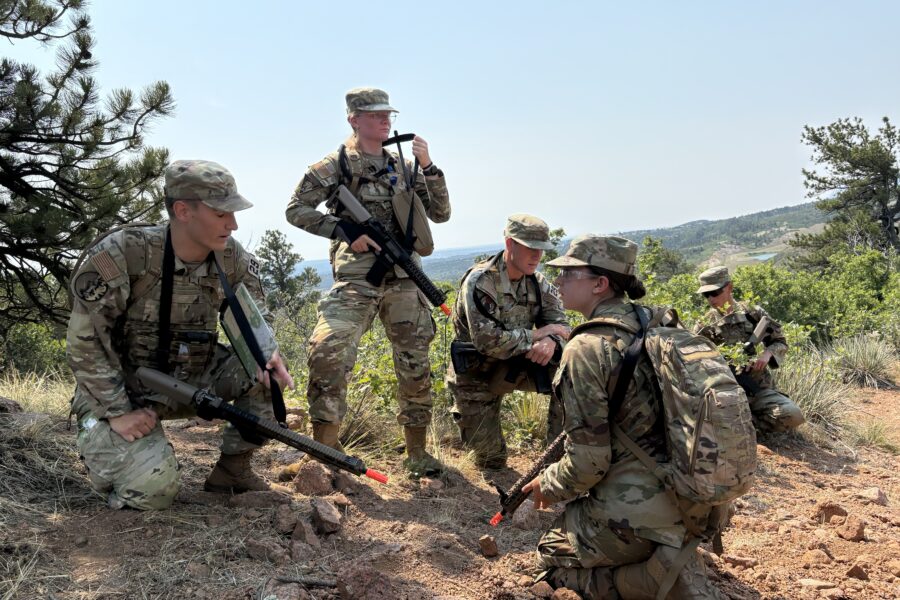
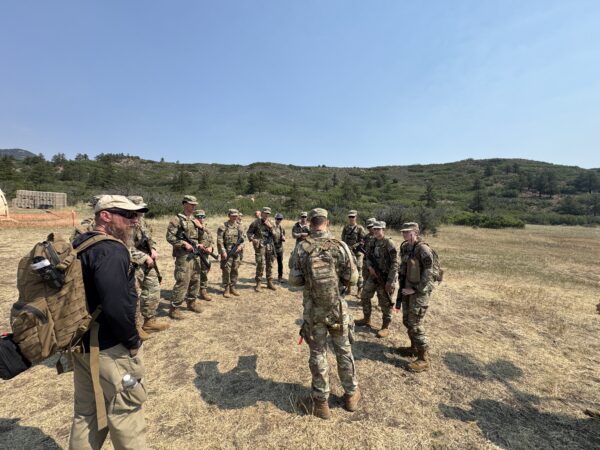
AIR FORCE ACADEMY, Colo.—Walking in formation across scrubby brown grass and cacti, a dozen cadets, armed with airsoft rifles and wearing helmets and vests, pause as a bearded man in black and camouflage passes an alert to their squad leader. The signal comes down the line: Get down, there’s a drone!
The cadets scatter, ducking behind bushes, and burying themselves in the grass. Then the bearded contractor, from veteran-owned Touchpoint, delivers a lesson: The drone is overhead, so look up, and next time, hide yourself more strategically.
Formations like this one are one small part of a major overhaul of the U.S. Air Force Academy’s summer military training. A new Combat Skills Group now imparts the basics of survival, evasion, resistance, and escape to cadets, along with combat casualty care; small unit movements and tactics; and countering small drones.
The training imparts an important perspective, says USAFA Superintendent Lt. Gen. Tony D. Bauernfeind.
“We’re not trying to create Soldiers,”he told Air & Space Forces Magazine. “We’re creating joint warfighters.”
Giving all cadets a taste of combat fundamentals gives them more perspective on how to support and lead ground operations, said Commandant of Cadets Col. Brandon J. Tellez.
“It’s really wild that this is now bread-and-butter experience that these guys are getting,” said Tellez, a 2001 Academy grad. “When they walk into the larger service, not just the Air [Force] and Space Force, but how that integrates into the joint force, the vocabulary we are giving them—layered with the experiences to actually bring those words to life—is immeasurably valuable.” said Tellez/
The newest of the combat skills courses is the Cadet Warfighter Advanced Course, required for all rising sophomores (cadets 3rd class). CWAC replaces the former Combat Survival Training class, which taught cadets the basics of SERE.
Now they get something richer. “They get to go out and spend five days in the field, where they sleep overnight,” explains C1C Kaleb Abouelghar, the cadet commander of the Combat Skills Group. “They’re given three MREs, and they have to survive, basically.”
It’s an introduction to the privations that could occur to aircrew who find themselves isolated in unfriendly territory, as happened the F-15E crew known as “DUDE 44” in April when they were shot down over Iran. The result was a dramatic, high-profile rescue.
“They were using the exact skills that we’re teaching them now,” Abouelghar said “In order to survive and get home, they are using ridge lines and different isolated personnel techniques in order to stay low-observable and to stay alive.”
The course goes beyond SERE with additional scenarios, such as practicing combat search and rescue, using AN/PRC-163 Multi-channel Handheld Radios to call in strikes on opposing forces or dealing with a mass casualty event triggered by a strategically placed mock IED.
Contract instructors—many of them former Army and Marine Corps special operators—help oversee the training but most of the oversight is led by cadets in another course: the Cadet Warfighter Instructor Course (CWIC). Launched last year with the help of Active-Duty Army Green Berets, CWIC is a next-level version of the “basic warfighting” skills course known as CWAC. Reinforcing those skills, it also teaches upperclassmen how to be instructors and how to staff a Tactical Operations Center, including briefing, commanding, and controlling all the action necessary to make CWAC work.
Previous classes weren’t exposed to these challenges, Tellez said.
“I was a very successful, aggressive fighter pilot, leader, joint warfighter for a decade and a half,” Tellez added. “It wasn’t until I was a junior major that I could even spell TOC.”
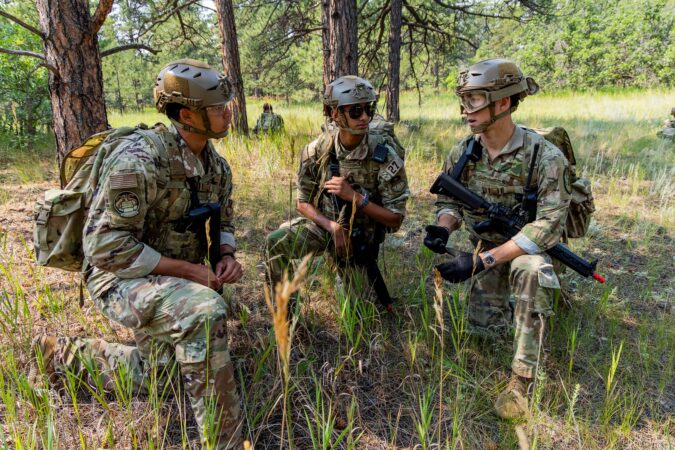
Cadets who complete CWIC earn an “instructor” tab and, in addition to helping to guide CWAC, will also help shape the military training cadets get during the academic year, Abouelghar said. Between running a TOC or teaching a small unit, the idea is that cadets will gain a better understanding of how they can fit in and lead joint forces, regardless of where their career takes them.
“A lot of our cadets are going to work in career fields where they’re working with our other forces, and that’s one of the things that makes us so strong,” Abouelghar said. “And so instead of having to learn on the job and figure out what all these different things mean for joint functions, they’re able to learn now, so that way they have a better understanding when they commission.”
A third Combat Skills Group course, the Special Warfare Orientation Course, is for cadets interested in special warfare careers more exposure to the skills they will need in those fields.
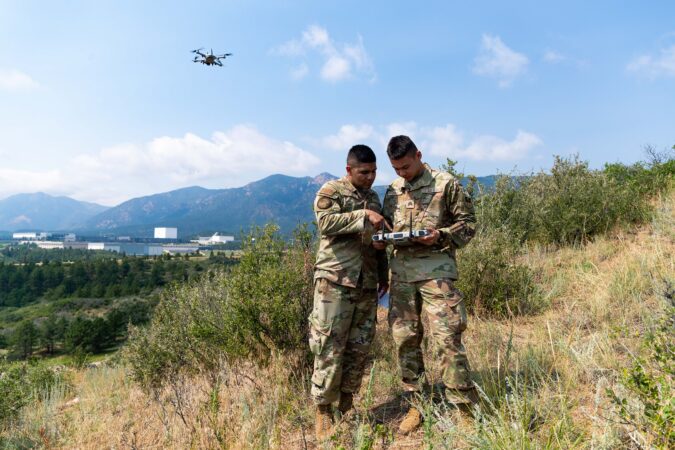
In addition to the “shoot, move, and communicate” basics and combat casualty care, another combat skill USAFA wants every cadet to develop is drone operations.
“Our goal is to get every single cadet to have hands-on [experience with] as many drones as we can,” Abouelghar said. “We have about 60 to 70 drones that we’re flying nonstop, and we’re making sure that our cadets are all getting their hands on and getting experience with them.”
Cadets can learn to fly the small, inexpensive quadcopters in a day or two and then quickly demonstrate to other novices. Controlled using digital tablets, they’re easy to fly and increasingly familiar to a generation that’s grown up with similar tech.
How cadets use these drones in the Combat Skill Group’s courses will evolve, leaders say. Automation will eventually be introduced, and Acosta and Abouelghar expect the training will improve each year as cadets experience the classes and graduate into leadership roles, where they can refine the courses over time and build on their own experiences.