
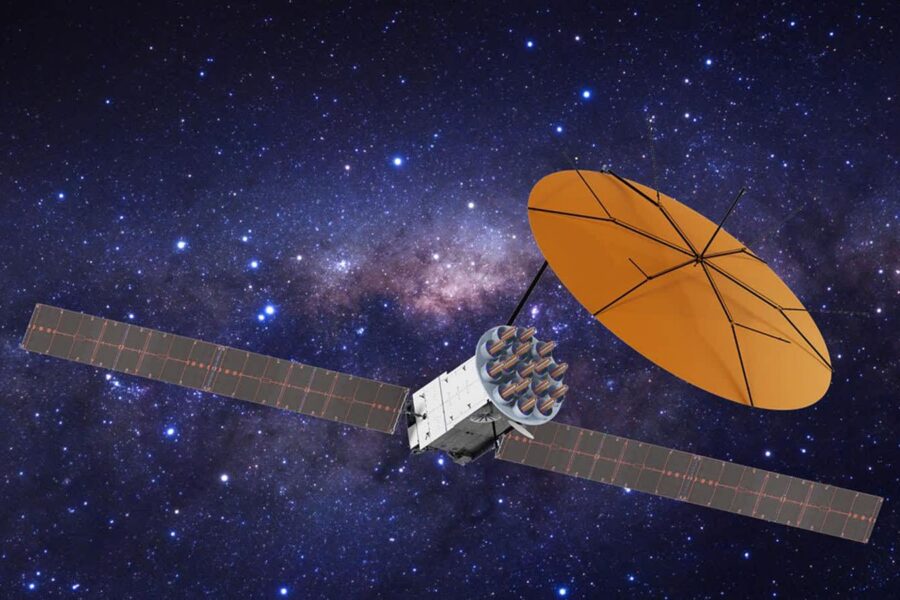
The Space Force is moving forward with a series of experiments to test ideas for broadening its narrowband satellite communication mission to medium-Earth orbit, and a new notice to industry seeks commercial satellites to help demonstrate the viability of a future hybrid architecture.
In a July 24 Air Force Research Laboratory notice, the Space Force says it’s interested in using bandwidth from commercially owned and operated narrowband satellites, payloads, or communication links in MEO to use in upcoming experiments. The notice doesn’t provide a timeline for those efforts but makes clear that it is interested in capability that’s available “immediately or as soon as possible.”
“An Initial Launch Capability (ILC) by 2030 is potentially useful, but innovative approaches leading to earlier on-orbit capability are strongly desired,” the notice states. “The government recognizes that this initial prototype may not be fully representative of a final, future architecture, but rather represents an initial step to explore providing UHF services from MEO.”
The experimentation campaign will help the Space Force demonstrate interoperability between commercial satellites in MEO and existing government spacecraft in geosynchronous orbit. It could also inform a plan to either augment or replace those GEO satellites with a proliferated MEO constellation. AFRL states in the notice that it may require access to the capability for at least three years.
The Space Force currently relies on its Mobile User Objective System constellation for narrowband, or ultra high frequency, communications. The fleet of four satellites—plus one on-orbit spare—in geosynchronous orbit provides secure tactical communications capabilities. While UHF bands have limited bandwidth, they’re less vulnerable to weather, can operate through challenging terrain, and have better range and a stronger signal. They’re also harder to jam.
In late June, the Space Force awarded Boeing a $2 billion contract to build two more MUOS satellites that will serve as a bridge between today’s constellation and the service’s future narrowband architecture, which will likely include a mix of spacecraft in GEO and MEO. In a 2024 request for information, the service said it was also exploring concepts for a proliferated MEO constellation consisting of lower-cost satellites.
The Space Force is in the midst of crafting its strategy for that future architecture, according to Charlotte Gerhart, deputy portfolio acquisition executive for satellite communications and positioning, navigation, and timing. Gerhart said in a recent interview with Air & Space Forces Magazine the service is exploring a range of options as it crafts that vision.
“We’ll continue to watch and be aware of how industry and that commercial business case is adapting overall,” she said, noting that SSC is still defining its next steps and acquisition strategy.
According to fiscal 2027 budget documents, the Space Force plans to launch a prototype as soon as fiscal ‘30. In the coming year, it will start working on both the ground and space segment prototypes and begin buying long-lead parts for the communication payload and the MEO satellites, the documents state.
Editor’s Note: An earlier version misidentified the organization leading the narrowband study; it’s being led by the Air Force Research Laboratory.