
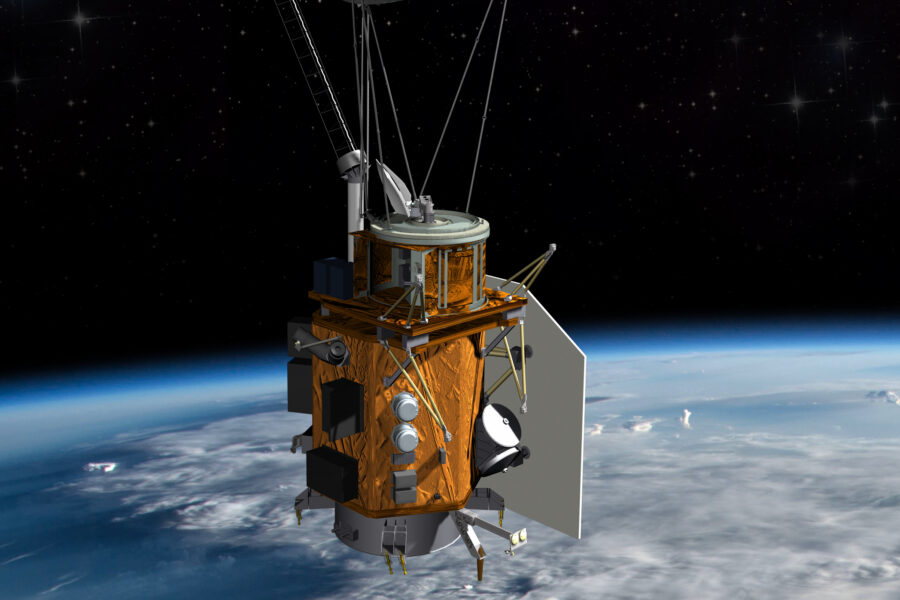
WSF-M is the Defense Department’s next-generation space-based meteorological satellite specifically designed to fill key gaps in ocean surface winds, tropical cyclone intensity, and electromagnetic “space weather” monitoring in LEO. WSF-M’s payload includes two main sensors. The passive microwave radiometer utilizes a 6-foot antenna array to monitor winds, cloud cover, snow depth, sea ice, and soil moisture, augmenting the Electro-Optical/Infrared Weather System (EWS) satellite system. The Energetic Charged Particle sensor, meanwhile, monitors electromagnetic “space weather in LEO” which can disrupt communications and electronic systems. WFS-M data is utilized by the Joint Typhoon Warning Center to improve the tracking of potentially damaging tropical storms as well as provide data for forecasting and mission planning to military users in real time.
USAF awarded Ball Aerospace a development contract in 2017, and most recently ordered a second satellite (SV-2) in January 2023. The first satellite launched from Vandenberg on April 11, 2024. WSF-M and EWS-G are replacing DMSP, which will reach its planned end-of-service date in September 2026. IOC was achieved at Vandenberg in April 2025. Its Microwave Imager (MWI) will use frequencies to gather real-time data on ocean surface winds, tropical cyclone intensity, and snow depth, closing gaps in the current monitoring capabilities. BAE Systems was also awarded a follow-on contract to build a second WSF-M satellite, which is scheduled for launch by the end of 2026.
Weather System Follow-On-Microwave Technical Data
Contractors: Ball Aerospace (satellite); BAE Systems (systems and sensor integration).
Operator/Location: USSF CFC, Mission Delta 2 (DEL 2), 19th Space Defense Squadron (19 SDS), NAF Dahlgren, Va.
First Launch: April 11, 2024.
IOC: April 24, 2025.
Design Life: Unknown.
Launch Vehicle: Falcon 9.
Constellation: One low-Earth orbit (LEO).
Active Satellites: •WSF-M SV-1. First satellite, launched in 2024; active.
Dimensions: 7.2 x 5.6 ft x 4.6 ft, not including deployed solar array.
Weight: 2,645 lb at launch.
Performance: Sun-synchronous orbit.
Altitude: Approx 517 miles.
Power: Solar array and batteries.