
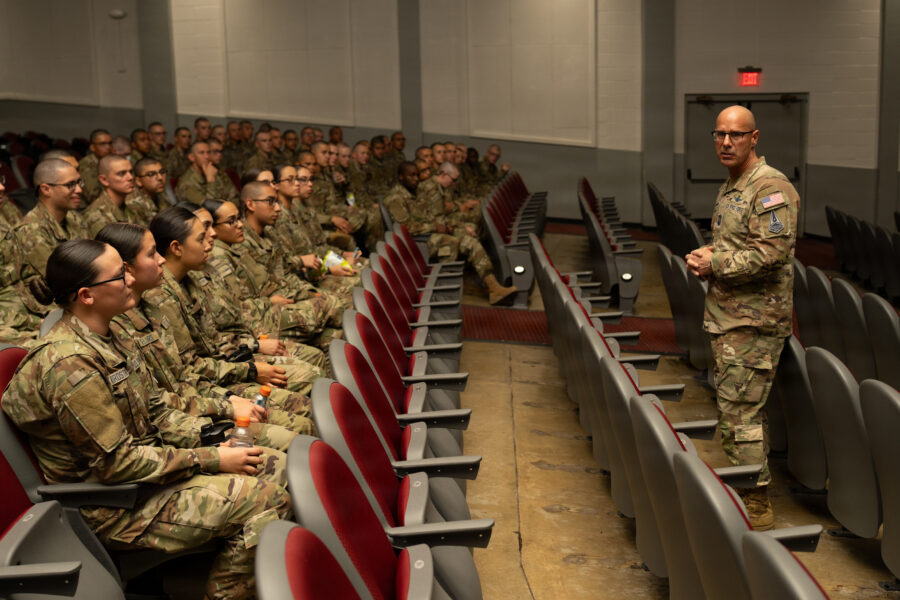
NATIONAL HARBOR, Md.—When Space Force leaders started talking about expanding the service early this year, the idea was simple: double the size of the force in the next five years.
At AFA’s Air, Space & Cyber conference this week, officials detailed just how they’re planning to grow so much so quickly—and it goes beyond doubling.
As things stand, the Space Force has less than 11,000 uniformed Guardians and around 5,000 civilian employees. Senior leaders said at AFA their goal is to reach 25,000 uniformed and 12,500 civilian Guardians—a combined increase of about 134 percent. A service spokesperson confirmed the plan is to reach those numbers by fiscal 2031.
Brig. Gen. Christopher Fernengel, former director of plans and programs on the Space Staff, had laid out those numbers earlier this year, but talk of doubling the force led many to assume the service was aiming for 20,000 uniformed Guardians by 2030.
Lt. Gen. David N. Miller Jr., the service’s top planner, reaffirmed the higher numbers during a panel discussion at the conference—and suggested those still might not be high enough.
“As much as I know we need 25,000 Guardians in the next five years, as much as I know we need about 12,500 civilians in the Space Force in the next five years, the actual requirement, I could argue, is more,” said Miller, who serves as deputy chief of space operations for strategy, plans, programs, and requirements.
The Need
The need for more people, USSF leaders say, is driven in part by new missions. The Space Force is preparing to launch scores of new satellites to track both air and ground targets and investing in what it calls “space control”—the ability to protect assets in space and hold adversaries’ space assets at risk. Air Force Secretary Troy Meink even made global headlines when he revealed for the first time at the conference that the Space Force has on-orbit space control weapons.
New missions requires more personnel to execute them, especially because the Space Force isn’t backing off any of its existing efforts, said Chief Master Sergeant of the Space Force John F. Bentivegna.
“Doubling the size just makes sense given all the things we have to do,” Bentivegna said. “Even though we’re killing it today with just under 11,000 Guardians, we need more.”
Indeed, Lt. Gen. Gregory Gagnon noted that the growth in the workforce is actually smaller than the growth in equipment and systems the Space Force is poised to see.
“We are already controlling 33 to 50 percent more satellites in outer space today than two years ago,” Gagnon, the head of Combat Forces Command, said. “In the next three years, with our budget funding, we will command and control over 500 percent more. That’s a fivefold increase in the amount of kit that will be in outer space, and the people to do that will be the Guardians that we need to double in mass.”
Gagnon said his command, which presents forces to combatant commanders around the globe, is already seeing “exponentially” more demand for space capabilities.
“Of the six geographic combatant commands, all of them are asking me for help,” he said. To meet that demand, he added, two-thirds of the Space Force’s planned growth will go toward generating “more combat crews and more force elements” for commanders.
Adding People
In discussions about growing the Space Force, officials have no concern about attracting enough people—after all, the service has easily met its recruiting goals every year of its existence and has even had to turn away thousands of interested recruits and transfers. The service has so much interest, Bentivegna and others have taken to saying the Space Force doesn’t recruit new members—it “scouts” them.
In order to meet its growth goals in a “sustainable” way, the service needs to be strategic, said Deputy Chief of Space Operations for personnel Katharine Kelley.
“It is arguably easier to just say, ‘I need this many new Guardians,’” said Kelley. “It is much harder to say, ‘I need to seed all of that talent inside the service that already exists and not create an imbalance in an up-or-out promotion system.’”
Too many new Guardians with little experience entering at the lowest ranks could wreak havoc on the service’s grade structure, she noted.
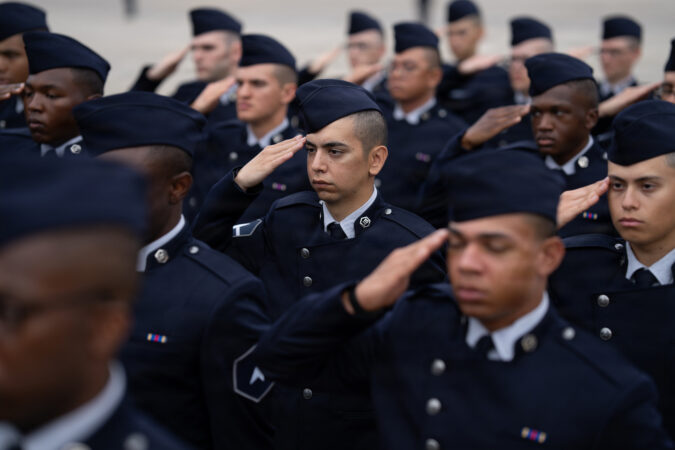
“We’re trying to balance not having all of our accessions be brand new in terms of experience,” she said. “We’re looking for ways to make sure that we can kind of balance this as a sourcing model and a sustainment model for people.”
One way is direct commissioning, allowing civilians with relevant space experience to join the service at a higher rank and grade, Kelley said. Another way is interservice transfers—the Space Force just opened its application window for such transfers from the Army, Navy, Air Force, and Marine Corps in fiscal 2027.
Inevitably, though, the makeup of the force will likely change, said Bentivegna—the Space Force has always been unique among the services given its high proportion of officers to enlisted, and while it’s unlikely to approach the ratio of the Air Force or Marine Corps, the coming growth is expected to favor the enlisted side.
“We’re going to grow more enlisted than we are going to grow officer,” Bentivegna said. “I think just a couple years ago it was almost a flat 50/50. Now we’re 53 percent enlisted, and I think that will continue to grow.”
The Pipeline
No matter what, every new Guardian that the Space Force accepts will have to go through training of some sort. That means a huge influx for Space Training and Readiness Command.
In 2027 alone, STARCOM boss Maj. Gen. James E. Smith said, his command will have to train up:
- Three times as many total Guardians as 2026: 1,000 to 3,000
- Twice as many enlisted: 700 to 1,400
- Four times as many officers: 400 to 1,600
Smith called that growth “a huge, huge scaling problem.” In response, STARCOM has raced to add around 75 new instructors at its various schools and courses.
The Space Force has always relied on the Air Force for support functions, and it will do so even more with the increased training workload, Smith said. But at the same time, the service has to continue to carve out its own identity of “Guardianship” and ensure the training is Space Force-centric.
“It’s not just enough to create a pipeline to create more Guardians,” Smith said. “We’ve got to have Guardians have the right skill sets to execute these new missions.”
Part of that, Smith said, is continuing an effort that was a top priority under former Chief of Space Operations Gen. B. Chance Saltzman: improving the service’s test and training equipment.
“There are some pieces still missing in our recipe. One of them is a fully constructed live, virtual, and constructive environment in order to do both tests, but also to do training,” Smith said.
This March, the Space Force issued a request for proposals for a physical test and training range that will feature a mix of ground and space-based systems. Officials have said they are looking to identify near-term gaps in test and training ranges and quickly field capabilities to address them.
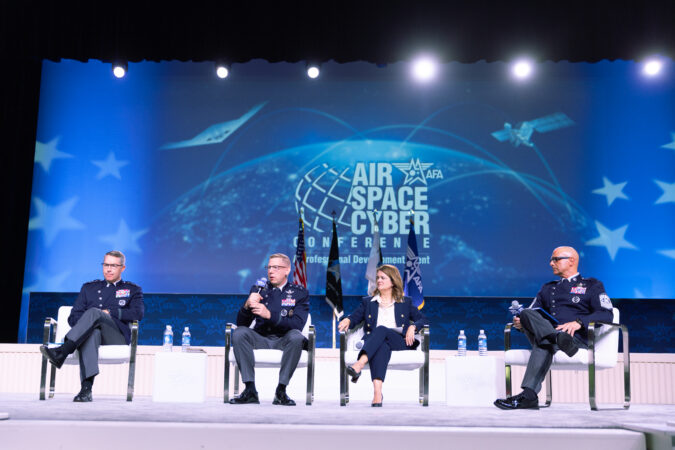
Photo by Jud McCrehin, Air & Space Forces Association
Infrastructure
Test and training ranges are just some of the infrastructure needs the Space Force must address with its coming expansion.
Kathryn Kolbe, assistant deputy chief of space operations for installations and logistics, said the service still faces “significant infrastructure shortfalls” and is trying to address them through expanded military construction.
“For the [fiscal 2027] budget, we submitted the largest investment in MILCON in Space Force history,” Kolbe said. “If appropriated, we would receive $2.2 billion.”
Almost half of that, $1 billion, would go toward building four new space operations centers. The service is also seeking an undisclosed classified total for five new tactical electronic warfare centers. And leaders have been investing billions of dollars in infrastructure to support more launches at its ranges on Cape Canaveral Space Force Station, Fla., and Vandenberg Space Force Base, Calif.
All this construction will take time, though, and the personnel growth is coming fast.
“In the meantime, we’re building temporary facilities for our operational units, for our training units, and for other requirements as they arise, as we plan, program, design, and construct our long-term facilities and infrastructure,” Kolbe said.
