
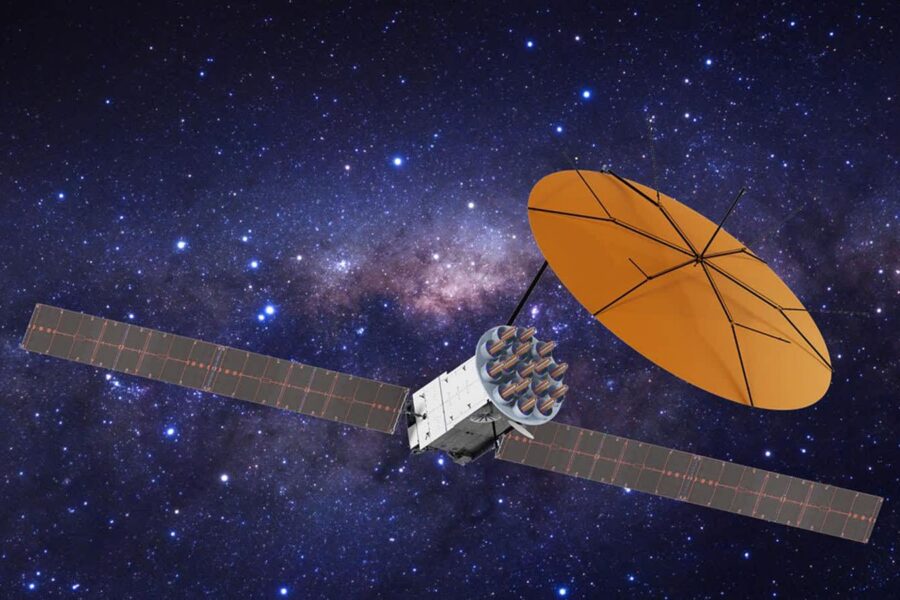
The Space Force selected Boeing to extend the life of its Mobile User Objective System for narrowband satellite communications, awarding the company $2 billion to build two satellites for the program.
The company edged out incumbent Lockheed Martin, who built the current fleet of MUOS satellites, which include four operational satellites and one spare. The Space Force expects the two spacecraft Boeing is building will keep the constellation in service until 2035, five years beyond its current life expectancy. The satellites are expected to launch “no earlier than” 2031 and 2032, Space Systems Command said in a June 24 press release.
“The two new space vehicles will extend the system’s Wideband Code Division Multiple Access, or WCDMA, capability,” SSC said. “This ensures continuity of operations for current and planned radio terminals, enabling U.S. and coalition partners to maintain a distinct tactical advantage.”
Boeing has heritage on the MUOS program, providing payloads for the current fleet. The company said in a June 25 statement its design will “increase capacity, reduce interference and improve connectivity.”
“When military users are operating in the most demanding conditions, this narrowband capability is their lifeline,” said Ryan Reid, Boeing’s senior director of space communications programs. “By building on our active 702MP spacecraft production line, we bring immediate execution momentum, proven reliability, and schedule predictability to the U.S. Space Force.”
MUOS operates in the narrowband frequency, a more focused range that’s less vulnerable to challenges with weather and terrain. Each satellite carries a legacy payload that’s backward compatible with older terminals and equipment still needed by some military users as well as a second, more modern Wideband CDMA payload that provides access to higher bandwidth. The Navy is one of the biggest users of MUOS capabilities and oversaw the program until 2023, when it formally transferred to the Space Force.
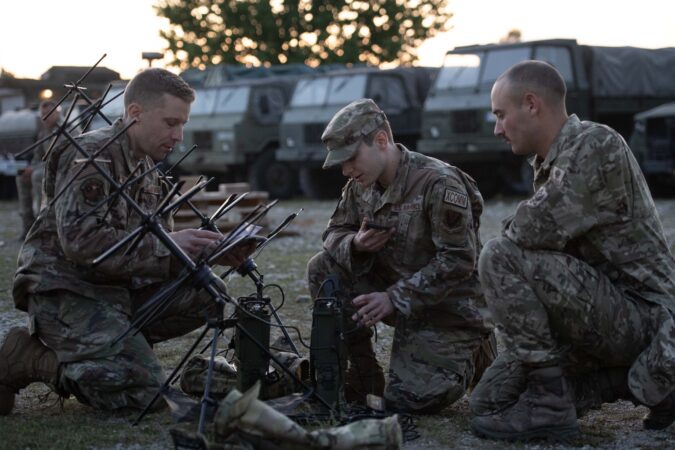
As part of the transition away from user equipment that’s dependent on the Ultra High Frequency Follow-on—the predecessor to MUOS—the two satellites Boeing is building won’t carry the legacy payload.
In parallel with the MUOS life extension, the Space Force is crafting a strategy for the future of narrowband SATCOM. In 2024, the service indicated in a request for information that it was exploring a proliferated constellation for the future architecture, with lower-cost satellites operating in medium-Earth orbit, below geostationary orbit where the satellites reside today. There are currently fewer than 200 satellites in MEO, making it less congested than other regions.
The service said in the 2024 request for info it was interested in capabilities that could be delivered by 2031, and fiscal 2027 budget documents corroborate those plans, stating that the service expects to launch a prototype satellite in fiscal ‘30. The documents indicate the service is considering those future requirements in the context of broader plans to field a hybrid SATCOM architecture that would include both commercial and bespoke military capabilities.
According to those budget documents, the Space Force plans to start work on both the ground and space segment prototypes and buying long-lead parts for the communication payload and the MEO satellites in the coming year. Col. A.J. Ashby—commander of System Delta 88, which is managing the MUOS life-extension effort—told reporters in April the service has completed its initial narrowband architecture studies and is working now on an acquisition strategy.
The Space Force is also experimenting with options to provide UHF connectivity via satellites in low-Earth orbit. Last July, York Space Systems launched a spacecraft as part of a Space Development Agency demonstration to see if satellites in LEO can both send and receive data via UHF. The company announced June 24 that the mission, dubbed Dragoon, successfully proved the capability.
“York satisfied initial mission exit criteria through five successful demonstrations over a three-month period, including three downlink demonstrations, which validated the spacecraft’s ability to transmit data down to a stationary government ground terminal, and two uplink demonstrations, which confirmed the ability to push most data from the ground back up to the
spacecraft,” the company said in a statement.
York said it plans to continue demonstrations with the satellite in the coming months, exploring other capability sets. A spokesperson declined to provide more detail.
“We are evaluating the potential of demonstrating other resilient tactical communications capabilities, but cannot discuss further at this time,” the spokesperson said.
SDA spokesperson Jennifer Elzea said Dragoon served as a pathfinder for future SDA missions
“A technical assessment by SDA confirmed that Dragoon achieved planned risk reduction objectives to inform [the Proliferated Warfighter Space Architecture’s] Transport Layer Tranche 2,” Elzea told Air & Space Forces Magazine in a statement. “Additional demonstration activities will continue using Dragoon this quarter.”
