
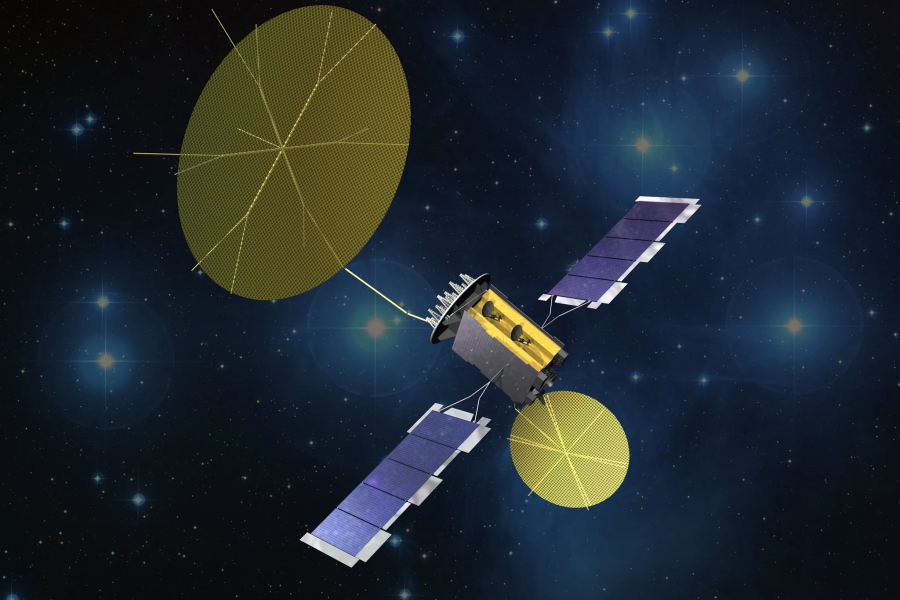
MUOS provides next-generation global UHF narrowband and BLOS military SATCOMS. The constellation was originally developed by Lockheed Martin for the Navy and is designed to replace the legacy UHF Follow-On (UFO) system, enabling a tenfold increase in capacity as well as interoperability with legacy terminals. Each satellite is equipped with an advanced SATCOM payload that converts 3G cellular-like service to military UHF as well as a UHF payload compatible with UFO terminals. MUOS provides tactical air, land, and sea platforms reliable SATCOMS even in challenging terrain and weather conditions and also extends SATCOMS to the high Arctic.
The system utilizes both geosynchronous satellites and ground-station relays to provide mobile phone-type, voice, text, and data to users in the field. MUOS can interface with the Defense Switched Network and DOD’s Global Information Grid offering clear voice and videoconferencing over existing networks. The system comprises four operational satellites, an on-orbit spare, and four ground relay stations in addition to networking and satellite control. USSF aims to procure two additional MUOS satellites targeted for launch by 2030, coinciding with the projected end life of the initial vehicles. Service life extension efforts initiated by the Navy would procure two additional satellites, equipped only with the advanced Wideband Code Division Multiple Access (WCDMA) payload to replace the oldest satellites in orbit by 2030.
Full exploitation of MUOS’ capabilities has been hampered by the slow modernization of user platforms to date, and many USAF platforms are in the process of transition. The Naval Satellite Operations Center transferred its remaining UHF satellites, including five legacy UHF Follow-Ons, a single remaining UHF FLTSAT, and two range extending nanosats to the USSF along with control of MUOS on June 6, 2022. General Dynamics got a $28.4 million contract for sustainment and modernization of the ground segment of the Mobile User Objective system. It is expected to be complete by 2027. Canada reached IOC becoming the first allied MUOS user in June 2024, with full operational capability for Canadian Forces achieved in 2026.
Mobile User Objective System Technical Data
Contractor: Lockheed Martin.
Operator/Location: USSF CFC, Mission Delta 8, 10th Space Operations Squadron (10 SOPS), Naval Base Ventura County, Calif.; Schriever SFB, Colo.
First Launch: Feb. 24, 2012.
IOC: 2012.
Design Life: 14 yrs.
Launch Vehicle: Atlas V.
Constellation: Four (plus one on-orbit spare).
Active Satellites: •MUOS-1. Launched in 2012, on orbit and operational (CONUS/Americas). •MUOS-2. Launched in 2013, on orbit and operational (Pacific). •MUOS-3. Launched in 2015, on orbit and operational (Atlantic). •MUOS-4. Launched in 2015, on orbit and operational (Indo-Asia). •MUOS-5. Launched in 2016, on-orbit spare.
Dimensions: Length 21.9 ft, height 12 ft, width
Weight: 8,405 lb (including 6,450 lb of fuel).
Performance: UHF narrowband/BLOS 3G-equivalent voice, chat, and data 89.5 north to 65 south latitude worldwide.
Orbit Altitude: Geosynchronous.
Power: Two deployable solar arrays.