
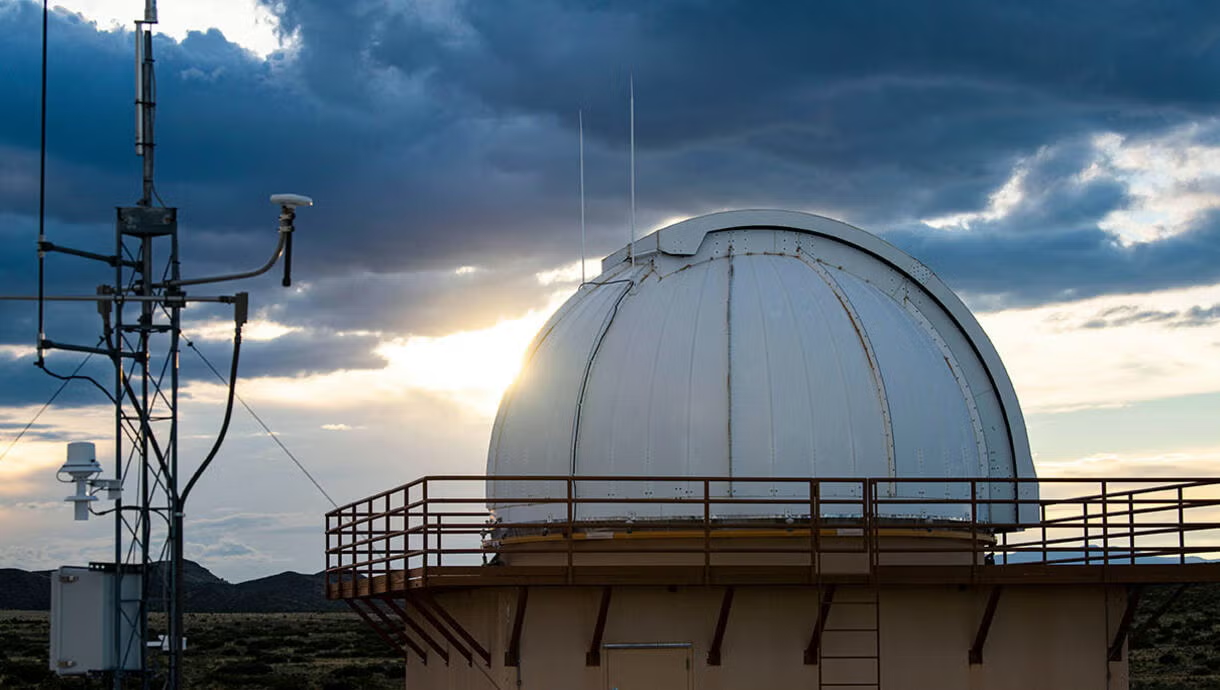
The Space Force has accepted an upgrade to its Ground-Based Electro-Optical Deep Space Surveillance telescope for operations, bringing increased visibility into orbit to its Maui Space Surveillance Complex in Hawaii.
The modernized variant, called the Ground-Based Optical Sensor System, has double the field of view of the older version, a more rapid scanning capability, and is three times more sensitive to light. L3Harris performed the upgrades.
“The upgrade enables rapid search and discovery of small, hard-to-see, and stealthy threats in medium-Earth Orbit, geostationary Orbit, high-Earth Orbit, and cislunar orbits,” Space Force’s Combat Forces Command said in an April 14 press release.
Space domain awareness systems like GBOSS are in high demand from operators and have long been at the top of U.S. Space Command’s priority list. The need for more visibility in the domain will continue to grow as the number of commercial proliferated satellite constellations increases, and as China, Russia and other U.S. adversaries show an apparent willingness to demonstrate aggressive maneuvers on orbit.
The Space Force operates nine legacy GEODSS telescopes at three locations in the U.S. and the Indo-Pacific. Prior to the Maui site’s operational acceptance, the service approved the first GBOSS configuration at White Sands Missile Range in New Mexico last year. The third site in Diego Garcia has not been upgraded.
CFC accepted GBOSS for early use and testing in October 2025, which means the 15th Space Surveillance Squadron has already been using the telescope for operations.
“Early use enabled concurrent time for testing, training, and system familiarization while facilitating warfighter feedback and early identification of system issues or operational gaps,” according to a CFC spokesperson.
Col. Barry Croker, commander of CFC’s space domain awareness-focused Mission Delta 2, said the upgrade significantly improves the service’s ability to monitor “adversaries who try to hide in orbit.”
“Objects in space that were once too dark or too close to one another are now observable,” he said in the press release.
L3Harris performed the GBOSS work under a wide-ranging, 10-year, $1.2 billion sustainment and upgrade contract between the Space Force and L3Harris called Maintenance of Space Situational Awareness Integrated Capabilities, or MOSSAIC. The company just received a $150 million award for its seventh option year.
“This milestone confirms Ground-Based Optical Sensor System is ready to deliver timely, high-fidelity space intelligence directly to Space Force operators, enabling faster decision-making, improved threat detection, and greater protection of satellites that underpin military operations and daily life on Earth,” the company said in a statement.
The Space Force has not yet indicated whether it will move ahead with similar upgrades at the Diego Garcia site. To date, the service hasn’t provided funding for the effort. Art Loureiro, director of space defense solutions at L3Harris, told Air & Space Forces Magazine the work is not included in the most recent MOSSAIC award.
