
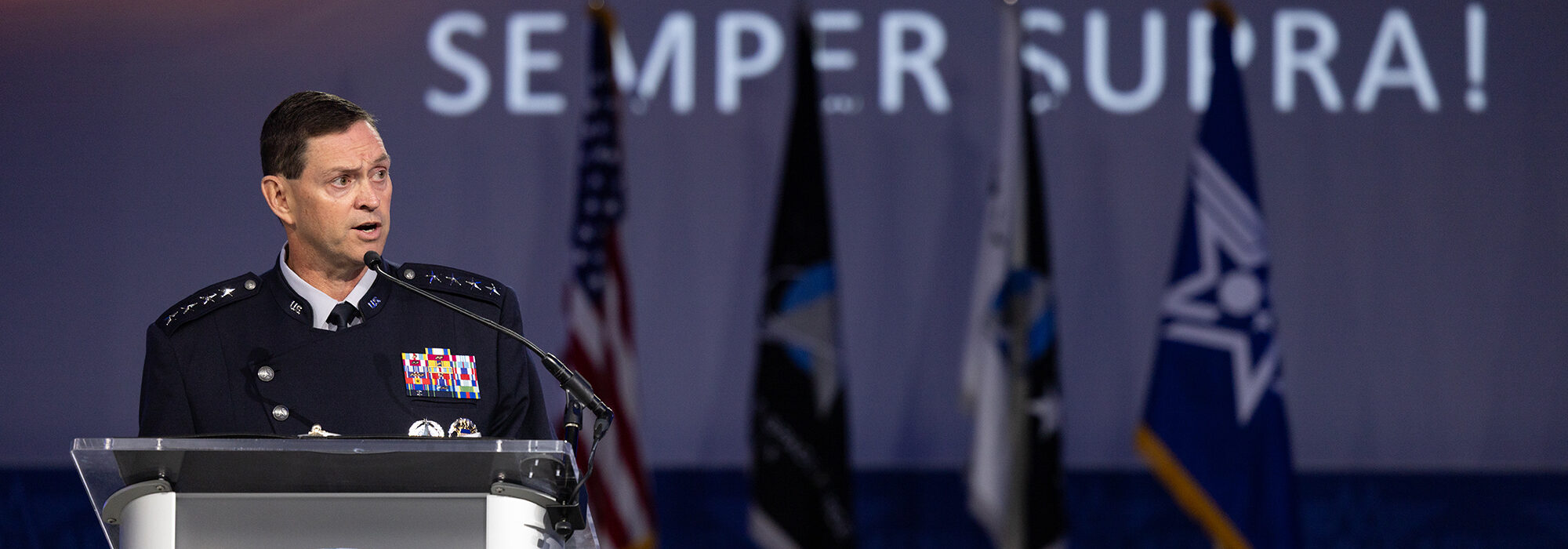
Precision strike is an Air Force mission, but it’s hard to be precise without the Space Force.
Reflecting on his tour as the nation’s second Chief of Space Operations, Gen. B. Chance Saltzman pointed to Operation Midnight Hammer, where seven B-2 bombers struck Iran’s nuclear sites in June 2025: Flying at a classified altitude, the bombers hit their targets with 14 perfectly timed blasts, each a 30,000-pound bomb, each set to explode in sequence with engineered precision.
Executing complex timed missions isn’t like opening CarPlay and following the prompts. “If you think that you simply just turn GPS on and navigate like you’re going to the store, that’s not how Midnight Hammer goes,” Saltzman told Air & Space Forces Magazine in an interview at his Pentagon office overlooking Washington, D.C. “We’ve got to do this in a specific time, and when is that time? When the aircraft releases the munition. … If you know all that and integrate, then you can backward-process it to make sure that the constellation is perfectly aligned to make sure you get as much accuracy as possible. …
“That synchronization is deliberate,” Saltzman added. “It takes an operator that understands it. It takes them integrated into the planning: ‘Hey, when are the B-2s going to be overhead? When is the release point? What’s your time on target?’”
Space operators have long stayed mum about their contributions to U.S. military operations. But as the Space Force approaches its seventh birthday and the CSO prepares to retire later this summer—Lt. Gen. Douglas A. Scheiss has been nominated to succeed him—Space Force leaders are beginning to speak more openly about how access to space both informs and enables the American way of war.
OPENING UP
From Operations Midnight Hammer and Epic Fury against Iran to Absolute Resolve—the mission that captured Venezuelan strongman Nicolás Maduro—the Space Force has become increasingly open about how it contributed to the fight. And increasingly, those contributions go well beyond providing vital GPS and satellite communications links, to include disrupting integrated air defense systems and more.
“The adversary is using satellite communications to synchronize their situational awareness, and if we can disrupt that, then we can help create envelopes of protection for people going into harm’s way—whether that’s extracting pilots that are on the ground or protecting assets that are going into an IADS,” Saltzman said. “If we weren’t there, it would have gone far differently.”
Much of the Space Force’s technical capability was already in place in December 2019, when President Donald Trump signed the legislation that made it an independent military service and Gen. Jay Raymond became its first Chief of Space Operations. But the work that Saltzman undertook to shape, organize, inform, train and discipline the Space Force as a warfighting service in his four years as CSO transformed how those capabilities are applied and engaged.
“What we’ve been able to accomplish in Venezuela, and Midnight Hammer, and Epic Fury kind of proved—OK—we’ve got forces that are capable now,” Saltzman said.
Adding ‘Structure’
Known universally as “Salty,” Saltzman joined the Air Force 35 years ago as a missileer at an entirely different point in history. What he learned since shaped his thinking as a military leader.
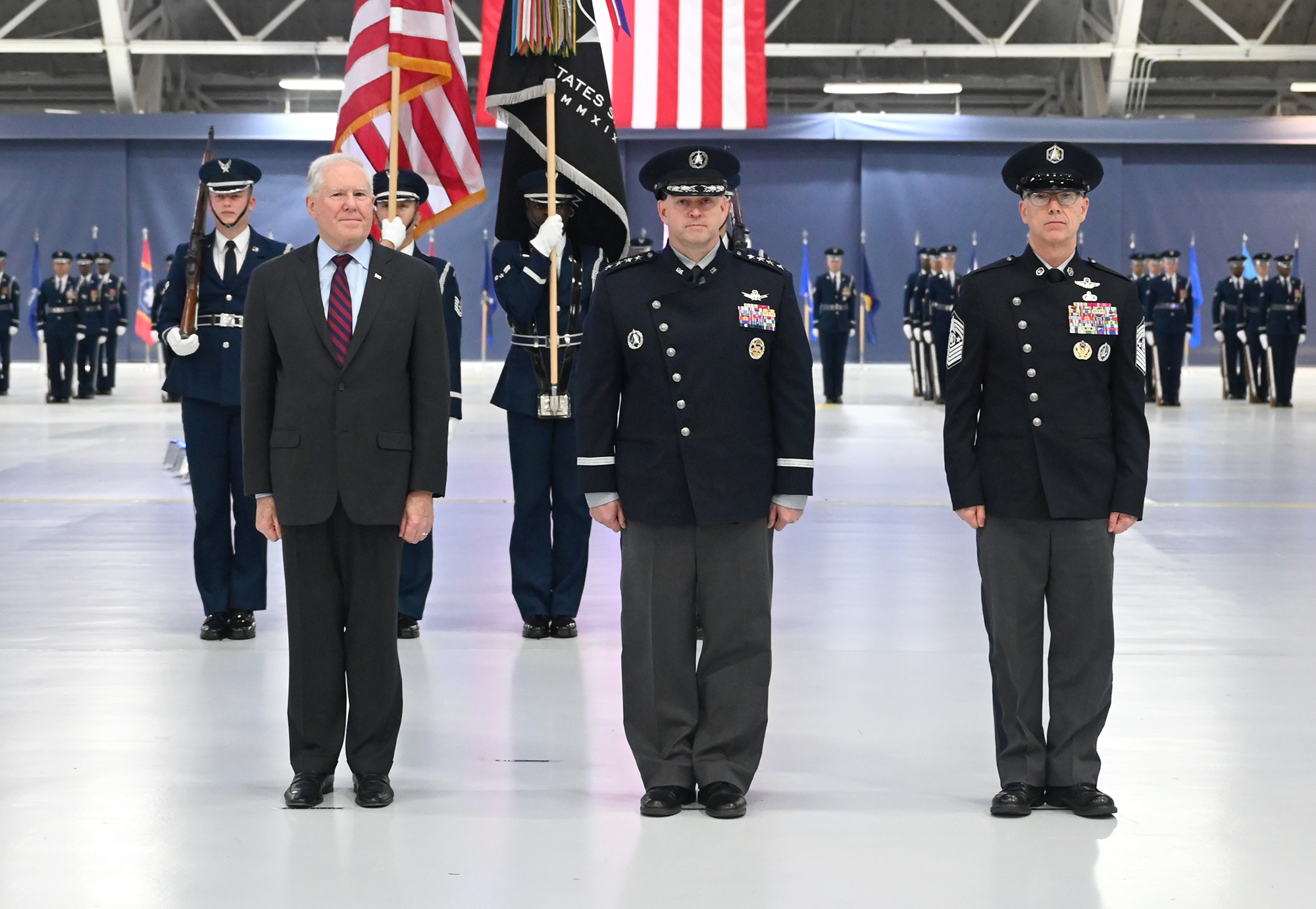
“Jay Raymond built the foundation for the Space Force, and Salty built the structure on top of the foundation—and it’s still being built,” said former Secretary of the Air Force Frank Kendall, who led the Department of the Air Force across both CSOs’ tenures. “It’s a journey. It’s not over with him. It won’t be over with the next CSO. But he made a lot of progress in the time he was CSO.”
Saltzman oversaw substantial budget growth over that time, the Space Force budget rising from $26.1 billion his first year to a fiscal 2027 request—still far from approved—totaling $71.2 billion. A significantly expanded budget is necessary, he argues, to ensure that the first new U.S. military service since the Air Force was established in 1947 can do what the nation needs it to do to control the space domain.
Whether Congress approves more than doubling Space Force spending remains an open question, but it’s clear the budget will continue to increase substantially, even if it’s not all in one gulp.
For Saltzman, one of the central pillars of his focus has been to “normalize” space operations as part of what the military does—and to lay to rest early skepticism over whether the Space Force needed to be and would remain independent.
The first step in that process was to fully integrate the Space Force into U.S. military operations, which are led not by the military services, but by the nation’s regional and functional commanders.
Saltzman established component commands at every geographic combatant command, beginning with Space Forces Indo-Pacific Command just weeks after taking office in 2022. In recent operations in the Middle East, Space Forces Central has been an active participant throughout—just like the air, naval, and land components of CENTCOM. Previously, the space role resided in the air component.
“The joint force didn’t know how to incorporate us because space operations weren’t normalized into joint processes,” Saltzman said. “We didn’t have service components to do the planning. We had to normalize that because every service has service components in the combatant commands.”
Similarly, the Space Force didn’t rotate forces through typical operational readiness cycles and “present” them to joint force commanders in the same way the other services did. “We didn’t have a force generation model where we trained our forces to get ready for high-end combat, so we had to normalize that because everybody else does,” Saltzman said.
DEFINING DOCTRINE
Space warfighting doctrine also largely did not exist. Peter Hays, a professor of space policy at George Washington University, said Saltzman played a major role in advancing that doctrine. One of Saltzman’s main achievements was declaring “that space superiority is job one, because that enables all other missions,” said Hays, who taught Saltzman at Air University’s School of Advanced Air and Space Studies at Maxwell Air Force Base, Ala., an incubator of future service leaders.
Saltzman codified his vision through a series of publications—2023’s “Theory of Success” and “Competitive Endurance”; 2025’s “Space Force Doctrine Document 1,” which defined space as a warfighting domain, and the “Space Warfighting Framework”; and this year’s future-focused “Objective Force 2040” and “Future Operating Environment.”
“We need as many vested stakeholders helping us … as possible, and by writing these documents out, it gives them a framework to have that discussion,” Saltzman said.
While other leaders focus major speaking opportunities on rallying the troops with emotion and spirit, Saltzman took to the stage at major events, such as AFA’s Air, Space & Cyber Conference or Warfare Symposia and delivered carefully crafted speeches with deliberate purpose, each one building on the last, each egging on the service to see itself not as technical specialists, but warfighters in a complex, competitive, and high-risk domain.
CULTURE CHANGE
To explain the transition he’s trying to bring about, Saltzman and Kendall described the Space Force as being like converting the Merchant Marine of the 1920s into the naval force that helped win World War II. Both the Air Force’s space capabilities that would become the Space Force and the Merchant Marine of that period were built to operate in benign and safe environments, free from military aggression, and both had to transition to a more volatile and dangerous era, in which enemy forces would pose rising threats.
That transition requires more than new equipment: It demands a different culture to approach a very different existence. Instead of silently executing work in the shadows, more of what the Space Force does is now on display—as much to declare what’s possible to the other services as to the public they serve. (And also to project deterrence to potential adversaries).
“If we don’t talk about ourselves, who will?” asked Saltzman.
The majority of Space Force members today did not transfer from another service, as in the early days, but instead have never worn another service insignia. New processes are in place, and a long-awaited Guardian performance review system is nearing completion.
But creating a unique Space Force culture is not something he believes can be directed—it has to evolve organically, Saltzman said. “I think if you try to deliberately build a culture, you’ll get more wrong than right,” he said. “The culture is kind of the reflection—the outcome—of the collection of decisions and actions that you take as a service. What I’m conscious of is when we make decisions, when we build processes, when we take actions: There will be a culture that emerges.”
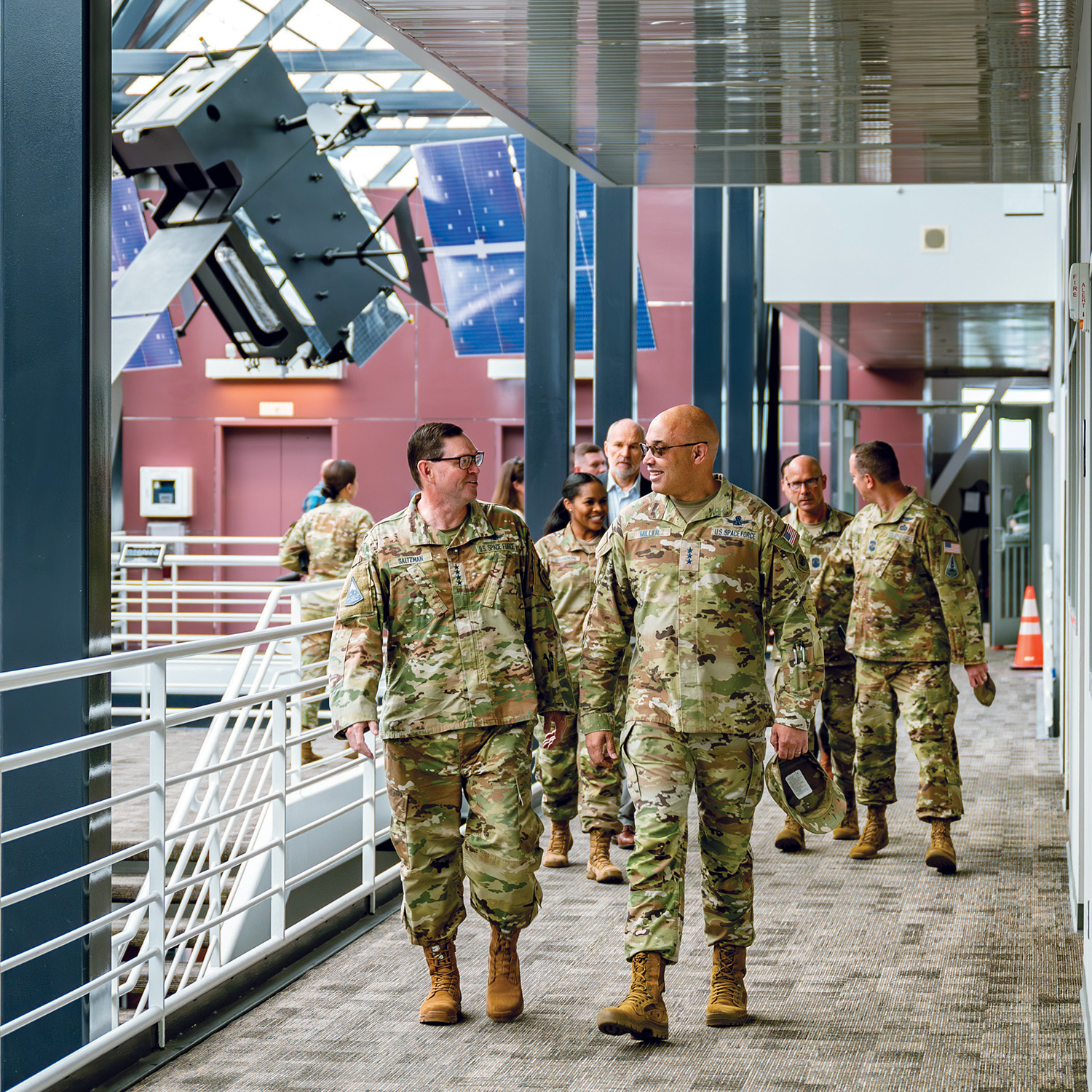
“SpOC” nomenclature, and renamed it Combat Forces Command. U.S. Space Force photo by Dave Grim
Weapons School’s Space Course Grew and Changed Over Decades
By Courtney Albon and Chris Gordon
When Chief of Space Operations Gen. B. Chance Saltzman graduated from the Air Force Weapons School in 2001, he was equipped with academic knowledge about how to integrate space capabilities into Air Force operations.
But he only received limited hands-on experience with the systems themselves. The Weapons School at Nellis Air Force Base, Nev., is the Department of the Air Force’s graduate program for advanced warfighting, the place where top performers go to master their craft and drill with the best of their peers. The school boasts a long legacy of delivering practical skills in its training of advisors and tacticians. But a quarter century ago, it lacked the resources to provide deep training in its space-specific course.
“Our training back then was primarily academic,” Saltzman told Air & Space Forces Magazine in a recent interview. “Our primary role was to take space into air operations and try to educate people on how space could be integrated into their plans and operations more effectively.” The Space Superiority Weapons Instructor Course (WIC) looks a lot different today. Its evolution over 25 years reflects the growing importance of space in joint military operations and the elevation of a once small cadre within the Air Force to lead a separate and distinct military service.
Saltzman, who spoke at the Air Force Weapons School graduation June 13—making him the first Guardian to do so—said the Guardians who move through the course today are trained on both defensive and offensive operations, with a focus on integrated mission planning. And, as he put it, they’re part of a team rather than “an educator about the team.”
“That’s a pretty big shift,” he said.
Col. Agustin Carrero, commander of Space Delta 11, which oversees the 328th Weapons Squadron at Nellis, said the Space WIC has changed in other ways, too. Established in 1996 for weapons officers, today’s Space WIC is geared toward both officer and enlisted Guardians. Most of the students come into the class with either a solid understanding of Space Force systems, some “tactical knowledge under their belt,” or both, Carrero said. “The focus, especially since the creation of the [Space Force] is more on honing our warfighting skills and making sure that as a service we can meet our moral obligation to contest the domain in support of joint operations,” he told Air & Space Forces Magazine. To do that, the course leans heavily on aggressor training in a virtual environment, allowing Guardians to hone their tactics operating against a simulated adversary.
Carrero said he expects the course to continue to evolve as the Space Force prepares to potentially double in size in the coming years. That kind of expansion means more investment will be needed across the service’s training enterprise, including to grow the weapons instructor course.
Some expansion is already occurring. The school is renovating an existing facility at Nellis to accommodate more students, with construction starting later this year. The 328th expects to move into the building full time in summer 2028. Carrero said the extra facility will allow the course to train as many as 100 students per year. Today, the Space WIC graduates about 25 students each year across two 23-week sessions.
Two new space course tracks will be launched in the coming years: an intelligence track in 2028 and a cyber track in 2029.
Carrero said the course will continue to increase training to prepare Guardians to operate in a contested domain, especially as the Space Force brings on new missions. And while today, Space WICs primarily train virtually, Carrero said he expects more training in the future could be performed using live satellites.
“One of the ways that the course is evolving is to develop those additional warfighting skills that we’re going to need as we bring on board additional capabilities,” Carrero said. “We definitely see the need to evolve the course.”
UNUSUAL CAREER
At 57, Saltzman is ending his four-star career closer to the age of a typical incoming chief of staff, rather than one who is retiring. His career track is unique, and unlikely to ever be replicated. Saltzman never envisioned a space career, in fact, and asked why he chose the secretive space field, he is blunt: “Oh, I didn’t.”
The cause was the end of the Cold War and the military downsizing that followed. Saltzman was a missile officer and the Air Force was cutting back the missile force.
“They really just didn’t have jobs for missileers,” Saltzman recalled. “I had a buddy that was in the NRO, and he called and says, ‘I think I can get you out to the NRO.’ I said, ‘What’s the NRO?”
The National Reconnaissance Office operated the nation’s spy satellites and was so secretive that its very existence remained classified until 1992. Its budget was hidden in the Air Force budget, and much of it remains hidden there even now.
Arriving at the NRO, Saltzman was assigned to OD-4—Operating Division Four—where he worked in a giant windowless building known as the “Blue Cube,” in Sunnyvale, Calif., at the now shuttered Onizuka Air Force Station. When the Air Force subsequently combined missiles and space operations into a single Air Force Specialty Code, 13S, his future was set.
“Missiles and space merged into the same career field before it broke back out again,” Saltzman said. “13 Sierra used to be ICBMs and space operations. And so, as an ICBM operator who had a job in the NRO, I was suddenly a space operator too.”
Saltzman went on to attend the Air Force Weapons School and to become an instructor there. He held jobs at the Joint Space Operations Center, then at today’s Vandenberg Space Force Base, Calif. (then a USAF installation); at Air Force Headquarters in the Pentagon; operational roles at Buckley Air Force Base, Colo., Air Force Space Command, and as Deputy Commander of U.S. Air Forces Central Command and Deputy, Combined Forces Air Component Commander, U.S. Central Command—where he helped run and direct combat operations. He was Deputy Chief of Space Operations for Operations, Cyber, and Nuclear, when he was selected to succeed Raymond.
Younger than and junior to his competitors for the job, Saltzman got the nod because of his overall vision.
“Salty won the job in his interview,” Kendall recounted. “We were open-minded going into interviews. But out of that process, Salty became a unanimous first choice for the job. He demonstrated the ability to very thoughtfully articulate what the Space Force needed to do to be successful, and we thought that was really important for the leadership of the Space Force and also for advocacy for the Space Force in the Washington arena.”
Space had been seen as peaceful for so long that many space operators couldn’t imagine anything else. The public struggled with the idea that America needed a military branch to defend it—if they even knew the Space Force had been created. Within the military, space had likewise been seen as something other than a warfighting domain—more as an enabler of air, land and sea operations, providing connectivity that helped those forces see and communicate.
Changing those perceptions was central missions for Saltzman. By openly discussing Russian and Chinese threats and U.S. efforts to counter them, he has sought to better inform the public. His references to “counterspace” capabilities, otherwise known as space weapons, broke a long-standing taboo about using destructive force in space.
By lifting the veil of secrecy just enough to more effectively explain the Space Force’s role, Saltzman consciously strove to build awareness of, and congressional and public support for, the Space Force.
At the same time, Saltzman built on Raymond’s efforts to expose the capabilities China and Russia have put in orbit. He talked about what the U.S. Space Force must do to counter, he said, their “on-orbit capability, whether it’s grapplers or kinetic capability.”
“We’re talking about directed energy, we’re talking about jamming, whether it’s in Ukraine and the Black Sea, the jamming that occurs in Iran,” he said. “We’re talking about all that stuff. So, the threat is out there at the unclassified level. We didn’t do that when I was a colonel.”
Retired Lt. Gen. David Deptula, the dean of AFA’s Mitchell Institute for Aerospace Studies, said Saltzman moved the Space Force “from its formative stage into a more operationally focused, combat-credible force.”
Equally important, he added, was Saltzman’s Competitive Endurance concept, which focused on three pillars: “avoiding operational surprise,” “denying adversaries first-mover advantage,” and then being prepared to conduct “responsible counter-space campaigning.”
“This concept of competitive endurance gave the Space Force a clear strategic framework,” Deptula said.
Saltzman’s designated successor is Schiess, now the Deputy CSO for Operations. He is set to inherit an organization with a more visible profile and broader public support than Saltzman had, and with a budget profile intended to grow the force. Once confirmed, he will try to execute on Saltzman’s plans to double the Space Force’s size by 2030.
“As long as we are clear on what the plan is and what the requirements are across the board, the thousands of decisions that will have to be made below this office level can be made, and I think that’s what we focus on,” Saltzman said. “Keep giving the resources and be clear-eyed on what the requirements are and what the plan is to execute.”
Wrapping up his final appearances on Capitol Hill during the Pentagon’s fiscal 2027 budget rollout, Saltzman earned repeated plaudits from nearly every senator or U.S. Representative he spoke with. They opened their remarks in public hearings by thanking Saltzman and extolling his service. Significantly, the committees approved his budget requests without going into special classified sessions.
“When I first went to the Hill, they still didn’t understand why there was a Space Force,” Saltzman recalled. “I still had senators, I still had congressmen asking me, ‘Why should we invest in the Space Force? What is it that the Space Force brings? Why is this so important?’ We’re not hearing those questions anymore.”