


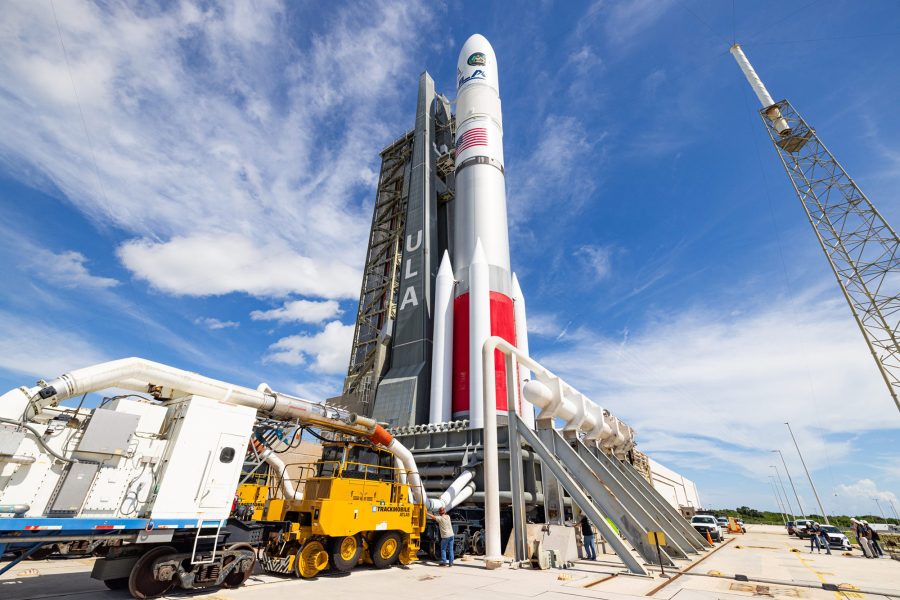
United Launch Alliance’s Vulcan rocket—sidelined since February after an anomaly—is scheduled to return to flight Nov. 13 to launch a batch of satellites for Amazon’s high-speed internet constellation in low-Earth orbit.
ULA revealed Vulcan’s highly anticipated return date Oct. 28, saying the launch vehicle will fly a redesigned solid rocket booster nozzle that it hopes will correct the issue that caused a Feb. 12 mishap, which the company characterized as a “significant performance anomaly.”
The anomaly occurred during the Space Force’s USSF-87 mission, which carried two satellites for the service’s Geosynchronous Space Situational Awareness Program and a training and demonstration satellite. While the launch was successful—the solid rocket booster anomaly occurred after liftoff—the fallout from the nozzle issue has left Vulcan grounded and has caused significant delays to the slate of military and commercial missions the rocket was scheduled to fly.
“The integrated team has made great strides in improving our understanding of the solid rocket booster anomaly that occurred on the previous Vulcan flight and have identified several potential contributors which have been mitigated through design and process improvements to the nozzle,” ULA said in a statement. “To support our customers, this upcoming launch will utilize the improved nozzle design, and additional testing and analysis will continue in parallel with the mission.”
While the Amazon LEO launch is a welcome step toward resuming regular Vulcan operations, it’s not clear when the rocket will once again carry U.S. military payloads. Brig. Gen. Eric Zarybnisky, the Space Force’s portfolio acquisition executive for space access, told reporters Oct. 21 that his team is “actively working with United Launch Alliance” to resolve the anomaly and understand what level or risk the service is willing to take on some key missions.
“We’re doing our due diligence to make sure that we’re understanding the real fundamental physics that are going on, and making sure we understand what happened and how we correct that,” he said.
The Space Force will collect data from Vulcan’s first few commercial flights and use that to craft a plan for future military missions, Zarybnisky said.
“It’ll depend a lot on what we see, not only on the engineering and tests that we’re doing on the ground, but also what we see from the flight data from the commercial missions they fly,” he said.
ULA and SpaceX are the only two launch providers with rockets currently certified to fly the most sensitive national security space missions, and Vulcan’s grounding has contributed to delays of several key Space Force missions, including the launch of the first Next-Generation Overhead Persistent Infrared missile warning and tracking satellite.
To mitigate those delays, the Space Force has shifted four missions originally scheduled to fly on Vulcan to SpaceX’s Falcon 9 and Falcon Heavy rockets. According to Space Systems Command, those four include:
- The final GPS III satellite, which was launched on a Falcon 9 in April
- A Space Development Agency Tranche 1 tracking mission that is expected to launch on a Falcon 9 before the end of this year
- A payload stack that includes the Air Force Research Laboratory’s Oracle-M cislunar pathfinder satellite was moved from the USSF-112 mission to the USSF-63 mission, which is scheduled to launch on a Falcon Heavy this year
- A Next-Gen OPIR satellite previously manifested on a Vulcan mission, USSF-50, was moved to SpaceX’s USSF-174 mission, which will fly on a Falcon Heavy rocket
For the payload and full mission swaps, the Space Force will shift a future SpaceX mission back to ULA to launch at a later date rather than cancel the contracts it has in place with ULA.
Zarybnisky noted that while the service has been able to make some trades, not all missions or payloads can easily transfer from one vehicle to another. He said the Space Force meets with the NRO and NASA every two to three months to discuss the government’s manifest and determine how to balance priorities between civil, commercial, and national security missions.
“One of the challenges we see on some swaps is integration timelines and doing the work to understand loads and dynamics and all the analysis work it takes to do that,” he said. “If that work has been done ahead of time, they we can pretty rapidly execute the swaps. If it has not been done, that can drive some of the timelines. And then for some of my customers, there are really hard technical challenges they have, and they just can’t be swapped for specific reasons.”