
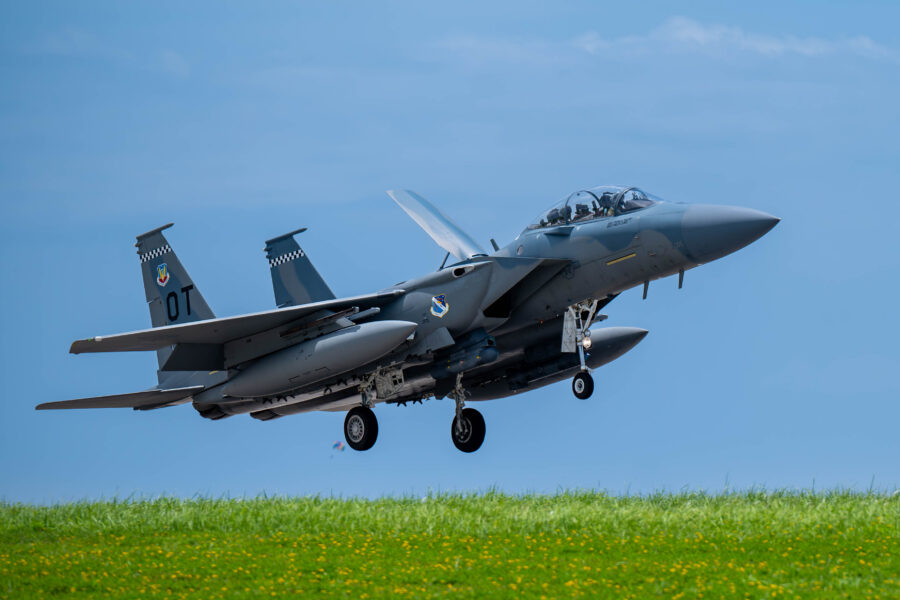
The Air Force’s decision to more than double its purchase of F-15EX Eagle II jets may bolster the service’s fighter fleet, but it also comes with risks and questions officials will have to manage in the years ahead, a new Pentagon report warns.
Earlier this year, Air Force officials announced plans to expand its planned F-15EX fleet from 129 to 267 jets, as they move recapitalize the older F-15E Strike Eagle. When the change was announced as part of the fiscal 2027 budget rollout, the Air Force said it needed to buy more F-15EXs alongside F-35As because both jets bring different capabilities that will be needed in in a future war.
Yet in the F-15EX’s selected acquisition report released in August, program officials noted “new cost and schedule uncertainties” that come with the increase they’re trying to mitigate.
Boeing declined to comment on the concerns raised in the acquisition report. The Air Force did not immediately respond to a query.
One concern is how the expanded procurement plan will play out over time. The previous F-15EX acquisition strategy called for eight lots of the jet; the new one calls for 12. This will likely require Boeing to conduct “a major technical refresh” to overcome diminishing manufacturing sources and material shortages, the report states.
Eventually, key systems such as the F-15EX’s radar, mission computer, electronic warfare suite, and engines could become obsolete and need to be replaced. This “constitutes a significant redesign effort,” the report states.
The program’s method for managing this risk involves testing and integrating those upgraded subsystems as part of future operational flight program releases now scheduled for between 2031 and 2035.
“This provides a structured, risk-reduced pathway for flight testing and fielding these new capabilities without causing a gap in the production line,” the report said.
Another concern is uncertainty around the costs of extending production. Program officials say they have not yet fully estimated those costs, though they has begun a rapid cost estimation process to inform the fiscal 2028 budget request. Until then, the EX program is using government estimates for its initial budget sizing, while “commissioning formal studies to obtain preliminary cost and schedule estimates from the contractors,” the report said.
The report also highlighted schedule issues that will need to be worked through in the short and long term. Parts and material shortages risk slowing the production of F-15EX jets in Lot 2 and beyond, officials wrote, noting that some of the most acute shortages including the jet’s Elbit-made large area displays and low-profile heads-up displays, General Electric F110 engines, and Collins-made cartridges for ejection systems.
Those shortages were mitigated for Lot 1B largely by stocking up on supplies during the production halt caused by a factory strike from August to November 2025—but the risks remain for future lots, the report said. The Pentagon is taking actions to keep the F-15EX’s production schedule on track, such as by putting borrowing and payback agreements in place with foreign military sales customers to maintain the supply of crucial parts.
But the strike at Boeing’s St. Louis, Mo., plant that makes the F-15EX has permanently set the jet behind schedule, the report said. Boeing’s F-15EX contract requires it to deliver all 12 Lot 3 jets in early calendar 2026, but due to the strike, the report said the company will only be able to deliver six of those jets by the end of 2026.
These “unrecoverable delays” are having cascading effects on the Air Force’s plans to field the Eagle II. The acquisition report notes the 142nd Wing of the Oregon Air National Guard will not receive all of its F-15EXs from Lot 2 until at least mid-2026, and the first Lot 3 F-15EXs, meant to be stationed overseas, will not be fielded until at least the first quarter of fiscal 2027, the report said.
These oversea jets will be stationed at Kadena Air Base in Okinawa, Japan. Kadena previously had F-15C and D Eagle fighters, but the Air Force started retiring those aging fighters in November 2022. Since then, a steady stream of other fighters have rotated through Kadena. The planned permanent force of F-15EXs, which were originally supposed to start arriving in spring 2026, have been delayed into 2027.
The F-15EX program management office is working with the Defense Department’s Business Operators for National Defense, or BOND, team to figure out how to optimize the F-15EX production schedule and prioritize the Lot 3 jets planned for overseas assignments as they go through the final assembly process, the report said.
The program office is also working with Air Combat Command and the National Guard Bureau to create a coordinated bridging strategy, that makes sure older jets or alternate force structures are available to cover the Air Force’s operational requirements, until the F-15EXs arrive.
The fourth lot of F-15EXs is also already behind schedule, according to the report. Boeing should have started delivering those jets in 2026, the report said, but they are now not expected to start arriving until calendar 2028. Boeing has to increase its F-15EX production rate to two per month to meet its delivery requirements, the report said.
