
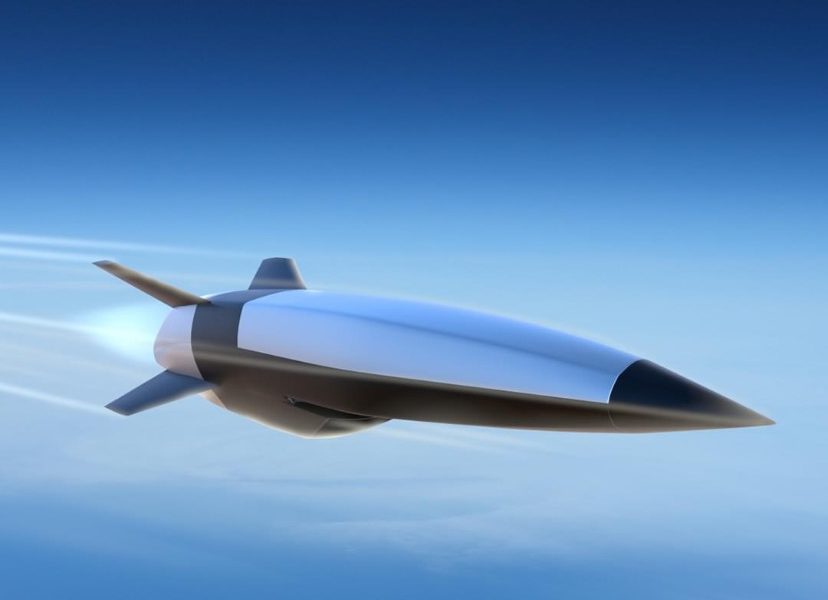
The Air Force Research Laboratory has signaled to industry it wants to develop a low-cost hypersonic cruise missile to deliver a wide range of payloads at a range up to 500 nautical miles.
In a brief one-page notice released Sept. 1, posted on Sam.gov, AFRL gave the broad outlines of its new project, which falls under the broader Pioneering Aerospace Capabilities, Engineering & Research program.
“Offerors are encouraged to consider modular open systems architectures, together with aggressive application of digital engineering advanced manufacturing techniques,” according to the note.
That note signals an openness to using 3D printing as a way to make a more affordable hypersonic missile than the Air Force has pursued in other programs, such as its two other hypersonic weapons, the Hypersonic Attack Cruise Missile and the Air-Launched Rapid Response Weapon.
HACM is an ongoing Air Force effort with RTX to build a scramjet-powered, air-breathing hypersonic missile to reach and maintain speeds of Mach 5 or greater, capable of being carried on tactical fighters and bombers; Northrop Grumman developed the engine.
ARRW is a Lockheed Martin-built, boost-glide, air-launched hypersonic weapon designed primarily to be carried by bombers.
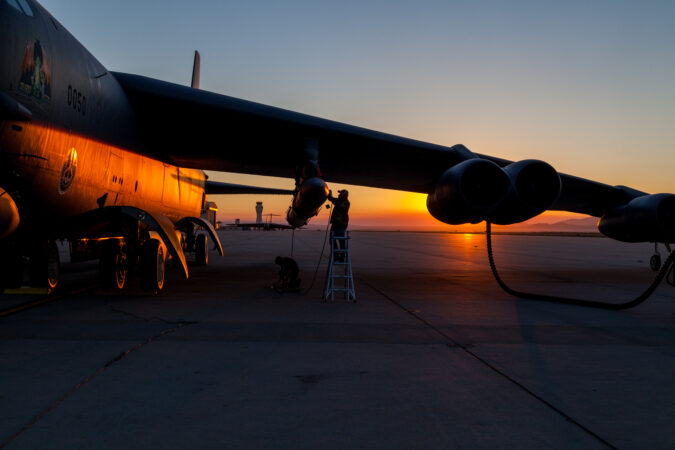
Payload
The new AFRL project has “no specific payload requirement,” according to the notice.
That agnostic payload approach differs from HACM, which from the outset was based around a kinetic warhead to strike heavily defended targets. The new project’s lack of specific warhead requirements means it could carry kinetic strike options, intelligence, surveillance and reconnaissance payloads, or electronic warfare gear.
But the strike option remains.
“It could provide new ‘middle ground’ options for precision strikes against time-sensitive targets,” retired Air Force Col. Mark Gunzinger, director of future concepts and capability assessments at the Mitchell Institute for Aerospace Studies, told Air & Space Forces Magazine. “Depending on its seekers and warhead variants, a 500-nautical mile hypersonic weapon could be used against ground fixed and relocatable targets, moving maritime targets, and possibly even high-value airborne targets like [Airborne Early Warning & Control] aircraft.”
More Options
Such a weapon would given Air Force planners a wider range of options, especially in far-flung regions of the Pacific, where an adversary such as the Chinese military uses complex anti-access, area-denial systems, Gunzinger said.
The hypersonic focus is also crucial for overcoming much of the Chinese military’s capabilities, he said.
“The capability and capacity to conduct prompt maritime strikes against moving targets such as the [People’s Liberation Army Navy] Type 055 Renhai class cruisers and Type 52D Luyang-III class destroyers will be critical to defeating an assault on Taiwan or other scenario,” Gunzinger said. “I would also stress the value of using hypersonic class weapons to counter high-value airborne aircraft like KJ-500/600 AEW&C aircraft, which will be key to countering the PLA Air Force’s long-range kill chains.”
And, if right-sized, that kind of missile could be used across a variety of platforms, such as the F-15EX, as well as the B-21, B-2, F-47 and even the F-35, he said.
“Frankly, sixth-generation stealth aircraft will not need 500 [nautical mile] standoff, but it would increase their ability to avoid the highest risk threat areas and expand areas it can attack in a single sortie,” the retired colonel and former B-52 pilot said.
While the Air Force is still working to field HACM, Gunzinger sees the potential of a low-cost cruise missile as an added, not replacement, capability. Especially, he said, if the future weapon could carry EW payloads, which are critical for suppression of enemy air defenses.
Scaling Hypersonics and Cost
The 3D-printing option might give the Air Force a way to scale the weapons in a way that Gunzinger and Mitchell have long advocated.
“Affordability can be a barrier to fielding hypersonic weapons at scale—the Army’s ‘Dark Eagle’ ground-launched boost-glide weapon that costs $40 million or more for a single warhead is a good example of this,” Gunzinger said. “So, an air-launched weapon that costs low single-digit millions of dollars each would increase the potential to acquire them at scale.”
The Air Force is seeking $1.96 billion in hypersonic funding for HACM and ARRW in its fiscal 2027 budget request, currently winding its way through Congress.
Most of that, about $1.2 billion, is for HACM: $404 million to buy the first operational lot of missiles and $806 million for continued dollars for research, development, test, and evaluation.
The service is also seeking around $748 million for ARRW—$452 million for procurement and $296 million for an Increment 2 version of the weapon work to be adapted for long-range counter-maritime missions.
But even beyond hypersonics, the Air Force is keenly interested in developing cheaper munitions. It is pursuing many of them through its Family of Affordable Mass Munitions program, which seeks to field 28,000 low-cost cruise missiles over the next five years. The Pentagon announced in July it was awarding multiyear contracts with companies Anduril, CoAspire and Zone 5 Technologies to produce those non-hypersonic weapons at a quick clip, starting in 2027.
The Project
The affordable hypersonic missile project will consist of two rounds. The first will have AFRL accept white paper submissions from industry, followed by a second round in which industry will submit full technical and cost proposals.
The lab first posted a notice for a potential “focused call” or technology demonstration competition in January, titled “Rapid Maturation and Demonstration of Hypersonic Weapon Concepts.” Then on March 16, it released a call for “Hypersonic Affordable Mass Weapon Concepts,” Molly Lachance, an AFRL spokesperson, told Air & Space Forces Magazine in an email.
“Following internal reviews and refined program requirements for the Hypersonic Affordable Mass Weapon Concepts (HAMWC) effort, we updated key project parameters to better align with mission priorities. Because these adjustments represented a material change to the original scope, a resolicitation was required,” Lachance wrote.
For the Sept. 1 notice, AFRL expects to post amendments within 30 days, according to the notice.