
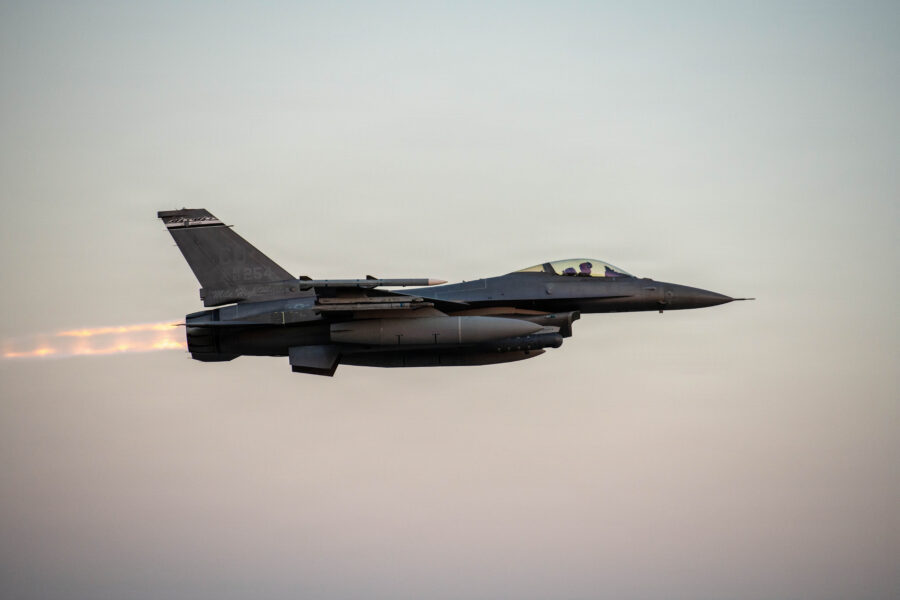
An F-16 Air National Guard unit’s six-month deployment to Kadena Air Base, Japan, this year illustrated the capabilities the Guard’s oldest fighter units can still offer—but also the challenges they face, officials told reporters this week.
On one hand, leaders said the Colorado ANG’s 120th Fighter Squadron was largely able to keep pace with its fifth-generation teammates and hone its Agile Combat Employment skills throughout the Pacific.
But on the other, the squadron’s 1980s-era F-16s are starting to show their age and lack at least some of the high-end capabilities the Air Force has said it wants to prioritize for a high-end fight.
“We’re able to keep up, with the exception of obviously being a fourth‑gen airplane,” Lt. Col. Frank “Chester” Prokop, squadron commander and detachment commander during the deployment, said. “We can’t get nearly as close to surface‑to‑air threats or air‑to‑air threats posed by China over there as some of the newer models. So, we’re kind of getting to the end of our capability. We’ve maxed it out. We played the perfect game.”
The January-to-June deployment, part of a rotation of fighters through Kadena as the base waits for its new F-15EX Eagle IIs, is a signpost of things to come for both the Air Force’s total fighter fleet, but more specifically for challenges faced inside the Air National Guard. The fleet is getting older while replacements are slowly ordered and delivered, and with the Active-Duty force being prioritized, the Guard is pushing the envelope with its legacy aircraft.
“The first piece is that any aging airframe is going to negatively impact operational availability and daily ops tempo,” Heather Penney, a former F-16 fighter pilot who now serves as the director of studies and research at the Mitchell Institute for Aerospace Studies. “I mean, you could talk about taking your 35‑year‑old car to an F1 race. Is that really what you want to do?”
Six Months at Kadena
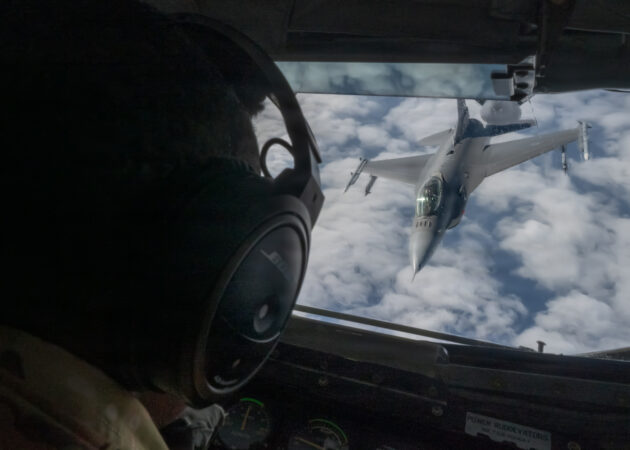
Originally, the 120th was supposed to deploy a dozen of its F-16C Block 30 jets to Kadena from January to May. But that stay was extended six weeks due to demands across the Air Force related to Operation Epic Fury and the conflict with Iran. The conflict also impacted plans to join exercises in Thailand.
Still, the Guardsmen and their jets got to put into practice the Agile Combat Employment training they—with the rest of the Air Force—have been putting in for years now. ACE envisions small teams of Airmen dispersing from large central hubs to operate from remote or austere airfields, and the 120th implemented that through “small-package movements,” shuffling two to six jets around the region.
Prokop and 140th Wing Command Col. Christopher “KojaCk” Melka said the unit can now generate detailed ACE deployment packages, including personnel, aircraft load, and ground equipment needs, in 10-15 minutes, rather than the weeklong planning cycles common only a few years ago.
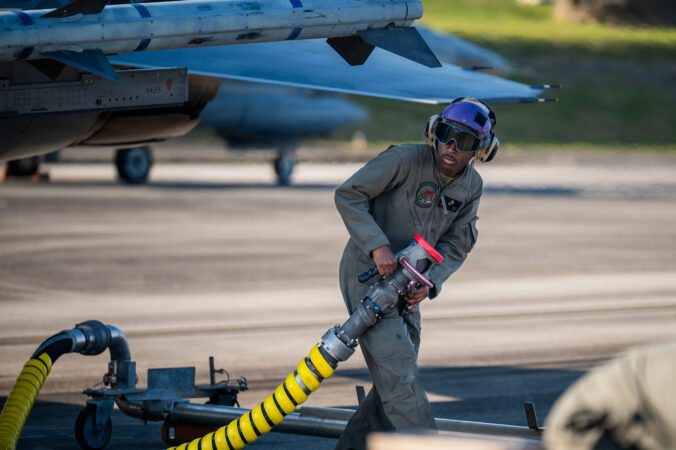
For a Philippines deployment, the squadron took four F-16s with a C-130 and worked with Marine Corps units. For Exercise Beverly Midnight at Marine Corps Air Station Futenma, Japan, the unit conducted hot-pit refueling and rearming work alongside F-35s.
The unit also employed the “Multi-Capable Airman” approach to shrink its maintenance manpower footprint, Melka said. Operating mostly out of Kadena, a smaller package of cross-trained airmen handled various maintenance tasks for the squadron, rather than relying on a larger footprint with specialized technicians.
“We’ve actually exposed some of our Airmen to other career fields to give them a little bit more background on both, so that if, for whatever reason, they found themselves in a more austere environment where we could only send a certain package of maintainers and support personnel, maybe one person covered the duties of two,” Melka said.
Recap Ripple Effects
While the 120th was able to practice concepts like Agile Combat Employment and Multi-Capable Airmen during its deployment, the unit also had to stretch to keep its F-16s going, Melka and Prokop said.
“When these F-16s were first produced, it was roughly about six to eight maintenance man-hours per flight hour,” Prokop said. “Now, our maintainers are averaging 15 to 20 maintenance man-hours for every hour of flight.”
That’s because issues that require more in-depth maintenance, such as structural failures such as cracks on the airframe, “are happening at a much increasing rate right now,” Prokop said. “And that is probably the biggest challenge that we face is our maintenance unit has not received any increase in manpower commensurate with the level of increased requirements for maintenance time on the aircraft.”
The unit has been fortunate, the lieutenant colonel said, to have experienced, veteran maintainers working those airframes. But the increased maintenance needs are pushing leadership to make adjustments, like using more simulator flight time rather than flying hours to keep pilots sharp.
“The capacity of our maintainers to keep them safe and keep them combat effective is still working very well,” Melka said.
The jets themselves have also been upgraded many times over the years to stay effective with things like new AESA radars, Link 16 data links, and ongoing software upgrades; Prokop noted the F-16 has an unofficial nickname of the “Burger King jet” as a reference to the fast-food chain’s “Have It Your Way” slogan.
Nevertheless, the decades-old aircraft, while competent now, are closer to the end of their service lives—and the 120th is one of around a dozen Guard squadrons that have not been officially selected to recapitalize their fleets with newer aircraft such as the F-35A or F-15EX, leaving the unit’s future in doubt.
For now, Penney said, units like the 120th can keep flying their F-16s. But the Air Force has yet to signal its long-term plan for them and currently isn’t buying new jets fast enough to replace the older jets anytime soon.
“The Air Force has got to recapitalize at a meaningful rate, because they have deferred and delayed increasing their recapitalization rate,” Penney said. “If you want to be recapitalized by 2035, you’ve got to buy more than 100 fighters a year.”
Service leaders have said they need to procure at least 72 fighters per year to keep the fleet’s age from increasing. But the last time the service managed to budget for that was in fiscal 2024.
In fiscal 2025, the budget request was for 60 fighters. In 2026, it dropped to a low of 45. The fiscal 2027 request, still pending, is for just 62 fighters.
And even then, these new fighters—the F-35 and F-15EX—are mostly going to the Active-Duty force, leaving the Guard to wait. That could have a ripple effect, as the Guard deploys in nearly any major contingency or large-scale operation as a need, not an add-on, Penney said.
“If the Air Force does not recapitalize the Guard in a concurrent and proportional manner, they risk not only losing a key element of the total force, but they risk leaving the Guard with operationally irrelevant airframes,” Penney said.